Yamabiko, the echo with a voice of its own
By Ralf Ittermann · last reviewed on
Yamabiko is a spirit of Japanese tradition.
The yōkai that answers every call in the mountains. Yamabiko is described as an echo with a voice of its own, answering every call in the mountains. Yamabiko is Japan’s mountain echo spirit, a figure to which the returning sound of the mountains was traditionally ascribed.
Yamabiko is the mountain-echo spirit of Japanese folk belief, a Yōkai that personifies the echo in the mountains. According to this idea, what one calls out in the mountains is not repeated by the rock but by the Yamabiko.
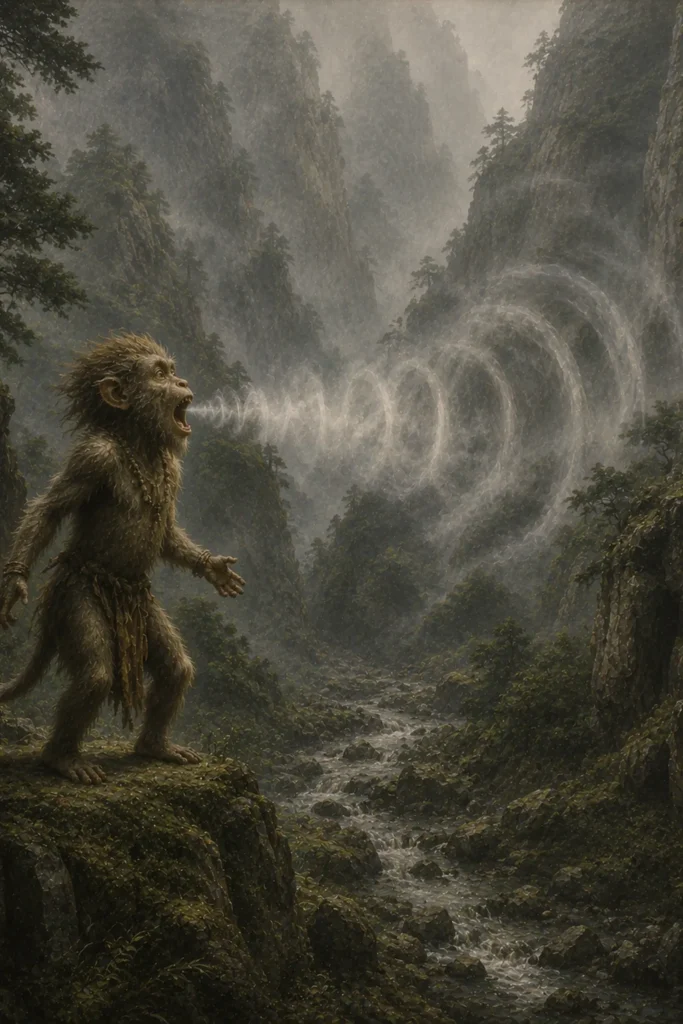
The figure was fixed in visual form in 1779 by Toriyama Sekien, who depicted Yamabiko in his Yōkai encyclopaedia as a small, ape-like or dog-like being. The echo spirit is not dangerous; at most it is confusing and eerie, because voices seemingly answer from nowhere.
Type: nature Yōkai, personification of the mountain echo
Origin: Japanese folk belief
Texts: Toriyama Sekien’s Yōkai encyclopaedia of 1779
Period: folk belief, fixed in visual form in 1779
Appearance: small ape-like or dog-like being
Context of tradition
Period of the Texts
The idea originates from Japanese folk belief surrounding mountain voices; it was given visual form in 1779 by Toriyama Sekien.
Area of Diffusion
Japan: The notion of a mountain spirit that repeats what is called out belongs to the general folk belief of mountain regions.
Sources
Well documented: Sekien’s Yōkai encyclopaedia of 1779 as the main visual source, together with modern Yōkai research, above all Foster.
Name and variants
Japanese: yama means mountain, hiko or biko means prince or youth; in everyday use, yamabiko simply means echo. Sekien writes the word with the characters for reverberation of the dark valley. Spelling and interpretation vary regionally between mountain prince and valley echo.
Form and voice
Appearance
In Sekien’s work, Yamabiko is a small, ape-like or dog-like being with an upright posture that dwells in remote valleys. Older and regional traditions also know an interpretation as a tree or mountain spirit; the ape-like image is the best-known version from Sekien.
Effect
Yamabiko explains the delayed echo: the call is repeated by the Yamabiko. The being is largely harmless, at most confusing and eerie, because voices seemingly answer from nowhere.
Profile: Yamabiko
The key aspects of the echo spirit at a glance.
Japanese folk belief surrounding mountain voices: an explanatory nature Yōkai, canonised through Sekien’s illustration of 1779.
The echo in the mountains: according to this idea, what the hiker calls out is repeated by the Yamabiko, not by the rock.
Small, ape-like or dog-like being with an upright posture in remote valleys; regionally also interpreted as a tree or mountain spirit.
Personification and explanation of the delayed mountain echo; an explanatory rather than a threatening Yōkai.
No shrine or festival cult is documented; no festivals or protective rites specifically for Yamabiko are known.
Within Japan, the Yobuko and the Kodama, the tree spirits; worldwide, the Greek nymph Echo as a personification of the same phenomenon.
From the mountain prince to Sekien's illustration
The word yamabiko is composed of yama, mountain, and hiko or biko, prince or youth; in everyday use it simply means echo. The Yōkai is the personification of this phenomenon. There are two layers here: an older notion of a mountain Kami or spirit that throws back sounds, and the visual fixation by Toriyama Sekien.
Sekien included the being in his Yōkai encyclopaedia in 1779 and wrote it with the characters for reverberation of the dark valley. His small, ape-like being with an upright posture became the definitive form of the Yamabiko and still shapes how the echo spirit is imagined today.
From the Yōkai canon to the train name
Through Sekien’s illustration, Yamabiko has a firm place in the Yōkai canon and in modern reference works, games and manga. The term yamabiko also lives on as an ordinary word for echo, among other things as the name of a Shinkansen train.
From the perspective of religious studies, Yamabiko is a harmless, explanatory nature Yōkai. Three clarifications: the ape-like appearance dominant today is strongly shaped by Sekien’s depiction and is not the only historical form. Yamabiko is not an evil figure but the personification of an acoustic phenomenon. And spelling and interpretation vary regionally between mountain prince and valley echo.
No cult for the echo
No separate shrine or festival cult is documented; Yamabiko is more an explanatory nature Yōkai than a cult deity. No festivals or protective rites specifically for Yamabiko are known either, and this should be honestly stated. Anyone who feels uneasy at eerie echo sites turns to the general protective forms of folk belief, not to a dedicated Yamabiko ritual.
Echo beings in Japan and elsewhere
Related within Japan are the Yobuko and, more broadly, the Kodama, the tree spirits, which are likewise associated with mountain voices and echo. In the Japanese mountain world, the hiker also encounters more powerful figures such as the Tengu king Sōjōbō or the mountain Kami Yama-no-Kami. Comparable worldwide is the Greek nymph Echo as a personification of the same acoustic phenomenon.
Frequently asked questions about Yamabiko
What is a Yamabiko?
The mountain-echo spirit of Japanese folk belief, a Yōkai that personifies the echo in the mountains.
Is Yamabiko dangerous?
No. It is a harmless, explanatory nature Yōkai; at most, the voice that seemingly answers from nowhere seems eerie.
Where does the ape-like image come from?
Mainly from Toriyama Sekien’s Yōkai encyclopaedia of 1779, which fixed the figure in visual form.
Further links
Further reading:
- Japan – all beings of the Japanese world of belief
- Sōjōbō – the Tengu king of the Japanese mountain world
- Yama-no-Kami – the mountain Kami of Shinto and folk belief
- Amulet, Sage, Protective Candle – traditional protective means
- Protection Compass – protective means at a glance
Literature (selection)
Further standard works in the bibliography.
As a mountain-echo spirit and Yōkai of the reverberation, Yamabiko is one of the quietest figures of the Japanese spirit world: not a terror of the mountains, but the friendly, eerie answer that follows every call from the valley.