iWell Guard

Zashiki-warashi, the Lucky Child in the Guest Room

The Zashiki-warashi is a spirit of Japanese tradition.

The lucky child from Iwate: where it dwells, the house prospers.

SpiritJapan

Table of Contents

Zashiki-warashi, the child spirit of Japan
Zashiki-warashi

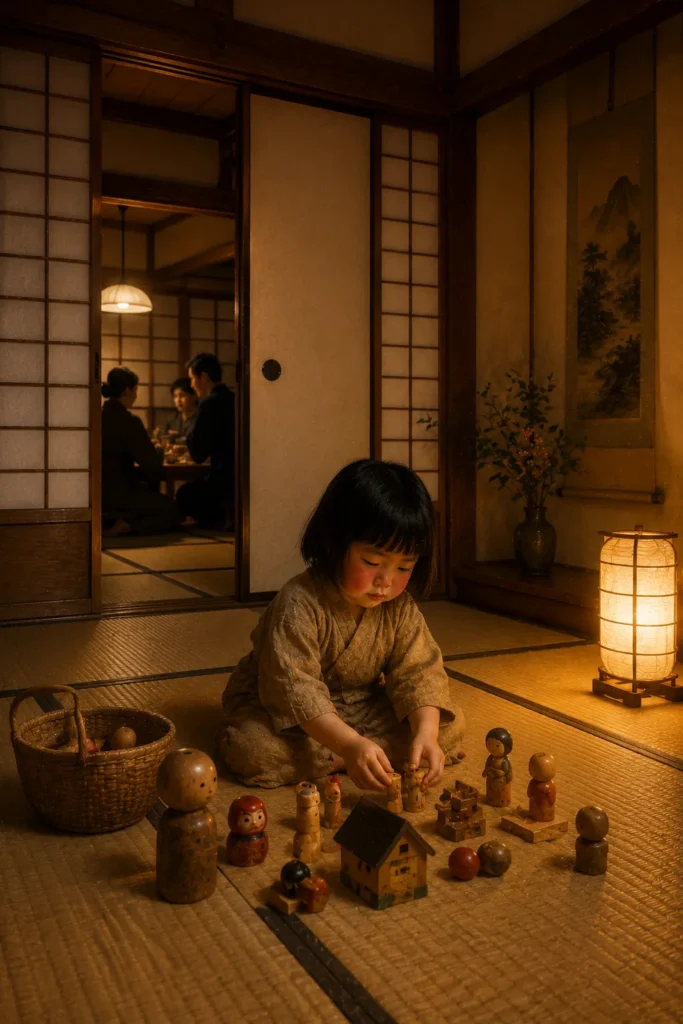
The Zashiki-warashi is a Japanese house child spirit from Iwate Prefecture, a yokai and at the same time a household protective spirit. It usually appears as a child of about five or six years old and is often invisible to adults.

Its core motif is reciprocal: a house with a Zashiki-warashi thrives and grows rich; if the spirit leaves the house, the family declines. It became nationally known through Yanagita Kunio’s Tono Monogatari of 1910, recorded from the informant Sasaki Kizen.

Overview: Zashiki-warashi

Type: House child spirit, yokai and household protective spirit
Origin: Iwate Prefecture in Tohoku, nationally known from 1910
Texts: Tono Monogatari (Yanagita Kunio), records from the Meiji and Showa eras
Period: Japanese folklore, national from 1910
Appearance: Child of about five or six years old, red face

Historical Classification

Period of the Texts

Japanese folklore with records from the Meiji and Showa eras; the figure became nationally known from 1910 through the Tono Monogatari.

Area of Diffusion

Iwate Prefecture and the Tohoku region in north-eastern Japan; Tono continues to market itself as the home of folk legends to this day.

Sources

Well documented: Yanagita Kunio’s records and yokai research, chief among them Michael Dylan Foster.

Name and variants

Japanese: The name combines zashiki, the tatami guest and reception room, with warashi, an archaic dialect word for child, especially used in Tohoku. Regional variants are zashiki-bokko and kura-bokko, the storehouse child.

Appearance

Appearance

The Zashiki-warashi usually appears as a child of about five or six years old, with a red face and hanging hair, appearing as either a boy or a girl. It is often invisible to adults but visible to children; frequently it is only present acoustically, through spinning-wheel sounds, footsteps or the rustling of paper, and it plays small pranks.

Effect

The core motif is reciprocal: a house with a Zashiki-warashi thrives and grows rich, but if the spirit leaves the house, the family declines until it dies out. A white Zashiki-warashi is considered a good omen, a red one a sign of impending departure.

Profile: Zashiki-warashi

The key aspects of the child spirit at a glance.

Tradition

A yokai and household protective spirit of Tohoku folklore, made nationally known through Yanagita Kunio’s Tono Monogatari of 1910.

Relates To

Household and family: the presence of the child spirit brings fortune and prosperity, while its departure heralds the family’s decline.

Depiction

A child of about five or six years old with a red face and hanging hair, appearing as either a boy or a girl; often invisible to adults.

Sphere of Influence

Fortune and prosperity for the house; alongside small pranks and acoustic signs such as spinning-wheel sounds, footsteps or the rustling of paper.

Approach

No formal cult: food offerings such as rice with adzuki beans, and child-friendly rooms with sweets and toys, keep the spirit in the house.

Comparables

The Scottish Brownie, the German Kobold and the Slavic Domovoi; within Japan, the kijimuna and the kura-warashi.

From Tono to the World: Yanagita's Records

The name combines zashiki, the tatami guest and reception room, with warashi, an archaic dialect word for child that is especially used in Tohoku. Regional variants are zashiki-bokko and kura-bokko, the storehouse child. The figure became nationally known through Yanagita Kunio’s Tono Monogatari of 1910, recorded from the informant Sasaki Kizen; further records extend into the Meiji and Showa eras.

The classic Tono tales reveal the darker side of the motif: there, families are wiped out by poisoning after the spirit’s departure. In these stories, a household’s prosperity and the presence of its child spirit are inseparably linked.

Reception and classification

The Zashiki-warashi is very present in manga, anime, film and games, among others in xxxHolic, Yo-Kai Watch and the film Home. Tono markets itself as the home of folk legends, and its inns, chief among them the Ryokufuso, are tourist destinations.

In religious studies, the Zashiki-warashi is regarded as a fortune-bringing house child spirit. Important clarifications: Yanagita Kunio is considered the founder of Japanese folklore studies, his Tono Monogatari its founding text. The origin of the figure is a genuine scholarly controversy, spanning infanticide interpretations, the notion of a divine child and further hypotheses. And it is not always a girl, nor consistently red-haired; the red depiction is rather a modern iconographic convention.

Offerings that keep the spirit in the house

There is no formal cult for the Zashiki-warashi. Food offerings, especially rice with adzuki beans, keep it in the house; if the offering is left untouched, this is taken as an omen of decline. Child-friendly rooms are set up with sweets and toys. The most famous Zashiki-warashi inn is the Ryokufuso at Kindaichi Onsen in Iwate, where the spirit is regarded as an ancestor turned protective spirit.

House Spirits with a Prosperity Bond, Compared

As a house spirit that brings fortune and whose departure means decline, the Zashiki-warashi corresponds to the Scottish Brownie, the German Kobold and the Slavic Domovoi; within Japan, the kijimuna of Okinawa and the kura-warashi stand alongside it, both classified by Orikuchi Shinobu as the same type. Functionally comparable is also the Korean household god Seongju.

Frequently Asked Questions about the Zashiki-warashi

What is a Zashiki-warashi?

A Japanese child spirit of the house from Iwate, a yokai and household protective spirit that brings a house luck and prosperity.

What happens when it leaves the house?

Folk belief holds that the family then declines until it dies out; in classic Tono tales, ruin follows through poisoning.

Is there a cult devoted to it?

No, there is no formal cult; it is kept content with food offerings such as rice with adzuki beans and child-friendly rooms in the house.

Further links

Recommended internal links:

Literature (selection)

A selection of key sources and studies:
  • Yanagita, Kunio: The Legends of Tono. Tokyo 1975.
  • Foster, Michael Dylan: The Book of Yokai. Berkeley 2015.
  • Foster, Michael Dylan: Pandemonium and Parade. Berkeley 2009.

Further standard works in the bibliography.

As a Japanese house spirit and child spirit, the Zashiki-warashi embodies a house’s luck in its most fragile form: a child that stays as long as it is treated well, and whose departure no one can prevent.

Classification & Protection

ILEVEL
The Protection Compass assigns this being to influence level I, Minor influence.

Against its influence, cross-cultural tradition names these protective means:

Compare in the Protection Compass →

Recommended protective means

iWell Guard

The simplest protective means in this collection: 41 layers of fine gold 999, platinum, silver and silicon, manufactured in Ruhla, Thuringia. It requires no activation, is bound to no person, and is effective within a radius of around 50 meters, even without being worn.

All protective means at a glance →