Shinigami, messenger of predetermined death
By Ralf Ittermann · last reviewed on
Shinigami is a spirit of Japanese tradition.
Not an old Kami, but a messenger of death from the Edo period.
Shinigami is a Japanese death spirit that guides people to their predetermined death. Unlike the ancient Kami of Shinto, it is a young, synthetic figure, formed from Buddhist ideas of death and the Western-derived image of the Grim Reaper.
As a spirit, not a classical god, it embodies death as part of a natural cycle: less a terrifying individual than a personified process, one that in the Rakugo tale can even be outwitted with cunning.
Type: Personified death spirit without a fixed cult
Origin: Japanese Edo period, fusion of Buddhist ideas of death with the Western Grim Reaper
Texts: Puppet theatre and narrative literature of the Edo period, and also the Rakugo tale Shinigami by Sanyūtei Enchō (1892, Meiji period)
Period: 18th/19th century to the present
Appearance: inconsistent, without a fixed classical image, in modern times usually merged with the Grim Reaper
Historical Background
Period of the Texts
Relatively young: the first records date from the Edo period of the 18th and 19th centuries; an old, classical origin is lacking.
Area of Diffusion
Formed in literature and theatre, today spread massively above all through manga and anime.
Sources
Well documented for the modern emergence of the figure, yet a classical, ancient cult is lacking: the Shinigami remains a young, literary-theatrical figure.
Name and variants
Japanese: shi means death, kami or gami means god or spirit: Shinigami is the god of death or death spirit. The term does not belong to the old Shinto vocabulary but from the outset denotes the younger, synthetic figure of the Edo period.
Form and effect
Appearance
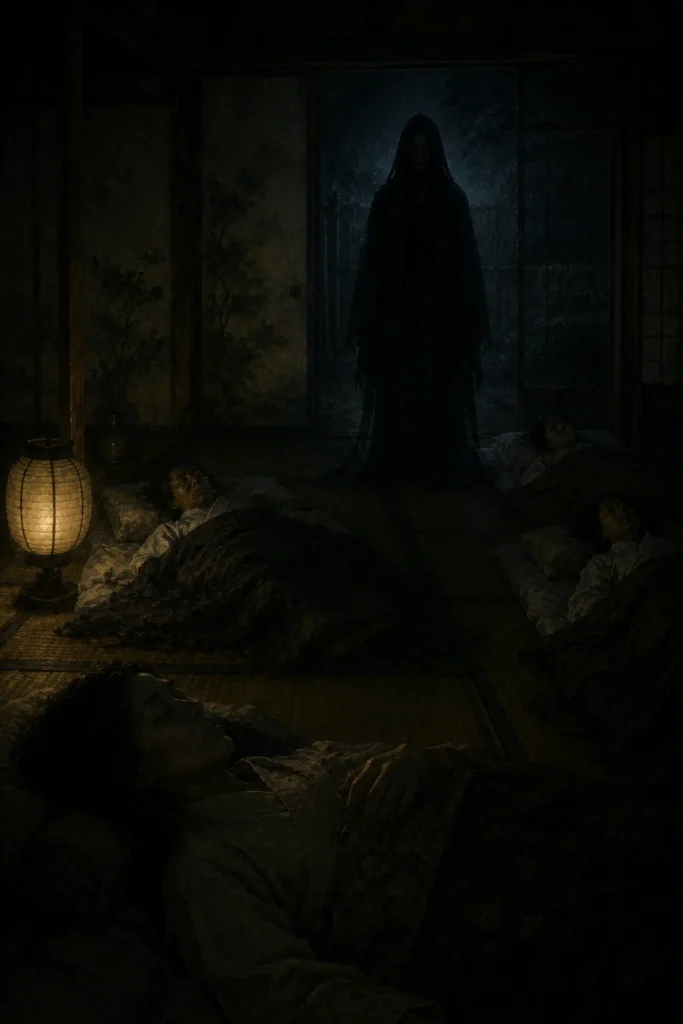
The Shinigami is not a god in the classical sense but a personified process. In Edo-period literature it appears rather as an invisible, tempting power, in the modern image merged with the Western Grim Reaper.
Effect
It leads people to their predetermined death and can tempt them towards suicide or double suicide. In the Rakugo tale Shinigami, it can be evaded through cunning, which shows that it is less an active attacker than an executor of fate.
Profile: Shinigami
The key aspects of the death spirit at a glance.
A young figure outside the old Shinto pantheon, formed in puppet theatre and in narratives of the Edo period.
The dying and those marked for death, whom it guides to their predetermined death.
An inconsistent image without a fixed classical form, in modern understanding usually merged with the Western Grim Reaper.
An executor of predetermined fate, who can also tempt people towards suicide or double suicide.
The general Buddhist death rite; in the Rakugo tale Shinigami it can be briefly outwitted with cunning and magic formulas.
A synthetic figure of the Edo period
The name Shinigami combines shi, death, and kami or gami, god or spirit, and means god of death or death spirit. The figure does not belong to the old Shinto pantheon: the term first appears in the Edo period, for instance in puppet theatre and in tales of double suicide and possession.
It arose from the mixing of Buddhist ideas of death, including the death-demon figure Mara, with Western-derived images of the Grim Reaper amid increasing contact. Shinto already had a goddess of death in Izanami, yet the Shinigami is a later, popular new creation.
Reception in manga and anime
The Shinigami is enormously present in manga and anime: as Ryuk and other figures in Death Note, as a soul reaper in Bleach, and in works such as Soul Eater. Death Note is regarded as the defining example of the modern Shinigami reception.
From a religious-studies perspective, the Shinigami is to be classified as a spirit and personified process, not as a classical Kami. It is a model case of religious syncretism, in which Buddhist, Western and folk elements merge into a new figure of the Edo period and modernity. A classical, ancient cult is lacking, since the figure remains young and literary-theatrical.
Buddhist death rite instead of a protective cult
The Shinigami is young and literary; a distinct protective cult has not developed. The general Buddhist handling of death applies: consecrated water, incense and sutras accompany the transition, along with the death vigil by candlelight and acceptance of the cycle in which death is embedded. In the Rakugo tale, the Shinigami is briefly outwitted through cunning and magic formulas, but this is a narrative motif and not a rite.
Messengers of death and judges of the dead in comparison
The Shinigami is closely modelled on the Western Grim Reaper, which shaped the modern figure. Related is the Breton Ankou, the messenger of death with the cart, as well as the Greek god of death Thanatos and the Buddhist-Hindu judge of the dead Yama or Enma, and the death demon Mara. Within Japan, the Shinigami stands alongside the vengeful spirit Onryo and the political vengeful spirit Goryo, from which it clearly differs as a more neutral executor of fate.
Frequently asked questions about the Shinigami
Is Shinigami an old Japanese god?
No, he is a young figure of the Edo period, arising from Buddhist and Western ideas.
Is he identical to the Grim Reaper?
Related to and influenced by him, but not identical: for the Shinigami, death is regarded more as a natural cycle.
Can one escape him?
Only as a narrative motif, for instance through cunning in Rakugo tales; there is no real cult of warding him off.
Further links
Further reading:
- Japan – all beings of the Japanese tradition
- Ankou – the Breton messenger of death
- Onryo, Goryo – Japanese vengeful spirits
- Holy water, smudging, protective candle – traditional protective means
- Protection Compass – protective means at a glance
Literature (selection)
Further standard works in the bibliography.
As a Japanese spirit of death, the Shinigami is above all one thing: a messenger of death without an ancient cult, young enough to live on in manga and anime today, and yet as inescapable as the death it embodies.