iWell Guard

The Maneki-neko: the Japanese beckoning cat

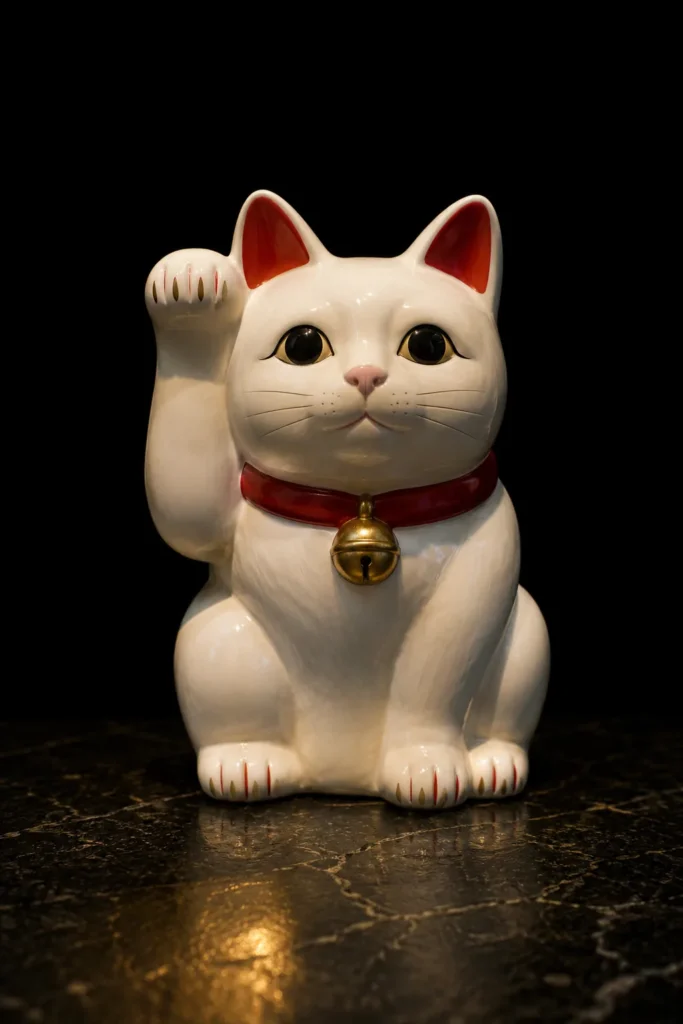
The Maneki-neko is the Japanese beckoning cat. With one paw raised, it stands in shops and homes and is said to beckon in good fortune, customers, and prosperity. It is one of the best-known lucky charms in Japan.

Protective SymbolJapanLucky Charm
Maneki Neko - protective symbol, museum-style illustration

Classification

The Maneki-neko is a small figure in the shape of a seated cat with one paw raised. It originates from Japan and is one of the most widespread lucky charms there. In shops, restaurants, and homes, it is a familiar sight.

The name Maneki-neko literally means beckoning cat. It describes the posture of the figure precisely. The raised paw is not raised in greeting but performs a beckoning, summoning motion.

Unlike an apotropaic protective image, the Maneki-neko is primarily an attracting lucky charm. It is meant to call in good things, above all fortune, customers, and prosperity. In this way it belongs to the signs that work through attraction.

In religious studies and in the study of Japanese folk culture, the Maneki-neko is a strong example of a lucky charm closely linked to economic life. It stands especially for the success of trade and commerce.

Despite its simplicity, the Maneki-neko carries a carefully considered meaning. The position of the paws, the colors, and the objects it holds are not arbitrary. They form a small system of signs, which is explained below.

The Beckoning Gesture

The most striking feature of the Maneki-neko is the raised paw. It points forward and upward and performs a movement that is understood in Japan as a beckoning gesture.

An important cultural difference applies here. In Japan, beckoning is done with the palm facing downward. To Central European eyes, the movement therefore looks more like a dismissive wave. In fact, the cat is calling people over, not turning them away.

This beckoning gesture is the core of the meaning. The Maneki-neko summons fortune and customers. It is, in a sense, a permanently beckoning figure that invites good things into the house or shop.

On many figures, the paw is designed to move. A mechanism makes it move up and down, so that the beckoning motion is actually performed. This makes the cat appear even more lively in its welcoming gesture.

The beckoning gesture makes the Maneki-neko an active lucky charm. It does not wait for fortune to arrive on its own but calls it in. In this respect it differs from protective signs that merely ward off misfortune.

Legends of Origin

There are several legends about the origin of the Maneki-neko. None of them can be established as the sole authoritative account. Together they show how the image of the fortune-bringing cat is rooted in Japan.

One well-known legend tells of a temple and a cat that lived there. The cat is said to have beckoned a noble lord with its raised paw. When the lord followed the cat, he narrowly escaped a violent storm. Out of gratitude, he is said to have made generous gifts to the temple.

Another legend is connected with an old woman who, out of poverty, had to give away her cat. The cat is said to have appeared to her in a dream and advised her to make a figure in its likeness. These figures sold well and helped the woman.

Most of these legends can be placed in the Edo period, a long era of peace during which trade and urban life flourished. It was during this time that the Maneki-neko spread as a lucky charm of merchants.

Whether the legends are historically accurate in their details is not the decisive point. They serve above all one purpose. They explain vividly why a cat with a raised paw should bring fortune, and they anchor the sign in memorable stories.

Appearance and Colors

The Maneki-neko is usually depicted as a seated cat. One paw is raised, while the other rests against the body or holds an object. The cat often wears a collar with a small bell, a reference to a well-cared-for, prosperous house cat.

The material is usually ceramic or porcelain; figures made of wood and other materials also exist. Sizes range from small tabletop figures to large pieces placed in shop windows or at entrances.

The color of the Maneki-neko is meaningful. The most common color is white, often with patches, which is regarded as a general lucky charm. This coloring goes back to a cat pattern highly valued in Japan.

There are also Maneki-neko figures in other colors with their own meanings. Golden figures are associated with prosperity and money. Red figures are linked with health. Black figures have a particular role that deserves its own section.

The Maneki-neko often holds an object in its resting paw. A common choice is an old oval gold coin. This reinforces the figure’s connection with prosperity and good business and makes the good wish even more explicit.

Right Paw and Left Paw

An important detail of the Maneki-neko concerns the question of which paw is raised. The right and the left paw carry different meanings, and this determines what purpose the figure is placed for.

A raised right paw is associated with money and prosperity. A figure with a raised right paw is intended primarily to promote financial success. It is thus a lucky charm for commercial prosperity.

A raised left paw is associated with people and customers. A figure with a raised left paw is meant to call in guests and clients. It is therefore popular in restaurants and shops that depend on a large number of visitors.

There are also figures with both paws raised. These are meant to attract both at once, money and customers. This form is less common, however, than figures with a single raised paw.

The height of the raised paw can also be interpreted. A very high raised paw is said to call in fortune from a greater distance. These details show that the Maneki-neko is a carefully considered sign whose posture is read precisely.

The Maneki-neko in the Shop

The preferred location for the Maneki-neko is the shop. In stores, restaurants, and businesses, the beckoning cat is especially common. There it has a clear purpose, namely to call in customers and success.

The Maneki-neko is usually placed in a clearly visible spot, for example near the entrance, in the shop window, or at the cash register. From there it beckons to passers-by and, in a sense, invites them to enter the shop.

This connection with trade is characteristic of the Maneki-neko. It is not primarily a protection for the house or the person, but a lucky charm for working life. Its concern is the prosperity of business and commerce.

This shows that luck and protective signs can relate to very different areas of life. Some safeguard birth, others a journey, others still the home. The Maneki-neko is oriented toward the sphere of trade and economic livelihood.

The Maneki-neko is also placed in private homes, where it then often serves as a general lucky charm for the family. The emphasis of its meaning lies in the commercial sphere, however. There, the beckoning cat is an almost self-evident companion.

Lucky Charm and Protection

The Maneki-neko is predominantly a lucky charm, yet it also has a protective aspect. This is most evident in the black figures. The black Maneki-neko is not responsible for prosperity but for warding off misfortune.

The black Maneki-neko is attributed with the ability to keep away evil influences and bad luck. It thus belongs to the apotropaic protective signs, while the white and golden figures serve to attract good fortune. In the color black lies the protective meaning.

This division is instructive. It shows that one and the same figure can be understood, depending on its color, either as an attracting lucky charm or as an apotropaic protective sign. The Maneki-neko thus covers both fundamental directions of the protective tradition.

Even independently of color, the Maneki-neko carries a basic protective quality. A figure that calls in good things and fills the house with fortune leaves less room for misfortune. Attracting the good and warding off the bad work together.

The Maneki-neko is therefore not only a cheerful lucky charm but also a sign with protective qualities. The black Maneki-neko in particular makes it clear that the beckoning cat belongs to the world of protective and lucky signs as a whole.

Japanese, Not Chinese

A widespread confusion concerns the origin of the Maneki-neko. Very often the beckoning cat is taken to be a Chinese sign. This attribution is incorrect. The Maneki-neko originates from Japan.

The confusion has several causes. The Maneki-neko is also very common in Chinese-influenced shops and in the Chinatowns of many cities. Anyone who encounters it there readily assigns it to Chinese culture.

Added to this is the fact that the beckoning gesture and the good-luck wish fit well with general East Asian ideas. The figure therefore does not appear to many observers to belong unambiguously to a single culture. In fact, however, its origin lies in the Japanese Edo period.

This clarification is not a minor point. It is part of an accurate presentation. Protective and lucky signs are often attributed to the wrong cultures in general awareness, and the Maneki-neko is a common example of this.

The conclusion to hold onto is that the Maneki-neko is a Japanese sign. Its wide distribution in Chinese-influenced contexts and beyond does not change its Japanese origin. This distinction is part of a careful engagement with the sign.

Reception Today

The Maneki-neko is today known worldwide. As a figure in shops, as a toy, and as a motif in design, it is widespread far beyond Japan. It belongs to the best-known lucky charms of all.

In Japan itself, the Maneki-neko remains as lively as ever. It is part of the familiar image of shops and restaurants. There are even places and temples that are closely associated with the beckoning cat and where it is especially venerated.

With worldwide distribution comes a shift in meaning. In many contexts, the Maneki-neko is perceived only as a cheerful, decorative figure. The precise meaning of the paws and colors is then no longer known.

The core idea nonetheless remains. The Maneki-neko is and remains a sign that calls in fortune. Even those who do not know the details understand the inviting, beckoning gesture of the cat.

The Maneki-neko is thus a good example of a lucky charm that has traveled far beyond the borders of its culture of origin. From a Japanese sign of the Edo period, it has become a figure at home in shops around the world.

Selected Bibliography

  • U. A. Casal: The Goblin Fox and Badger and Other Witch Animals of Japan (1959)
  • Nelly Naumann: Die einheimische Religion Japans (1988)
  • Ian Reader: Religion in Contemporary Japan (1991)
  • Manami Okazaki: Maneki Neko. Japan's Beckoning Cats (2019)
  • Lafcadio Hearn: Glimpses of Unfamiliar Japan (1894)

Related key terms: Maneki-neko beckoning cat lucky charm Japan Edo period paw lucky cat shop.

iWell Guard and Protective Traditions

iWell Guard stands in the cultural-historical lineage of wearable protective objects, to which the Maneki-neko also belongs. A modern companion for people who live with protective symbols: made in Germany, 41 layers of genuine gold, platinum, and silver, with a 30-day right of return.

Individual experiences may vary. Not a medical device. No healing claims.