The Daruma: the Japanese wish and roly-poly doll
By Ralf Ittermann · last reviewed on
The Daruma is a round, red Japanese doll that rights itself after every knockdown. It stands for perseverance and accompanies a wish or a goal until it is achieved. This entry presents the Daruma as a Wish and Luck doll that rights itself after every knockdown.
Classification
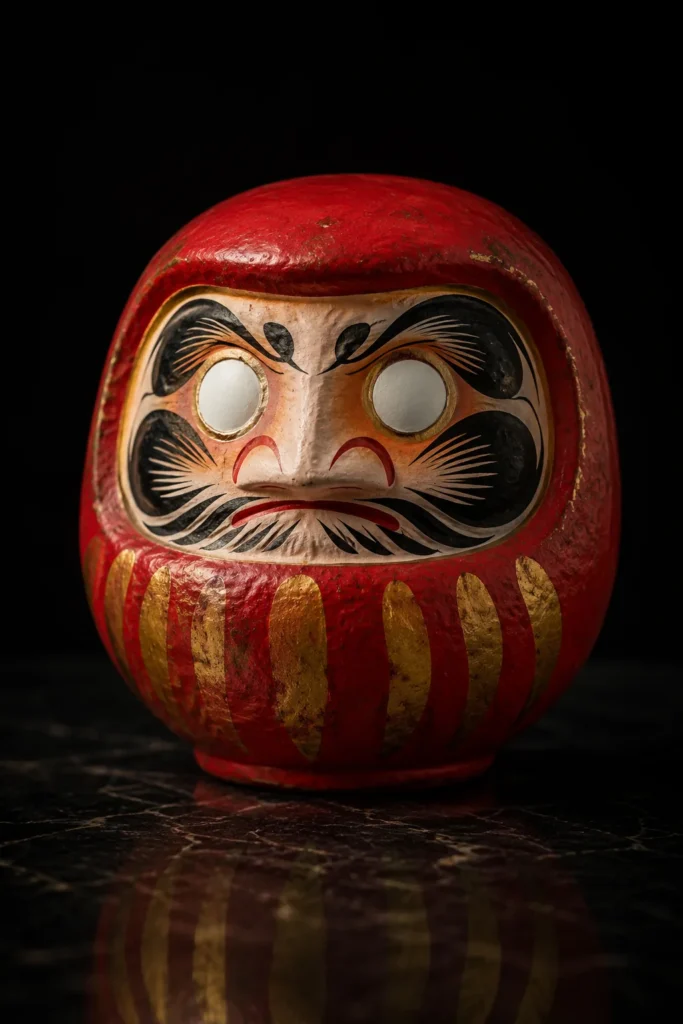
The Daruma is a Japanese doll of rounded form, typically in a strong red. It has no arms and no legs and is weighted at the base. This causes it to right itself after every knockdown.
The doll is widespread in Japan and is among the most familiar good-luck and wish objects in the country. It is associated with the setting of goals and with the desire to achieve them.
The Daruma is not a protective image in the strict defensive sense. It stands rather for an attitude, namely for the perseverance to continue pursuing a goal in spite of setbacks. At the same time it carries traits of a good-luck and protective object.
In the study of Japanese folk culture, the Daruma is a good example of an object that joins a religious origin with very practical use. It traces back to a figure from Buddhism and yet is an everyday object.
The Daruma combines several meanings in a single figure. Its form, its color, and the custom of gradually painting in its eyes each carry their own significance. These meanings are unfolded in what follows.
Bodhidharma, the Daruma
The name of the doll points to a significant figure in Buddhist history. Daruma is the Japanese form of the name Bodhidharma. Bodhidharma is regarded as the monk who founded a particular branch of Buddhism.
This branch is the school of meditation known in Japan as Zen. It places special emphasis on contemplation and on direct experience. Bodhidharma is venerated as the teacher who established this school in East Asia.
Bodhidharma is a half-historical, half-legendary figure. More narrative than verified knowledge exists about his life. Yet it is precisely these narratives that have shaped the image of him and have found their way into the form of the Daruma doll.
The doll does not depict Bodhidharma arbitrarily. It is the popular, lighter-toned representation of a venerated Buddhist teacher. In it, the memory of the founder of Zen lives on in an everyday form.
The Daruma therefore has a venerable background. What appears as a round, red doll is at the same time a likeness of one of the most important figures in the Buddhist tradition. Religious origin and popular form meet in the Daruma.
The legend of deep meditation
The unusual form of the Daruma doll is explained by a legend about Bodhidharma. This legend concerns his extraordinary meditation.
According to the narrative, Bodhidharma is said to have sat in uninterrupted meditation for many years, facing a wall. This sustained contemplation was regarded as a sign of his complete dedication to the practice.
The legend further recounts that through the long, motionless sitting his arms and legs withered away. From this striking narrative the form of the doll is explained. The Daruma has no limbs because the legend has them wither from Bodhidharma during his long sitting.
The round, limbless form of the doll is therefore not accidental and not a mere simplification. It is the visual rendering of a legend. Whoever looks at the Daruma sees before them Bodhidharma sitting in deep meditation.
The legend connects the cheerful doll with a serious content, namely with endurance in spiritual practice. This connection between endurance and form is the basis for the Daruma’s further meaning as a sign of perseverance.
Form: the roly-poly figure
The Daruma is built as a so-called roly-poly figure. This means it is weighted at the base and light toward the top. When knocked over, it returns to an upright position on its own.
This construction is the defining characteristic of the Daruma. It can be nudged, tilted, and toppled, yet it does not stay down. It rights itself every time. This behavior is the core of its meaning.
The Daruma is most commonly made from papier-mache. It is hollow and light, with a weighted base. This simple technique allows production in large numbers and makes the doll affordable.
The face of the Daruma bears a serious, strong expression with a distinctive beard intended to recall Bodhidharma. The eye area is typically left empty during production. The eyes are painted in only later, and this custom carries its own significance.
The form of the Daruma is thus designed entirely around a single statement. A figure that rights itself again and again is the vivid image of an attitude that refuses to be brought down by setbacks.
The two eyes and the wish
A particular custom is associated with the Daruma, concerning the two eyes of the doll. A new Daruma typically has two empty, white eye fields without pupils.
Whoever links a wish or a goal to the Daruma paints in one of the two eyes at the outset. This painting in takes place at the moment the wish is formed or the goal is set. It is, so to speak, the solemn beginning of the undertaking.
The Daruma with one eye painted in then accompanies the person for as long as the goal is being pursued. It is placed in a visible spot and serves as a daily reminder of the wish and of the task of holding to it.
Only when the goal is achieved is the second eye painted in. With that the Daruma is complete, and the custom is concluded. The second eye is, so to speak, the confirmation of success.
This custom makes the Daruma a companion to an undertaking. It is not an object that simply sits on a shelf; it is tied to a specific wish and takes part in its progress. The Daruma is thus a sign of personal commitment.
Fall seven times, rise eight
The deeper meaning of the Daruma is captured by a Japanese proverb. It speaks, in essence, of falling seven times and rising again eight times. This proverb and the roly-poly figure belong closely together.
The sense of the proverb is perseverance. What matters is not never falling, but rising again after every fall. Whoever remains persistent rises, in the end, more often than they have fallen.
The Daruma embodies this attitude in its construction. The roly-poly figure simply cannot stay down. It rights itself after every knockdown. It is therefore the perfect image of the virtue of endurance.
This meaning connects the popular Daruma once again with its Buddhist origin. The sustained meditation of Bodhidharma and the perseverance the proverb teaches are the same virtue. The Daruma carries it from the religious into the everyday sphere.
Thus the Daruma becomes a sign of encouragement. It stands beside the person pursuing a goal and reminds them that setbacks belong to the path. What matters is simply rising again each time.
The red color and protection
The usual color of the Daruma is a strong red. This color is not chosen arbitrarily. Red carries a protective meaning in the Japanese tradition, as in many other cultures.
Red is associated with strength and with the warding off of misfortune. In the past, the color red in Japan was also regarded as protection against illness. In the case of certain contagious diseases, red was attributed a warding effect.
From this idea the red Daruma received a protective meaning that extends beyond the setting of goals. It was also regarded as protection for health, particularly for the health of children.
The Daruma thus carries a protective quality alongside its meaning as a wish doll. Its red color places it in the line of red protective objects, which includes, for example, the red thread. Here too, color is the carrier of protective meaning.
Today Daruma dolls also exist in other colors, each assigned its own meaning. The red Daruma, however, remains the original and most widespread form. In it, the idea of perseverance and the protective force of the color red come together.
The annual cycle
The Daruma is frequently embedded in an annual cycle. Many people connect the purchase of a new Daruma with the beginning of the new year and with the wishes they form for that year.
At the start of the year, a new Daruma is acquired, often at a temple or shrine. With the painting in of the first eye, the wish for the coming year is fixed. The Daruma then accompanies the year.
At the end of the year, the old Daruma is not simply discarded. It is customary to bring it back to the temple. There the old dolls are collected and burned together in a ceremony.
This respectful burning corresponds to the treatment of other consecrated objects in Japan. The omamori, the Japanese protective pouch, is also brought back to the shrine at the end of its use and burned. The Daruma follows the same custom.
The annual cycle of acquiring, accompanying, and returning gives the Daruma a fixed place in the course of the year. It makes the object a recurring companion that takes on a wish and a resolution anew each year.
Contemporary reception
The Daruma remains extraordinarily vibrant in Japan to this day. It is purchased at the start of the year, it accompanies undertakings of all kinds, and it is a familiar companion at examinations, in business life, and for personal goals.
The Daruma becomes especially visible at major undertakings and decisions. Even at elections it has become common to display a Daruma and to paint in its second eye only upon success. In this way the doll has entered many areas of public life.
Beyond Japan, the Daruma has become known as a figure. It appears in design, in games, and in popular culture. In this wider spread, its Buddhist origin is often no longer recognized.
Nevertheless the core meaning remains recognizable. The Daruma is the image of perseverance, the object that refuses to be knocked down. This message is comprehensible even without knowledge of the Buddhist background.
The Daruma is thus a striking example of an object that unites many meanings within itself. It is a likeness of a Buddhist teacher, a companion to a wish, a sign of endurance, and through its red color a protective object. This richness makes it one of the most layered good-luck objects in Japan.
Selected bibliography
Related key terms: Daruma Bodhidharma roly-poly doll perseverance wish doll Zen eyes Japan red color.
iWell Guard and protective traditions
iWell Guard stands in the cultural-historical lineage of wearable protective objects, to which the Daruma also belongs. A modern companion for people who live with protective symbols: made in Germany, 41 layers of real gold, platinum, and silver, with a 30-day right of return.
Individual experiences may vary. Not a medical product. No healing claims.