Kuchisake-onna, the urban legend of the 1979 school-route panic
By Ralf Ittermann · last reviewed on
Kuchisake-onna is a spirit of Japanese tradition.
The masked woman who asks children if she is beautiful. The entry traces the Kuchisake-onna to the 1979 school-route panic, when the masked woman’s question spread fear among children.
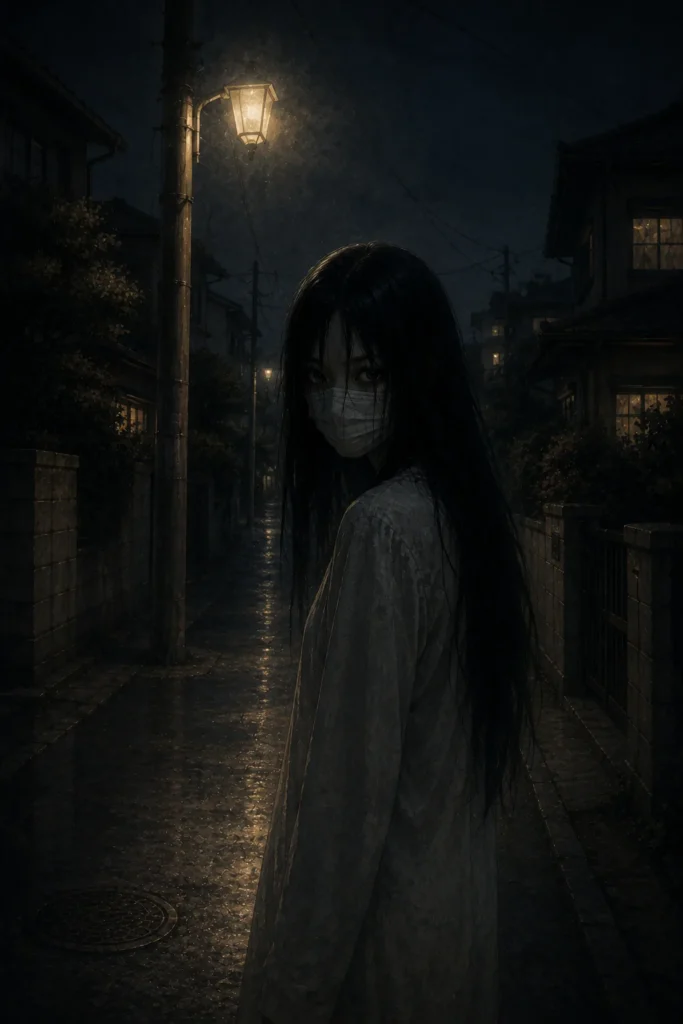
Kuchisake-onna, the slit-mouthed woman, is a modern Japanese urban legend with no roots in old folklore. Appearing as a masked figure with a mouth slit from ear to ear, she approaches mainly children on their way to school and asks whether they are beautiful, reacting with growing threat depending on the answer.
Her origin lies in a rumour that arose in Gifu Prefecture at the end of 1978 and became a nationwide panic in 1979 through newspapers and magazines. The legend spread above all through cram schools, which brought together children from different neighbourhoods, and only subsided at the start of the summer holidays.
Type: Modern urban legend, masked figure of fear
Origin: Rumour from Gifu Prefecture, end of 1978
Texts: Newspaper and magazine reports of the 1979 mass panic
Period: Emergence 1978, mass panic 1979, still alive today
Appearance: Woman with a mouth mask, beneath it a mouth slit from ear to ear, often carrying scissors
Historical Classification
Period of the Texts
As a mass phenomenon, the legend dates to 1978 and 1979; isolated claims of older Edo-period roots remain speculative and are not part of the documented core line.
Area of Diffusion
First Gifu Prefecture, then all of Japan: through newspapers, magazines and cram schools, the legend spread nationwide in 1979, in some prefectures accompanied by police patrols.
Sources
Good for the legend’s history itself: contemporary press reports and the studies of Michael Dylan Foster document the emergence and course of the panic.
Name and variants
Japanese: kuchi means mouth, sake to tear open or split, onna woman: Kuchisake-onna literally means the woman with the slit mouth. Unlike old yokai names, the name directly names the trauma that the legend itself narrates.
Appearance
Appearance
Kuchisake-onna wears a surgical mouth mask, beneath which she hides a mouth slit from ear to ear. She often carries a pair of scissors or a sickle.
Effect
In the evening and at night, she approaches mainly children on their way to school and asks whether she is beautiful. If the answer is no, she injures or kills the child; if the answer is yes, she removes the mask, reveals the slit mouth, and asks again. She reflects contemporary fears about cosmetic surgery, the anonymity of the suburbs, and the danger on the way to school, and is a symbol of the deceptive facade.
Profile: Kuchisake-onna
The most important aspects of the urban legend at a glance.
A modern Japanese urban legend with no roots in old folklore, originating in the mass-media era of the late 20th century.
Mainly children on their way to school, who are approached in the evening or at night by the masked woman.
A woman with a white mouth mask and long hair, beneath it a mouth slit from ear to ear, often carrying scissors or a sickle.
A figure of fear for the present day: she tests with her question about beauty and responds with injury or renewed threat.
Tricks internal to the legend rather than religious rites: an evasive answer, the word pomade, or thrown-down sweets.
Onryo, the older Japanese vengeful spirit, as well as Hone-onna and Betobeto-san as further figures of the Japanese spirit world, to which she is said to be closely related according to tradition.
From Gifu to nationwide school panic
The name combines kuchi, mouth, sake, to tear open or split, and onna, woman. Unlike most Japanese ghost figures, Kuchisake-onna has no roots in old folk belief: her origin lies in a rumour that arose in Gifu Prefecture at the end of 1978.
In 1979 newspapers and magazines carried the rumour nationwide, and in some prefectures police even patrolled in response. The main channel of spread was cram schools, which brought together children from different neighbourhoods and thus carried the rumour from district to district. With the start of the summer holidays the panic subsided. Isolated claims of older Edo-period roots remain speculative and are not part of the documented core line of the legend.
Return of a modern figure of fear
Kuchisake-onna is a fixed part of the canon of Japanese urban legends and is regularly revived. Numerous films, including Carved from 2007, as well as manga, anime and video games take up the figure.
In terms of religious studies, Kuchisake-onna is not a spirit of the dead in the classical sense, but a modern, yokai-like figure of fear. She is a case study in legend formation in the age of mass media and shows how the old pattern of the disfigured, vengeful woman continues into the present.
Tricks within the legend rather than ritual
As a modern urban legend, Kuchisake-onna has no traditional religious means of warding off. What is passed on are only tricks internal to the legend: saying the word pomade three times, throwing her hard candy, or confusing her with a counter-question in order to flee. These are narrative motifs, not handed-down rites. Where protection is nonetheless sought, people fall back on general means: a worn amulet, the sound of bells, generally regarded as a protective sign against uncanny beings, or the light of a protective candle on the nightly path. None of these means is specifically handed down for Kuchisake-onna.
Urban legends compared
As a modern figure of fear, Kuchisake-onna corresponds to Western urban legends such as the tale of the Hook Man or of Bloody Mary; a more recent internet legend with a similar effect is Slender Man. Within the Japanese spirit world she is close to the Onryo, the age-old vengeful spirit, whose centuries-old pattern of the disfigured, wrathful woman continues to have an effect in her modern form, though she does not share its religious roots in the cult of the dead. She is also related in motif to the Hone-onna, another female ghost figure of Japan.
Frequently asked questions about Kuchisake-onna
How old is the legend?
As a mass phenomenon it dates from 1978 and 1979; older forerunners are not documented.
How does one escape her, according to the legend?
By giving an evasive answer, by saying the word pomade, or by throwing candy at her.
Is there genuine religious protection?
No, only tricks internal to the legend, no handed-down rites.
Further links
Further reading:
- Japan – all beings of the Japanese tradition
- Onryo – the classic Japanese vengeful spirit
- Hone-onna, Betobeto-san – related Japanese figures
- Amulet, Bells, Protective candle – general protective means
Literature (selection)
Further standard works in the bibliography.
As a slit-mouthed woman, Kuchisake-onna remains the most effective Japanese urban legend of the post-war period: not an old spirit from temples and chronicles, but a figure that, in 1979, from a single rumour in Gifu, held an entire country in suspense.