iWell Guard

Shimenawa: the braided straw rope as a boundary of the sacred

Shimenawa is a braided rope made of rice straw that marks off sacred areas in the Japanese religion. Hung with white paper strips, it draws a visible boundary between the pure and the impure and keeps misfortune away.

Protective symbolJapanThreshold rope
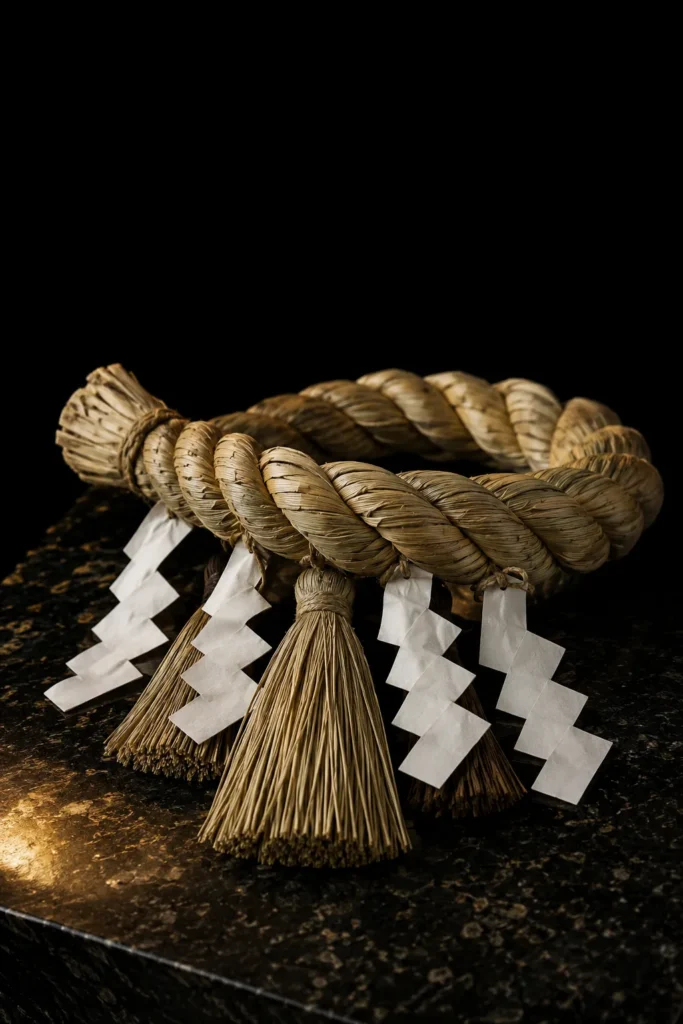
Shimenawa - protective symbol, museum-style illustration

Classification

Shimenawa is a sacred rope from the religious world of Japan. It is made of rice straw braided into a thick strand.

The task of the shimenawa is demarcation. It draws a boundary around an area, an object or a place and marks it as sacred, as pure and as dedicated to veneration.

The shimenawa belongs to Shinto, the native religion of Japan. In Shinto the distinction between the pure and the impure holds a high rank, and the shimenawa makes this distinction visible.

The rope is often hung with white, zigzag-folded paper strips. These strips are called shide and are a firm part of the appearance of the shimenawa.

In religious studies the shimenawa is a good example of a boundary marker. It does not protect through a frightening image but by drawing a threshold that the impure is not meant to cross.

This page treats the shimenawa as a protective and boundary marker. It belongs to a group of threshold markers that, in many cultures, denote the transition between an ordinary and a protected area.

Form and material

The shimenawa is a rope, yet a rope of a special kind. It is made of rice straw, the dried stalk of the rice plant.

The straw is twisted into strands, and these strands are braided together. This creates a thick, firm rope. Some shimenawa are slender, others of considerable girth and weight.

One peculiarity of the shimenawa is the direction of its braiding. It is often braided against the usual twisting direction. In this way the rope is already marked by its construction as something special, set against the everyday.

Many shimenawa taper toward the ends or are thickest in the middle. Tufts of loose straw frequently hang down from the braided rope, which gives the shimenawa its characteristic appearance.

At regular intervals the white paper strips, the shide, are attached to the rope. Their zigzag folding makes them look like small bolts of lightning and makes the shimenawa recognizable from afar.

The material is significant. Rice is the most important field crop in Japan, and rice straw is a familiar substance bound up with life and nourishment. The sacred rope is made from this everyday material.

The boundary of the sacred

The most important task of the shimenawa is the drawing of a boundary. Where a shimenawa is placed, an area begins that counts as sacred and as pure.

This boundary is essential in Shinto. Shinto distinguishes strictly between the pure and the impure. Sacred places are to be kept pure, and the impure is to be kept away from them.

The shimenawa makes this distinction visible. It marks the line at which the ordinary ends and the sacred begins. Anyone who sees the rope knows that they are entering a special area.

This boundary is not built of solid matter. A shimenawa physically stops no one. Its boundary is a boundary of meaning, a visible call to treat the area with respect.

Above all, the boundary is meant to keep the impure and the harmful away. Whatever might harm the sacred area is not to cross the rope. In this sense the shimenawa is a protective marker.

The shimenawa thus protects by ordering. It divides space into a sacred and an ordinary area and shields the sacred area from what does not belong in it.

The shimenawa at the shrine

The most common location of the shimenawa is the shrine. At the shrines of Shinto the sacred rope can be seen in many places.

A shimenawa often hangs over the entrance to the shrine grounds or at the gate, which is called torii in Japanese. In this way it marks the threshold that the visitor crosses when entering the sacred precinct.

Shimenawa are also placed on the buildings of the shrine itself. Some shrines are known for especially large and heavy shimenawa, whose making requires a great deal of rice straw and considerable care.

Within the shrine grounds the shimenawa marks off the especially sacred spots. It denotes the place where the deity is thought to be present, and shields it from the less sacred areas.

The shimenawa thus structures the shrine. It leads the visitor from threshold to threshold, from an area of lesser to an area of greater sanctity, and makes this gradation visible.

At the shrine the shimenawa thus fulfills its basic task in full. It orders the sacred space, marks its boundaries and shields the most sacred spots from the impure.

Sacred trees, rocks and the New Year

The shimenawa is not limited to the shrine. It also marks sacred objects of nature that lie outside the shrines.

In Shinto, individual trees, rocks or other natural objects can count as the seat of a deity. Such a sacred tree or rock is frequently wound with a shimenawa.

The rope sets this tree or rock apart from its natural surroundings. It indicates that what stands here is not an ordinary object of nature but a sacred place connected with a deity.

Also well known are two rocks joined by a shimenawa, which are venerated as a pair. Here the rope expresses the sacred bond between the two rocks.

The shimenawa has its own widespread use at the Japanese New Year. During this period smaller shimenawa, often furnished with further ornaments, are placed at the entrances of houses.

This New Year ornament is meant to keep the house pure and to keep misfortune away, so that the deity of the new year can be welcomed. Thus at the turn of the year the shimenawa also draws its protective boundary around people’s houses.

The paper strips shide

In most cases the white paper strips, the shide, belong to the shimenawa. They are a sign in their own right with their own meaning.

The shide are strips of white paper folded in a particular way. Through the zigzag folding they take on a characteristic shape reminiscent of a bolt of lightning.

The white paper points to purity. The color white is closely bound up with purity in Shinto, and the shide express this idea on the shimenawa.

The shide are hung on the rope at regular intervals. In this way they underline the task of the shimenawa. They emphasize that beyond the rope a pure area begins.

The same paper strips are also found at other places in Shinto. They hang from a staff used in ritual purification and are thus a firm part of the imagery of purification and consecration.

Shimenawa and shide together form a single sign. The rope draws the boundary, the paper strips emphasize the purity beyond this boundary. Only together do they give the full picture of the sacred, demarcated area.

Threshold markers across cultures

The shimenawa can be considered within the wider context of threshold markers. The marking of boundaries and thresholds is significant in many cultures.

In numerous traditions the threshold, the transition from one area into another, is experienced as especially significant and as especially exposed. A protective sign is therefore often placed at the threshold.

The Jewish tradition has the mezuzah on the doorpost, the Islamic tradition has protective texts above the door, and many European customs know signs at the threshold of the house. The concern is always the protected transition.

The shimenawa belongs to this group. It is the Japanese threshold marker that denotes and protects the transition from the ordinary into the sacred area.

What is distinctive about the shimenawa is its basic idea. It protects not through an image or a text but solely through the drawing of a boundary. It is, as it were, a pure threshold made visible.

The shimenawa thus shows that the idea of the protective boundary is widespread across cultures. Its Japanese form joins this idea with the high value of purity that defines Shinto.

Purity and order in Shinto

The shimenawa cannot be understood without the idea of purity. Purity is one of the central concepts of Shinto.

Shinto knows the distinction between a pure and an impure condition. The impure is connected with death, with illness and with defilement, the pure with life, with health and with closeness to the deities.

Sacred places and sacred acts require purity. Before entering a shrine, visitors purify themselves by rinsing their hands and mouth with water. Purity is the precondition of veneration.

The shimenawa fits into this order. It marks the pure, sacred area and sets it apart from the ordinary. It is, as it were, the visible line of purity.

The shimenawa is therefore less a means of protection that wards off than an ordering sign. It does not ward off the impure by instilling fear in it but by establishing a clear order of space.

The shimenawa is thus a good example of an understanding of protection that rests on order. The protection lies in the clear separation of the pure from the impure, and the shimenawa makes this separation visible.

Reception today

The shimenawa is present everywhere in Japan today. At shrines, on sacred trees and rocks and, at the New Year, on houses, the sacred rope can be seen in many places.

The great shimenawa of famous shrines are known beyond Japan. Their making is a feat of craftsmanship, and their renewal is often observed as a communal event.

At the turn of the year, shimenawa ornaments on the front door are, for many people, a firm custom. Even those not closely bound to Shinto often put up such a rope at the New Year.

The shimenawa has also become a familiar image of Japanese culture. It appears in depictions of Japan, in art and in design as a sign of the sacred and of tradition.

A factual account names the shimenawa for what it is, a marker of boundary and purity in Shinto. It draws a boundary of meaning, not a boundary that would physically restrain.

The shimenawa thus remains a living sign of the Japanese religion. In it the high value of purity, the idea of the protective boundary and the wish to separate the sacred visibly from the ordinary come together.

Literature (selection)

  • Nelly Naumann: Die einheimische Religion Japans (1988)
  • Ian Reader: Religion in Contemporary Japan (1991)
  • John K. Nelson: A Year in the Life of a Shinto Shrine (1996)
  • Sokyo Ono: Shinto. The Kami Way (1962)
  • Klaus Antoni: Der himmlische Herrscher und sein Staat (1991)

Related key terms: Shimenawa straw rope rice straw Shinto shide purity threshold shrine Japan torii.

iWell Guard and protective traditions

iWell Guard stands in the cultural-historical line of portable protective objects to which the shimenawa also belongs. A modern companion for people who live with protective symbols: made in Germany, 41 layers of solid gold, platinum and silver, with a 30-day right of return.

Personal experiences may vary. Not a medical device. No healing promise.