Yūrei, ghost of Japanese tradition
By Ralf Ittermann · last reviewed on
Yūrei is a spirit of Japanese tradition.
Restless ghosts of the dead in Japanese tradition, returned over unfinished business.
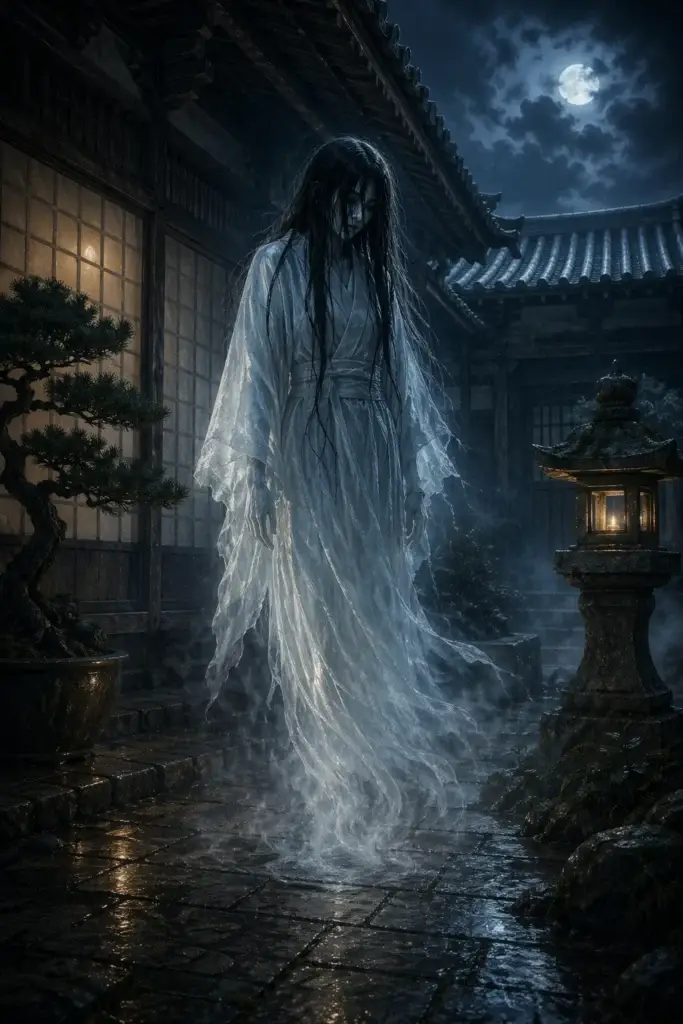
Yūrei
Yūrei (幽霊, “dim soul”) are the classic ghosts of the dead in Japanese tradition. They differ from the yōkai in that they come from the realm of the dead and return to the human world, usually because of some unfinished business: an unavenged murder, an abandoned child, an unrequited love, an embezzled estate.
The iconographically fixed figure goes back to the Edo period: a white funerary kimono, long black hair falling across the face, missing feet, limply hanging hands. The image derives substantially from the work of the painter Maruyama Ōkyo (1733, 1795).
The onryō subclass and the vengeful-spirit archetype
The Yūrei divide into several subclasses, of which the onryō (vengeful spirits) represent the dramatically most prominent type.
Onryō are yūrei with explosive affects, whose lack of release springs not from a vague wistfulness but from injustice suffered. The canonical onryō literature documents cases of murder, marital betrayal, or political persecution as catalysts for supernatural haunting.
The difference from the simple yūrei lies in the intensity of the phenomenal manifestations: onryō produce natural disasters, outbreaks of fire, or familial breakdown across several generations.
Classification systems in Buddhist texts distinguish between shiryō (ghosts of the dead) and akuryō (evil spirits), with onryō standing closer to the latter category. In modern classifications the onryō is defined as a yūrei with manifestational potential.
At a glance: Yūrei
Type: ghost of the dead, vengeful spirit (onryō)
Origin: Shintō ideas of death, Buddhist cosmology of rebirth
Texts: Konjaku Monogatarishū, Ugetsu Monogatari (1776), Yotsuya Kaidan (1825)
Period: popular from the Middle Ages onward; classical iconography in the Edo period
Trigger: an unresolved bond, an unavenged injustice, incomplete funerary rites
Classification
Period of the texts
The idea of wandering spirits of the dead is deeply rooted in Japan. Already in the setsuwa collections of the 12th to 14th centuries, the dead return to settle matters. The specific yūrei concept consolidated in the Edo period.
The iconographic codification came through Maruyama Ōkyo in the late 18th century, as well as through the ghost plays and woodblock prints of the Edo period. The kabuki drama “Tōkaidō Yotsuya Kaidan” (Tsuruya Nanboku IV, 1825), with the vengeful-spirit figure Oiwa, shapes the image of the onryō to this day.
Area of distribution
Yūrei traditions are widespread throughout Japan. Settings in literature and theater are often concrete places: Yotsuya (Tōkyō) with Oiwa’s story, Banchō for the plate-counting Okiku, the Tenmangū shrine for Sugawara no Michizane.
During the Obon season in August, when the souls of the dead are believed to return, yūrei dominate the stage and popular ghost stories alike.
Source situation
Core sources: Ueda Akinari, Ugetsu Monogatari (1776); Tsuruya Nanboku IV, Tōkaidō Yotsuya Kaidan (1825); Lafcadio Hearn, In Ghostly Japan and Kwaidan (1899/1904).
Modern scholarship: Michael Dylan Foster (2015); Iwasaka, Michiko & Toelken, Barre (1994) Ghosts and the Japanese; Komatsu Kazuhiko (2017). The material continues to have an effect into the present, visible in films such as “Ringu” (1998) and “Ju-On” (2002).
Name and variants
Literally “dark/dim soul” from 幽 (dim, dark) and 霊 (soul, spirit).
- Onryō (怨霊), vengeful spirit; a subgroup of the yūrei with an aggressive profile.
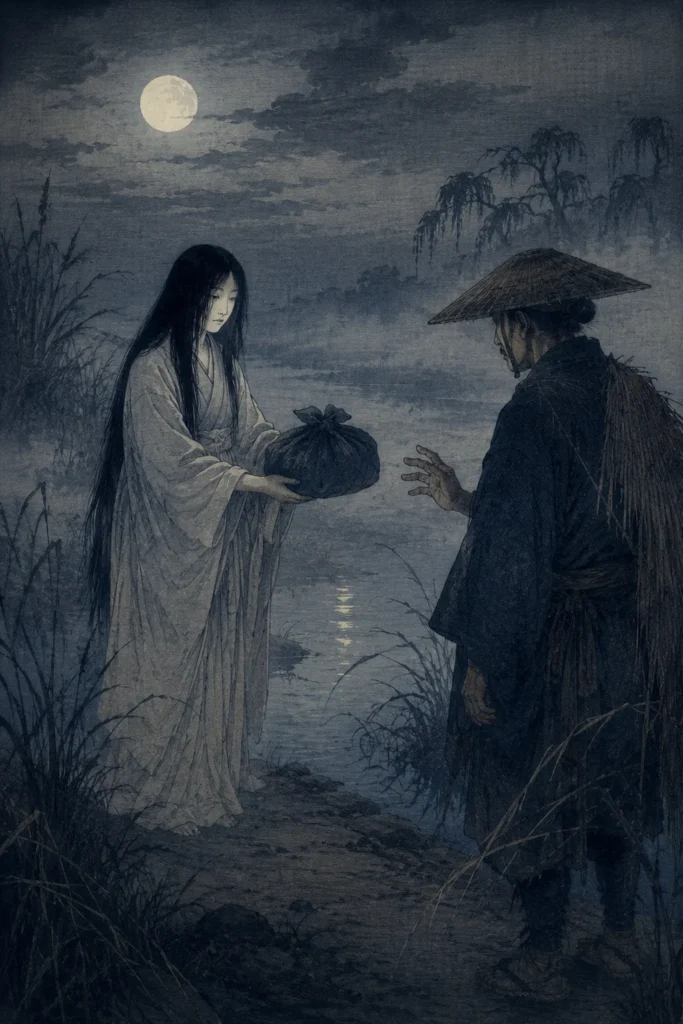
- Ubume (産女), the spirit of a woman who died in childbirth.
- Funayūrei (船幽霊), spirits of the drowned that attack ships.
- Zashiki-warashi, child household spirits, between yōkai and yūrei; tending to bring good fortune.
- Goryō (御霊), especially powerful vengeful spirits of high-ranking persons; with their own cult.
Description
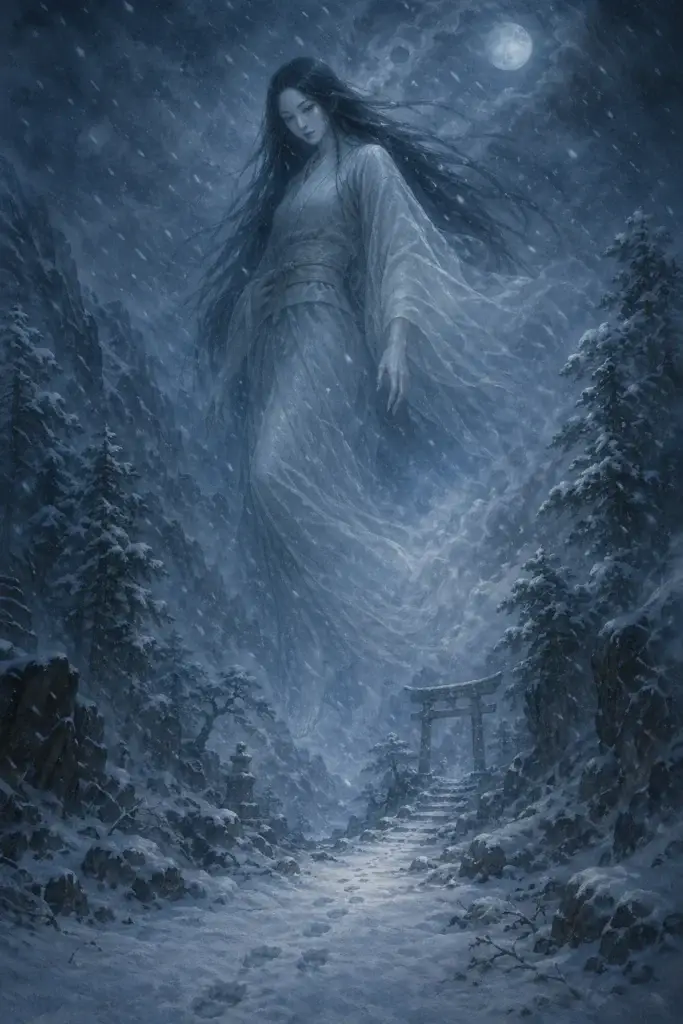
Appearance. A white funerary kimono (shinishōzoku, with the lapels wrapped over the body the reverse way), long, disheveled black hair, a pale, usually young face, limply hanging hands, missing or blurred feet. Often accompanied by two flickering hitodama flames.
Behavior. Yūrei usually appear where they died or where the injustice was committed. They rarely speak; they lament, point, and frighten. Onryō attack actively, cause accidents, and drive the guilty into madness or death.
Time. Visible at dusk, at night, and especially around two o’clock in the morning (ushimitsu-doki, “the ox third hour”).
Kabuki canonization and the botan-lantern motif
The kabuki stage transformed yūrei narratives into an iconic theatrical form.
Plays such as Kaidan Botan Doro (the peony-and-lantern ghost story, based on a sangoku tale from the seventeenth century) staged the yūrei as a dramatic protagonist whose pursuit of evil was rendered psychologically intelligible and at the same time aesthetically sublime.
This kaidan-mono genre established an archetype in late-Edo and early-Meiji kabuki: the suffering woman whose spirit appears in silk and blue light to bring the truth to light.
The choreography of the yūrei’s entrance used retrograde step sequences and slowed movements in order to encode the supernatural through the body. These kabuki innovations influenced later authors and established the yūrei as a central figure of Japanese horror aesthetics.
Profile: Yūrei
The most important aspects of Yūrei at a glance.
Human dead with unfinished business, to whom proper release is denied.
The perpetrators of the injustice, their families and heirs; chance witnesses at the site; physicians, undertakers, pregnant women in unstable phases.
Dressed in white, long-haired, pale, without feet; accompanied by hitodama flames.
Terror, illness, madness, accidents, and with the onryō the death of the pursued; with the Ubume, the nightly crying of an infant.
Complete Buddhist funerary rites, recitation of sutras (Heart Sutra, Nenbutsu), seeking out a priest, the erection of a small shrine (goryō cult), and the resolution of the unresolved matter.
The Korean Gwishin, the Chinese guǐ; European undead and the classical lemures; vow-breaking specters worldwide.
Protective practice
Complete funerary rites. Buddhist burial ceremonies with sutra recitation, posthumous names (kaimyō), and annual memorial rites are meant to prevent a deceased person from becoming a yūrei.
Obon. In summer (usually mid-August) the souls of the deceased are welcomed with lanterns, graves are cleaned, the Bon-Odori dance is traditionally performed, and at the end the souls are sent off again into the beyond on floating lanterns set out on rivers.
Goryō cult. Especially powerful vengeful spirits of historical persons (Sugawara no Michizane, Taira no Masakado) are venerated as deities of their own shrines, in order to appease them and to turn them into protective powers.
Resolution of the matter. In many stories the yūrei vanishes as soon as the unresolved problem is dealt with, a lost possession returned, a child cared for, a murderer brought to justice.
Yūrei, parallels in other cultures
Korea. Gwishin and especially the maiden ghost of the dead Cheonyeo-gwishin show a strong structural resemblance: white mourning dress, long black hair, return because of injustice.
China. The Chinese guǐ (see Gui) forms the historical lexical model and shares the motif of the return of the unreconciled dead.
Europe. The White Lady and the returning murder victims of the European legend cycles are typologically related; no historical line of descent exists.
Buddhism in general. In the Preta cosmology, the hungry ghosts form a closely related category of restless deceased (see Preta).
Hyakumonogatari Kaidankai and Shinto-Buddhist syncretism
The Hyakumonogatari Kaidankai (gathering of a hundred supernatural tales), a popular parlor ritual of the Edo period, channeled yūrei narratives into a structured social format.
Participants lit a hundred candles and took turns telling supernatural anecdotes; with each story a candle was extinguished and, according to popular belief, the supernatural potential grew stronger. The yūrei took a central position in this space of recitation, not as abstract concepts but as local, individually named deceased.
This attests to the everyday religious practice behind the literary archetype. The syncretism between Shinto ancestor veneration and Buddhist concepts of karmic bondage structured the theological understanding of the yūrei: they were neither purely Shinto kami nor purely Buddhist preta, but hybrid formations at the interfaces.
Local Shinto priests (kannushi) and Buddhist monks carried out rites of release that integrated both traditions.
Yūrei in Kabuki and Nō
Japanese theater shaped the image of the Yūrei over centuries.
In Nō theater, the group of ghost plays, the mugen-nō, forms its own structural type: a traveling monk encounters a person who at first appears unremarkable but who, over the course of the play, reveals himself or herself to be the spirit of a deceased person.
The spirit tells of its unresolved suffering, often an unrequited love, a violent death, or a guilt, and finally finds rest through the monk’s prayer.
This dramaturgy brings the basic religious conception onto the stage: the spirit remains bound to the world as long as an attachment holds it fast, and can be released only through ritual mediation.
The Kabuki theater of the Edo period developed from this a more popular, more drastic genre, the kaidan play.
Tsuruya Nanboku IV became famous with Tōkaidō Yotsuya Kaidan of 1825, the story of Oiwa, who is poisoned by her husband and returns as a disfigured vengeful spirit. Such plays used elaborate stage machinery for sudden appearances and transformations.
The iconographic conventions that today mark every yūrei go back substantially to the theater and the contemporaneous pictorial art: the white funerary garment, the long, disheveled black hair, the missing or hanging legs, the hands dangling powerlessly in front of the body.
The painter Maruyama Ōkyo is associated in art-historical tradition with the spread of the legless ghost image in the late eighteenth century. Scholarship emphasizes that this ghost image, regarded today as typically Japanese, is no age-old constant but a relatively recent pictorial formula standardized through theater and print graphics.
Onryō: the vengeful spirit and its religious background
Among the various manifestations of the yūrei, the onryō, the wrathful vengeful spirit, occupies a special position. It arises from a person who died under great injustice, with unfulfilled resentment, or violently.
The remaining resentment, in Japanese urami, binds the soul and drives it to revenge upon those responsible or, in the most feared cases, to indiscriminate destruction.
Belief in such spirits is well attested historically and had real political consequences. The best-known case is that of the scholar and statesman Sugawara no Michizane, who died in exile in 903. After his death, a series of misfortunes, deaths at court, and lightning strikes were interpreted as the work of his enraged spirit.
The court tried to appease him by rehabilitating him, honoring him with ranks, and finally venerating him as the deity Tenjin in a shrine. This process, the transformation of a dangerous spirit into a protective deity through veneration, is a core mechanism of the Japanese goryō belief.
From the standpoint of religious studies, a logic appears here that underlies the yūrei conception as a whole: the spirit is not by nature evil, but the expression of an unresolved condition.
The appropriate response is not combat but appeasement, whether through Buddhist funerary rites, through shrine veneration, or through the subsequent rectification of the injustice. This conception links the yūrei closely with the Buddhist teaching on attachment and with the native understanding of ritual purity and defilement.
Yūrei in modern horror
The yūrei conception is one of the few traditional ghost figures that not only survived in the twentieth and twenty-first centuries but found worldwide distribution. The starting point was the Japanese film industry.
The postwar films already took up classic kaidan material, and in 1964 Kobayashi Masaki filmed Kwaidan, a collection of such ghost stories based on the records of Lafcadio Hearn.
The decisive international breakthrough came with the horror cinema of the late 1990s. Films such as Nakata Hideo’s Ringu of 1998 and Shimizu Takashi’s Ju-on series established a ghost type that took up the classic yūrei iconography and placed it in a modern everyday context.
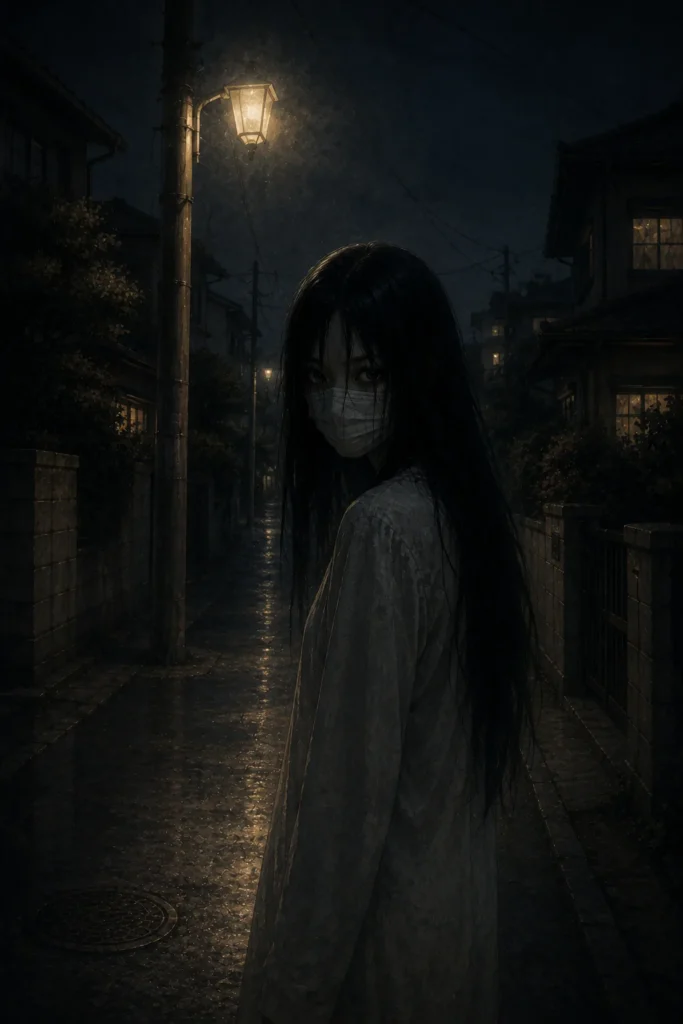
The pale female vengeful spirit with long black hair, moving in jerky and unnatural ways, became a globally recognizable image. The American remakes of the early 2000s spread this visual language further.
From the standpoint of religious studies it is remarkable how much of the traditional logic was preserved in these modern adaptations.
The film ghost too usually arises from a violent death and unresolved injustice, it too is bound to a place, an object, or a medium, and its working too follows the pattern of a spreading curse.
What changed is the context: in place of the Buddhist monk who releases the spirit, there often appears a spirit that cannot be released at all.
Modern horror has in many cases erased the consoling side of the tradition, the ritual solvability of the conflict, and left only the threat behind. It is precisely this comparison that makes visible what the traditional conception actually accomplished.
Further links
Further reading:
- Culture page Japan.
- Further individual profiles from Japan: Oni, Tengu, Kappa, Yuki-onna.
- Parallels: Gwishin (Korea), Cheonyeo-gwishin, Gui (China), Preta (Buddhism).
Literature (selection)
The protective practice described here is a religious-studies classification of historical traditions. iWell Guard ties into this cultural-historical line of portable protective objects and represents a contemporary form of it. More about the iWell Guard →