Cheonyeo-gwishin, spirit of the Korean tradition
By Ralf Ittermann · last reviewed on
Cheonyeo-gwishin is a spirit of the Korean tradition.
Virgin death-spirit of the Korean tradition, an unfulfilled bond as the reason for returning.
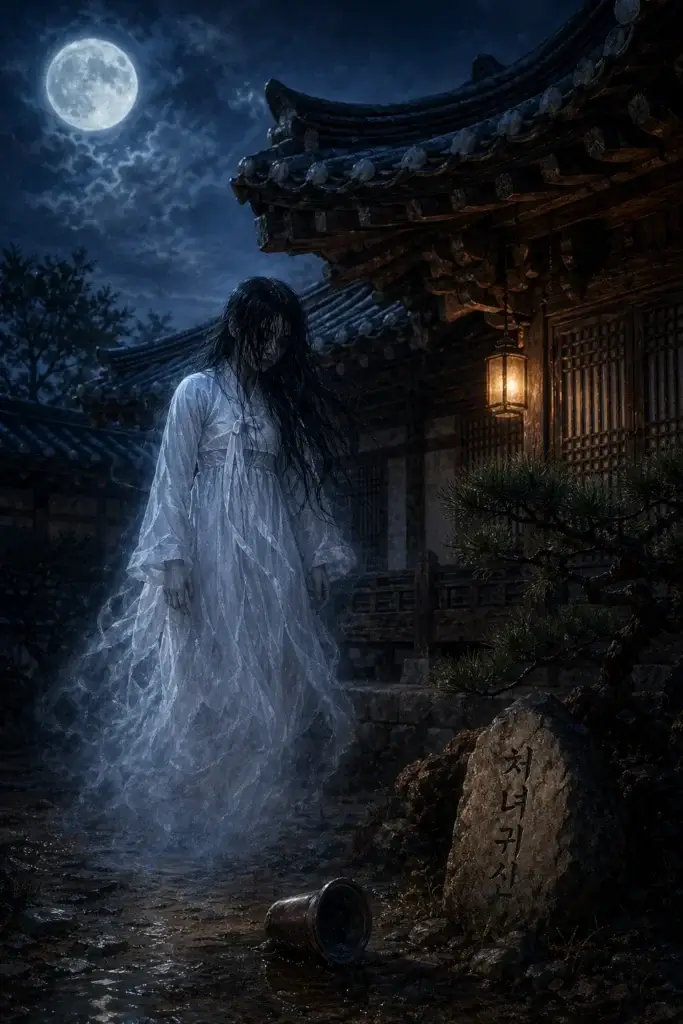
Cheonyeo-gwishin
The Cheonyeo-gwishin (처녀귀신, “virgin death-spirit”) is a particular form of the Korean Gwishin. It denotes the death-spirit of a young woman who died unmarried.
In the strongly Confucian Joseon society, marriage was regarded as a decisive aim in life; death before marriage meant a life lived incompletely and the absence of descendants who could carry out the ancestral rites (jesa).
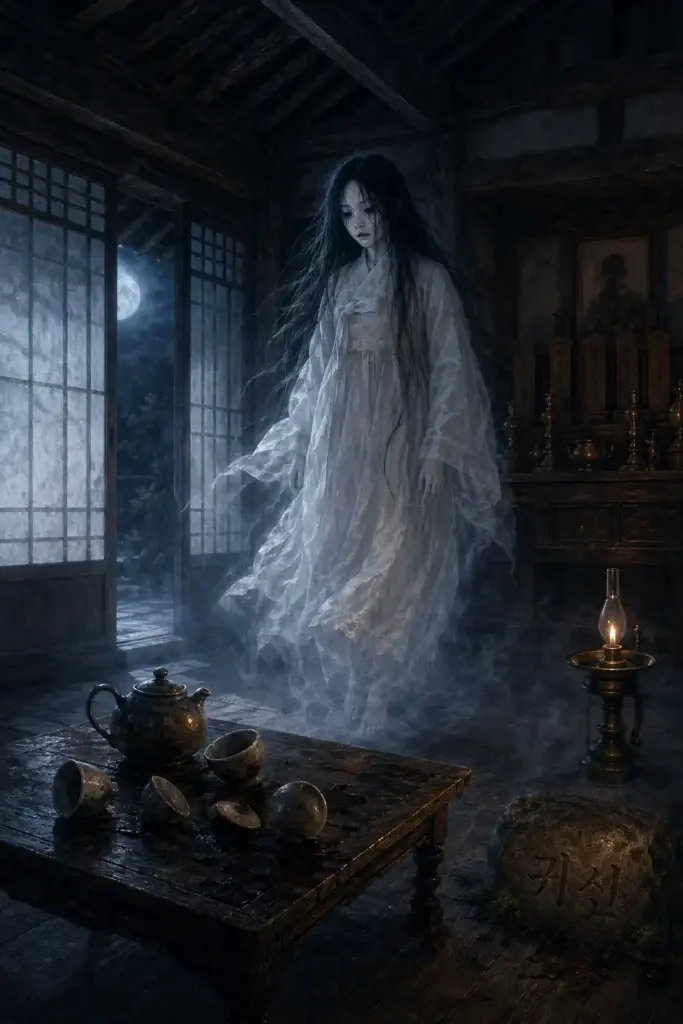
The figure is one of the most iconic of the Korean ghost motif, with a white mourning gown, long black hair and a hidden face, and it shapes K-drama and Korean horror film to this day.
Confucian gender order and han
The fate of the Cheonyeo-gwishin is directly tied to Confucian gender ideology. In the Joseon state, the role of the woman as wife and mother was normatively fixed; an unmarried woman was a social anomaly. Premature death intensifies this exceptional condition: she is taken into the family structure neither as wife nor as mother.
Her body remains ambiguously positioned. The han of the Cheonyeo arises from this structural erasure: she exists only as a deficit. Modern feminist interpretations of the Cheonyeo motif read in it a critical engagement with patriarchal systems. The spirit of the unmarried woman becomes the embodiment of all girls and women who are denied participation.
Quick overview: Cheonyeo
Type: death-spirit, subgroup of the Gwishin
Trigger: unmarried death, unfulfilled life task, absence of descendants
Origin: Confucian social order of the Joseon period
Motif: return to resolve the state of unfulfillment; posthumous marriage as resolution
Protective measures: posthumous marriage, jesa rites, shamanic gut
Context
Period of the texts
The figure consolidates itself in the Joseon period (1392, 1910) with the social entrenchment of Confucian family and ritual norms. In this order, marriage counts as a central status that governs belonging to the circle of ancestors.
A woman who dies unmarried falls out of this system and can be inserted neither into the ancestral circle of her family of birth nor into that of her (non-existent) husband.
Joseon-period yadam collections contain numerous Cheonyeo-gwishin narratives. In the 20th to 21st centuries, the figure is taken up intensively in film, K-drama and manhwa, among others in “A Tale of Two Sisters” (Janghwa, Hongryeon, 2003).
Area of distribution
The narratives are distributed across the whole of Korea, with particularly dense holdings in regions with a strong Confucian scholarly tradition, Gyeongju, Andong, Jeonju. The settings are frequently old estates of scholarly families, temples and empty rooms in the parental home of the deceased.
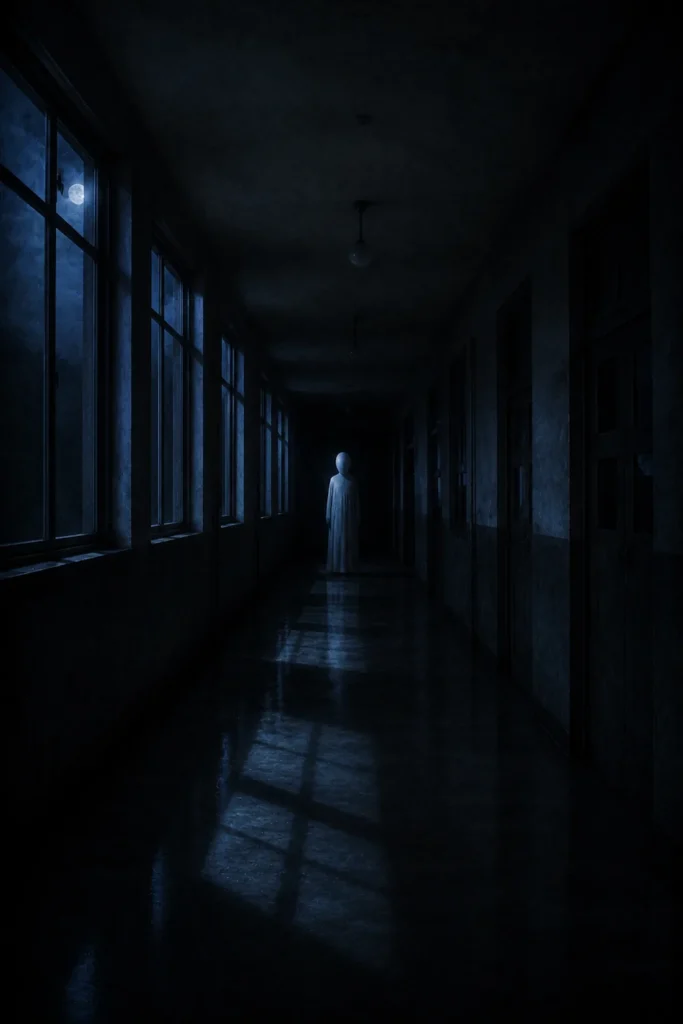
In modern versions, Cheonyeo-gwishin also appear in schools, hospitals and residential complexes, places in which young women live in the present and could suddenly die.
State of the sources
Important sources: Joseon-period yadam and paesol collections; Kim Tae-gon, Han’guk musok yŏn’gu (1981); Kendall, Shamans, Housewives (1985); numerous essays on the Confucian gender order of the Joseon period.
For film and popular-culture reception: works on Janghwa, Hongryeon (2003) and on the K-horror genre of the 2000s and 2010s.
Name and variants
Composed of 처녀 (“unmarried young woman, virgin”) and 귀신 (“death-spirit”).
- Son-gaksi, in some narratives a synonym or a subcategory.
- Mongdal-gwishin, the male counterpart: a man who died unmarried.
- Yeogwi (여귀), “female death-spirit”, a broader term.
- Jeoseung-gakssi, in folk narratives a designation for the bride in the afterlife, also in the ritual context of the posthumous marriage (yŏnggyŏl).
Description
Appearance. A young woman in a white mourning gown (sobok), long unbound black hair that conceals the face. Barefoot or in traditional socks. Usually without a visible face; the apparition communicates through posture and gesture.
Behaviour. Appears at the place of her death, in the parental home or at a site of unfulfilled longing. Rarely laments; stands silent, points to places or objects that hold a concern.
Effect. Triggers terror, illness, fainting, nightmares in witnesses. In severe cases the encounter leads to madness or death.
Iconographic constants and variations
In artistic traditions the Cheonyeo-gwishin is marked by constant features: white mourning clothing (sobok), long black hair, pale or bluish skin colour, sometimes the attributes of an unmarried woman such as maiden jewellery. In some local versions she still wears her wedding dress or the costume of the betrothed.
The white gown is not solely a symbol of mourning but also marks her sexuality as unspent and therefore dangerous. In modern adaptations the iconography is often grotesquely intensified: the Cheonyeo can appear in bloody wedding attire or with mutilated limbs.
This variation between the classical melancholic and the modern aggressive depiction shows how the original motif of mourning is rebuilt into a source of power.
Profile: Cheonyeo
The most important aspects of Cheonyeo-gwishin at a glance.
A young woman who died unmarried; a social and ritual void in the Confucian order.
Family and surviving relatives; residents of the parental home; chance witnesses; in modern reception: fellow residents and household servants.
Dressed in white, long-haired, pale, without a visible face or with closed eyes; a silent, sorrowful figure.
Nightmares, illness, unrest in the house; in severe cases the madness or death of witnesses; frequently a longer-lasting haunting.
Posthumous marriage (yŏnggyŏl) between two persons who died unmarried; shamanic gut; Buddhist death ceremonies; precise jesa rites performed by the family.
Japanese onryō and ubume; Chinese nǚ guǐ and minghun ghost-bride traditions; the European White Lady.
Protective practice
Yŏnggyŏl. The posthumous “ghost marriage” weds two persons who died unmarried to one another, so that both can be placed within the ancestral circle of a shared household. The rite is alive to the present day in individual regions of Korea, partly with dolls, partly with objects that represent the deceased.
Ssitgim-gut. The shamanic cleansing gut (especially the Jeolla and Jindo variant) dissolves the binding of the soul; the mudang calls, speaks, leads the spirit.
Jesa. The Confucian ancestral offering is carried out for persons who died unmarried in special forms, in order to make possible a placement within the ancestral circle.
Cheondo-jae. A Buddhist transition ritual intended to convey the soul out of the status of the restless Gwishin into a regular situation of rebirth.
Cheonyeo, parallels in other cultures
Japan. The Ubume, the woman who died in childbirth, shares the motif of the unfulfilled role. The classical onryō tradition of the Edo period shows a strong iconographic affinity.
China. Chinese ghost brides (minghun) are wedded in posthumous marriage rites; the motif is shared with the Korean yŏnggyŏl practice.
Europe. The White Lady of the German-speaking and Slavic legend cycles, often an abandoned bride or an early-deceased lady of the manor, is functionally and iconographically related.
Vietnam. Comparable “hungry death-spirits” of those who died unmarried exist in the Vietnamese folk tradition.
Literary and cinematic transformations
The Cheonyeo-gwishin is one of the most prominent figures of the Korean horror and fantasy genre. The motif allows filmmakers and authors to address questions of gender identity, marital violence and female sexuality.
The drama Tale of the Nine-Tailed uses Cheonyeo characters to explore themes of love experienced in separation and of grief.
A frequent modern motif is the Cheonyeo-gwishin who approaches one of her rivals in order to take revenge. The classical motif of the silent survivor mourning the deceased is here reversed: the dead woman becomes the agent of her own historiography.
The unmarried dead woman in Confucian Korea
The cheonyeo-gwishin (처녀귀신), the spirit of the deceased virgin, is one of the sharpest condensations of the social logic of Korean ghost belief. In the Confucian society of the Joseon period, a woman’s vocation in life was essentially marriage and motherhood.
A woman who died unmarried and without descendants had, from this perspective, not reached her social aim in life. At the same time she lacked a ritual place in the ancestral system, for she belonged permanently neither to her family of origin nor to a family-in-law that would have offered her rites.
From this twofold gap arises the conception of the cheonyeo-gwishin. Her han, her pent-up resentment and her unfulfilled longing, is considered especially strong, because a complete life was structurally denied to her.
Folk narrative makes of this a restless being that makes itself felt to the living, often to the family, at a particular place or to a person who bears responsibility for her fate.
The iconographic depiction is highly standardised: a white mourning gown, the traditional Korean sobok, long loose black hair, frequently a pallid face.
This image points immediately to death in the unmarried state, for the loose, unbound hair marks the marriage that was not carried out; married women wore their hair pinned up. The cheonyeo-gwishin thus bears her social situation visibly on her body.
Related, but to be distinguished, is the gwishin as a general category, into which the virgin spirit is classified as a specific type.
Narrative patterns and the motif of the suppressed truth
In the traditional narratives the cheonyeo-gwishin follows a recurring pattern. Frequently the woman has become the victim of a concealed injustice: a rape, a murder, a false accusation, a suicide forced for the sake of family honour.
The spirit then appears not at random but deliberately to an official or a powerful figure, usually in order to bring the suppressed truth to light. Only once the injustice is publicly acknowledged and the guilty punished can the spirit come to rest.
This pattern is broadly elaborated in literature. The narrative of Janghwa and Hongryeon, two sisters slandered unjustly, whose spirits appear to a new magistrate and move him to investigate, is among the best-known Korean folk narratives and was recorded and filmed several times.
The structure resembles a court trial: the spirit brings a complaint, the responsible authority investigates, the verdict restores the order. In this sense the cheonyeo-gwishin is less a creature of terror than an instance of justice that comes into play where living society has failed.
Modern popular culture has taken up this pattern and at the same time shifted it. In Korean horror cinema the virgin spirit often appears at first as a pure threat, yet the resolution regularly reveals the concealed injustice that holds her fast.
The old logic is thereby preserved: terror is the means, not the end. Read from the perspective of religious studies, the cheonyeo-gwishin is a mirror of the constraints that the Confucian gender system imposed on women, and her enduring cultural presence shows how deeply these constraints are anchored in collective memory.
Further links
Further reading:
- Culture page Korea.
- Further individual profiles of Korea: Dokkaebi, Gwishin, Gumiho, Jeoseung Saja.
- Parallels: Yūrei (Japan), Gui (China), Preta (Buddhism).
Literature (selection)
Further standard works in the literature index.
The protective practice described here is a religious-studies classification of historical traditions. iWell Guard ties in with this cultural-historical line of wearable protective objects and represents a contemporary form of it. More about the iWell Guard →