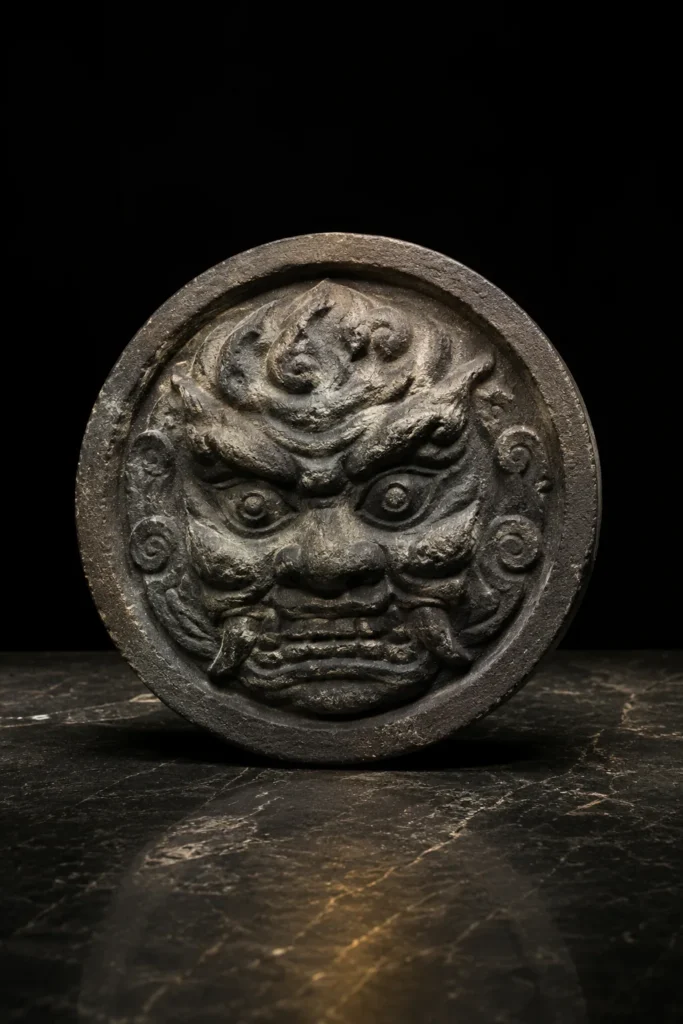
Dokkaebi, Spirit of Korean Tradition
By Ralf Ittermann · last reviewed on
Dokkaebi is a spirit of Korean tradition.
A mischievous nature and household spirit with a magical club, between goblin and demon.
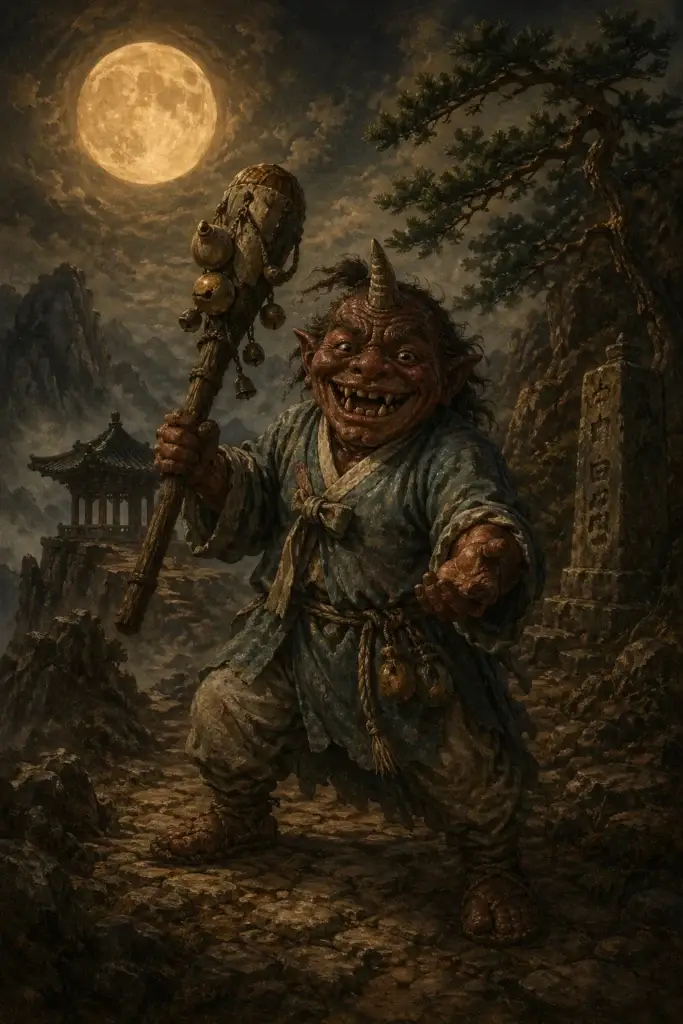
Dokkaebi
Dokkaebi (도깨비) are among the best known beings of Korean folk demonology. They are not spirits of the dead but arise from old, inanimate objects, a worn broom, a broken jug, a frayed garment, or from old trees.
In this sense they are related to the Japanese tsukumogami, yet they have a distinct, mischievous and heroic profile.
Typical of the Dokkaebi is its magical club (dokkaebi bangmangi), with which it can fulfil wishes, conjure up gold and make itself invisible. It loves wrestling matches, buckwheat pancakes and rice wine.
Samguk Yusa and the Early Dokkaebi Narratives
Korean ghost lore was shaped by the collection Samguk Yusa (Memorabilia of the Three Kingdoms, 13th century), whose author Iryeon documented early Dokkaebi narratives.
They are characterised as shapeshifting beings that are at once malicious and playful and potentially destructive. The texts already display the iconic Dokkaebi trait of shapeshifting and a fondness for deception.
One prominent narrative describes a Dokkaebi that appears at night on a country road and seduces travellers rather than harming them. This ambivalence between humorous disturbance and genuine danger remains constitutive for all subsequent Dokkaebi interpretations.
At a Glance: Dokkaebi
Type: Nature and object spirit, roguish goblin
Origin: Arisen from old objects, trees, stones
Texts: Samguk Yusa (13th c.), Joseon-era paesol collections
Behaviour: Mischievous, testing, often well disposed towards the righteous
Attribute: Magical club (dokkaebi bangmangi)
Classification
Period of the Texts
Early mentions are found in the Samguk Yusa and, occasionally even earlier, in Chinese-language texts about Korea. The classic form of the Dokkaebi motif, however, emerges in the Joseon period (1392 to 1910) with its rich activity of collecting folk tales.
During the Japanese colonial period (1910 to 1945) Dokkaebi were wrongly equated with the Japanese oni, a confusion still visible in old children’s books. Since the 1990s Korean folklore studies have sought a cleaner separation. The K-drama series “Goblin” (Dokkaebi, 2016 to 2017) has newly popularised the figure.
Area of Distribution
Dokkaebi traditions are widespread across all of Korea, with particularly dense bodies of tales in the southern provinces. Local variants differ in character and equipment: some Dokkaebi are friendly household spirits, others play tricks on travellers at mountain passes.
Typical places: old trees, wells, crossroads, abandoned houses, barns; more rarely in open landscapes.
Source Situation
Core sources: Iryŏn, Samguk Yusa (around 1281); Joseon-era paesol and yadam collections. For modern accounts: Kim Tae-gon (1981), Walraven (1994), Hong (2015).
The figure is prominently represented in children’s literature and animated media culture; some dictionaries of the 1980s still annotate the term with “Jap. oni,” which is now being corrected.
Name and Variants
The term 도깨비 is a native Korean word without a clear Chinese etymology.
- Cham-Dokkaebi, “true Dokkaebi”; the classic specimen with club and roguish profile.
- Oegan Dokkaebi, one-armed Dokkaebi, a local variant type.
- Dokkaebi bangmangi, the magical club as the main attribute.
- Dokkaebi bul, “Dokkaebi fire,” unexplained light phenomena over fields at night.
Characteristics
Appearance. From child-sized to tall; stocky, often with a single horn or one closed eye; patterned trousers (traditionally striped in red and black), barefoot, dishevelled hair. Some variants are one-armed or one-legged.
Attribute. The club (bangmangi) is its main tool. With it gold can be conjured up or rice multiplied. The club fulfils specific wishes when the owner says the right spell.
Behaviour. Dokkaebi challenge people to sireum (Korean wrestling). They are nocturnal, love alcohol, buckwheat pancakes and ox blood. They test a person’s virtue, rewarding the righteous and punishing the greedy severely.
Dokkaebi-bangmangi: The Magic Club as a Symbol of Power
The iconic attribute of the Dokkaebi is the bangmangi (magic club). In Korean folk narrative, the bangmangi is a club with which treasures can be created.
The bangmangi is not a tool of the Dokkaebi but rather a kind of embodiment of its nature and its power.
In folk stories, mortals who manage to obtain a bangmangi become temporarily endowed with supernatural gifts; however, such power typically ends in ruin or madness.
This reflects Korean theological conceptions of the incompatibility between human and spirit power. The bangmangi appears in literature and visual art (painting, later film) as the direct visual signature of the Dokkaebi presence.
Profile: Dokkaebi
The most important aspects of Dokkaebi at a glance.
From old objects (brooms, jugs, knives) or trees that were long carried or inhabited; rarely arising from humans.
Wanderers, hunters, farmers; all who are travelling in the mountains or near old trees; also household residents in whose kitchen an old broom or cooking pot stands.
Stocky humanoids with a horn, patterned trousers, a club in hand; barefoot, often one-armed or one-eyed.
Pranks, wrestling challenges, leading people astray on paths; at the same time gold and good fortune for the virtuous. Dokkaebi fire appears over fields at night.
Horse blood and red bean flour are considered effective; righteousness protects, greed attracts its wrath. Travelling alone at night with alcohol, a classic risk.
Japanese tsukumogami and oni; the Western goblin, gnome, troll; Chinese guǐ sub-forms.
Practice of Protection
Horse blood and bean flour. Classic means of protection against the Dokkaebi; horse blood is smeared on door thresholds, red bean flour is scattered.
Wrestling trick. Many tales report that a Dokkaebi loses to a human in sireum if the latter throws it not to the right but to the left. The Dokkaebi keeps its promise and vanishes.
Test of virtue. Dokkaebi regularly test a person’s sincerity: a poor, honest man is rewarded with gold; the greedy neighbour who feigns honesty is punished or made to look ridiculous.
Amulets and Jangseung. Protective posts at village boundaries do not specifically keep Dokkaebi away but do limit their range of action.
Dokkaebi, Parallels in Other Cultures
Japan. Tsukumogami share the motif of animated objects; Oni were inaccurately equated with Dokkaebi during the colonial period. The Dokkaebi is mischievous and testing, the Oni brutal.
China. Individual guǐ variants (such as the chī-gui) touch on the motif of the object or nature spirit.
Europe. Goblins of German-speaking folklore, household spirits of the Scandinavian tradition (tomte, nisse) and Irish leprechauns share the profile of the rogue and the tester, partly with a magical bag or tool.
Shamanic Tradition and the Mudang Relationship
The Korean shamanic tradition (Mudang practice) established a complex ritual relationship with the Dokkaebi sphere. Mudang (shaman-priests) developed procedures to negotiate with Dokkaebi, to direct their activities or to appease them.
In the Kut ritual (shamanic offering of appeasement) the Dokkaebi was often treated as a subordinate spirit entity that could be channelled through music, dance and offerings.
This shamanic practice differed markedly from Chinese and Japanese approaches, which tended to suppress spirits rather than integrate them. Korean shamanism treated Dokkaebi as legitimate actors of the spiritual ecology, not as pure evil.
This attitude permitted coexistence and pragmatic negotiation instead of confrontation. Modern ethnographic studies show that in rural regions where Mudang traditions were preserved, Dokkaebi reports were still being told in the 20th century with reference to shamanic possibilities of mediation.
Origin from Objects and the Logic of Transformation
A special feature of the Korean dokkaebi (도깨비) compared with other spirit beings is its origin. Unlike the gwishin, the spirit of a deceased person, the dokkaebi, according to a widespread notion, arises from inanimate objects.
Old things long used by people, above all brooms, fire pokers, flails and other household implements, are said to be able to transform into a dokkaebi after a long time, especially when they have come into contact with human blood.
This origin shapes its nature. The dokkaebi is not a spirit of the dead with an unfulfilled concern but an independent nature being that is closely interwoven with the human everyday world. It is familiar with people, knows their tools and their habits, yet maintains its own, often hard to predict logic.
Its character is ambivalent: it can play pranks, lead wanderers astray and cause mischief, but also bring wealth, above all through its famous club, which is said to conjure up objects on command.
Korean folk narrative knows numerous stories in which a person wrestles with a dokkaebi, outwits it or strikes a bargain with it. A recurring motif is wrestling all night long, after which the exhausted person discovers in the morning that the supposed opponent was an old broom or pestle.
Such tales show the dokkaebi as a being of the threshold, one that makes the boundary between thing and person, between familiar and foreign, between harm and gift permeable.
The dokkaebi in Folk Belief and Modern Culture
In traditional folk belief the dokkaebi was the object of its own, rather pragmatic veneration. In some coastal regions of Korea fishing communities held rites for it because it was credited with influence over the catch.
Here the dokkaebi appears as a bringer of good fortune whose goodwill could increase the catch. This regional anchoring distinguishes it from purely narrative bogey figures and shows that it had a firm place in lived religiosity.
A recurring difficulty for research concerns the iconographic transmission. During the period of Japanese colonial rule (1910 to 1945) and partly even before, the dokkaebi was frequently merged in textbooks and pictorial material with the Japanese oni, the horned, tusked demon.
Korean folklorists have pointed out that the horned image which today spontaneously appears to many people as a dokkaebi probably does not correspond to the older Korean notion, which depicts it rather as a humanlike, sometimes shaggy or coarse being without a fixed horned iconography.
In the present day the dokkaebi has undergone a broad revival. The television series Goblin (Korean original title Dokkaebi, 2016) made the figure known to an international audience, though it reinterpreted it strongly, towards an immortal, melancholy being.
Such modern appropriations move away from folk belief but retain the basic features: a being with superhuman power, with its own relationship to people, neither clearly good nor evil.
From the perspective of religious studies the dokkaebi remains interesting above all because it embodies the notion, widespread in Korea, that even the inanimate world of things can be charged with life and a will of its own.
Further Links
Further reading:
- Culture page Korea.
- Further individual profiles of Korea: Gwishin, Gumiho, Cheonyeo-gwishin, Jeoseung Saja.
- Parallels: Japan (Oni, tsukumogami), China (Gui).
Research Literature
Further standard works in the literature index.
The practice of protection described here is a religious-studies classification of historical traditions. iWell Guard ties in with this cultural-historical line of portable protective objects and represents a contemporary form of it. More about the iWell Guard →