Cerberus is the many-headed hound that guards the gate to the underworld in Greek mythology. He lets the dead in, but no one back out. As a hybrid being of dog, serpent and dragon, he embodies the inevitability of death.
Cerberus is one of the best known hybrid beings of Greek mythology. He belongs to the circle of monsters descended from Echidna and Typhon, and within this kinship he occupies a special position.
While other creatures of this line count as beasts to be fought, Cerberus fulfils an ordered function: he is the guardian at the entrance to Hades, the realm of the dead. He thus stands not for chaos but for the boundary between the worlds of the living and the dead.
From the perspective of religious studies, Cerberus is a threshold figure. His place is the doorstep, the transition, the spot where it is decided who may enter and who remains shut out. In many cultures the boundary to the beyond is controlled by a guardian, often in canine form.
Cerberus is the Greek expression of this widespread motif. His task is clearly defined: he lets the souls of the deceased pass, but prevents them from returning, and at the same time keeps away the living who seek to enter the underworld without permission.
The sources on Cerberus range from early Greek poetry through classical tragedy to the mythographic compendia of the Hellenistic and Roman period. Hesiod already names him in his Theogony, and Homer alludes in the Iliad to the hound of Hades without naming him explicitly.
The visual arts, above all vase painting, have depicted Cerberus repeatedly since the sixth century BC, usually in connection with the twelfth labour of Heracles.
The name Cerberus is not clearly explained in linguistic terms. In antiquity itself there was already no secure interpretation, which suggests that the name is very old and possibly stems from a pre-Greek layer. Several attempts at explanation stand side by side.
A common proposal connects Cerberus with the Old Indian word sarvara, which in the Vedic texts denotes one of the two dogs of the death god Yama.
From this would follow a shared Indo-European root for the notion of a spotted or piebald dog at the threshold to the beyond. This etymology has been much discussed in scholarship, but is regarded as not fully secure phonetically. Other scholars consider the name a loanword without Greek or Indo-European origin.
Folk-etymological interpretations of antiquity linked the name with terms for flesh or for devouring, which fitted the notion of the corpse-eater. Such interpretations are untenable from a linguistic standpoint, but they show how the Greeks themselves understood their hound of hell.
In the Latin tradition the name appears as Cerberus, a form that, through Roman poetry and later through medieval and modern Europe, became the customary spelling. The Greek form Kerberos is the older one and the usual form in the scholarly literature of religious studies.
The number of Cerberus’ heads varies considerably in the ancient sources. In the Theogony Hesiod names fifty heads, and Pindar is said to have spoken of a hundred.
In the later and in the now customary tradition the number three has prevailed. This three-headedness is also the most frequent form of depiction in the visual arts, although early vase images occasionally show Cerberus with two heads.
Beyond the three canine heads, many depictions bear further features that mark Cerberus as a hybrid being. Frequently mentioned is a tail in the shape of a serpent. From his back or his neck numerous serpent heads are said to rise. Some sources speak of a mane of serpents.
This combination of dog and serpent reinforces the impression of a chthonic figure, that is, one belonging to the earth and the depths.
His drool was held to be poisonous; from it, according to a widespread tradition, the poisonous plant aconite is said to have arisen when Heracles dragged the hound to the upper world.
In vase painting Cerberus usually appears in the scene in which Heracles fetches him from the underworld. The hero puts a chain or a rope on him, often accompanied by Hermes or Athena. Cerberus is not depicted as a bloodthirsty beast, but as an overpowered, sometimes almost fearful animal.
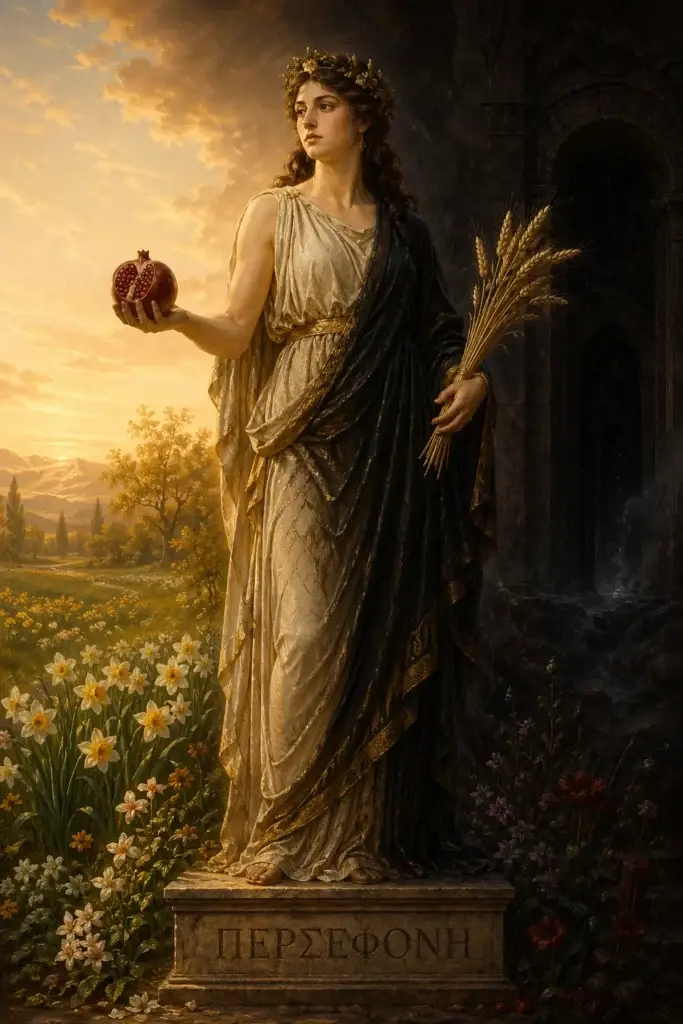
In some images he crouches or resists. Ancient art thus stresses less his dangerousness than his subjugation by the hero. In Roman sculpture and in sarcophagus reliefs he appears as well at the side of Hades and Persephone, as a fixed attribute of the ruling couple of the underworld.
The descent of Cerberus is fixed in Hesiod’s Theogony. He is a child of Echidna, a figure imagined as half woman and half serpent, and of Typhon, the mighty storm monster that rose against Zeus.
Cerberus is thus part of a brood of monsters that includes, among others, the Hydra of Lerna and the hound Orthos. This genealogy assigns him to the oldest, pre-Olympian layer of mythology.
Cerberus fulfils his central role as guardian at the gate of Hades. The dead cross the river of the underworld and reach the gate that Cerberus guards.
He greets those who enter, according to one tradition, with a wagging tail, but attacks anyone who tries to leave the realm of the dead again. His function is therefore directed in two ways: it secures the one-way street of death.
The most famous narrative is the twelfth and final labour of Heracles. On the order of Eurystheus the hero is to bring Cerberus up from the underworld. Heracles descends, receives from Hades permission to take the hound along, provided he subdues it without weapons.
With bare hands or by a firm grip Heracles overpowers the animal and leads it to the upper world. After presenting it to the horrified Eurystheus, he returns Cerberus to the underworld. This labour counts as the climax of the twelve deeds, because here the hero subdues death itself and returns alive.
Further episodes report attempts to deceive or calm Cerberus. Orpheus is said to have soothed him with his song when he descended to bring back Eurydice. The Sibyl, according to the Roman tradition in Virgil, gave him a honey cake laced with a sleeping draught so that Aeneas could pass.
From this episode comes the later figure of speech about the sop with which one quiets the hound of hell. Psyche too fed him a cake in the tale handed down by Apuleius, in order to get past him.

Cerberus was not a god and received no cult of his own in the narrower sense. There was no temple, no priesthood and no festival dedicated to him.
From the standpoint of religious studies this is significant: Cerberus belongs to those mythical figures who are firmly anchored in the body of narrative and imagery without being the object of their own ritual veneration.
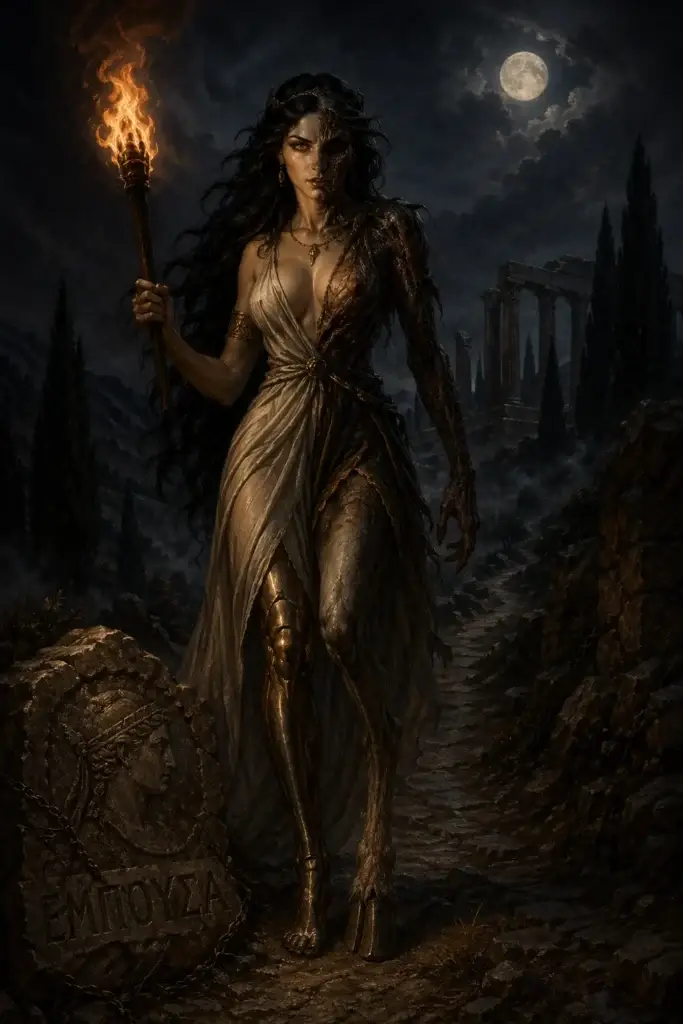
Indirectly, however, he was present in religious life. As an attribute of Hades and Persephone he belonged to the realm of ideas surrounding the underworld deities, whose cult was cultivated at various places.
At sites regarded as entrances to the underworld, such as certain caves and ravines, the threshold to the realm of the dead was taken seriously in ritual terms.
The place Tainaron at the southern tip of the Peloponnese was held to be one of the points at which Heracles is said to have brought Cerberus up.
In burial practice and in ideas of the beyond, the guardian hound played a role as part of the topography of the realm of the dead. Grave reliefs and sarcophagi took up the motif.
In the mystery cults, especially in the Eleusinian and Orphic currents, the concern was the soul’s safe path through the underworld. Here knowledge of the geography of the beyond, to which Cerberus also belonged, could be part of initiation. Direct offerings to Cerberus are, however, not attested.
In the relation to Cerberus the usual logic of protection is reversed.
It is not the human who protects himself from a demon; rather, Cerberus himself is the protective guardian who secures the realm of the dead against unauthorised entry and against the return of the dead. He is the personified guarding of the threshold.
In the transmitted narratives, strategies for dealing with the guardian nevertheless appear. They aim not at warding off but at appeasement. The honey cake that the Sibyl and Psyche give the hound is the best known means.
It belongs to a widespread pattern of ideas according to which guardians of the threshold can be made favourable through gifts, food or music. The song of Orpheus follows the same logic: not force, but appeasement.
Dogs did indeed have an apotropaic, that is, evil-averting, significance in Greek religion, especially in the circle of Hecate, the goddess of crossroads and of the boundary realms. The dog as the animal of the threshold, of the nocturnal path and of the transition is a recurring element.
Cerberus stands in this context as the form of the threshold hound heightened into the monstrous. The honey cakes laid down at nocturnal rites at crossroads, and the cake for Cerberus, belong to the same field of imagery.
An actual protective practice against Cerberus in the everyday life of the living did not exist, since one encountered him only after death.
The guardian hound at the threshold of the beyond is a motif that reaches far beyond Greek mythology. Comparative religious studies has worked out numerous correspondences.
The closest parallel is found in Vedic India. The death god Yama possesses two four-eyed, mottled dogs that guard the paths to the realm of the dead.
The possible linguistic kinship of the name Cerberus with the epithet of one of these dogs has led scholarship to suspect a shared Indo-European inheritance here: the dog as keeper of the path of the dead.
In the Norse tradition the dog Garm guards the entrance to the world of the dead, Hel. He too is a blood-smeared, dangerous guardian whose role corresponds to that of Cerberus.
In Egyptian religion the jackal-headed Anubis is assigned to the realm of the dead, though more strongly as companion and protector of the deceased than as a repelling gatekeeper. In the folk belief of many cultures the dog counts as an animal that scents the dead and knows the way to the beyond.
What these figures share is the combination of dog, boundary and death. The dog is the animal that guards house and herd, and this guardian function is transferred to the greatest of all boundaries, that between life and death.
Cerberus is the Greek form within this broad family of motifs, shaped by the heightening into the many-headed and by the fusion with the serpent motif.
Cerberus is one of the few ancient hybrid beings whose name has remained generally known to this day. Already in Roman poetry, in Virgil, Ovid and Seneca, he was a fixed component of the descriptions of the underworld.
Dante took him into his depiction of hell, where Cerbero guards the gluttons. In the visual arts of the Renaissance and the modern period he remained a recurring motif.
In modern culture Cerberus is present in many forms: in literature, in film, in games and in popular culture, often as a three-headed watchdog, frequently detached from his original mythological context.
His name has also entered the technical languages, for example as the designation of an authentication method in information technology, whose name alludes to the guardian function.
Research in religious studies and classical scholarship has examined Cerberus chiefly under three aspects. First, the etymology and the question of Indo-European roots of the guardian-hound motif.
Second, the iconography: the analysis of the vase images has shown how the depiction developed from the two-headed to the three-headed form and how closely Cerberus is linked with the legend of Heracles.
Third, his place in ancient ideas of the beyond, examined within the framework of larger works on the Greek conception of the soul and the dead.
Walter Burkert, Martin Persson Nilsson and Erwin Rohde have treated Cerberus in this connection, and Timothy Gantz has systematically compiled the literary and pictorial tradition. Cerberus thus remains a model case for how a single mythical being can give information about the boundary conceptions of an entire culture.
Related key terms: Cerberus Hades Heracles underworld hound of hell Echidna Typhon twelfth labour.
iWell Guard ties in with the cultural-historical tradition of portable protective objects, in the tradition of Greece and many other cultures worldwide. 41 layers, solid gold, platinum, silver, made in Germany. 30-day right of return.
Personal experiences may vary. Not a medical product. No promise of healing.