iWell Guard

Nereus, the truthful old man of the Aegean

Nereus is a god of the Greek tradition.

The shape-shifting seer and father of the Nereids.

Table of Contents

Nereus, god of the Greek tradition
Nereus

Nereus is the old man of the sea of Greek mythology, a benevolent lord of the sea, son of Pontos and Gaia and thought of as pre-Olympian. With the Oceanid Doris he fathers the fifty Nereids, among them Thetis and Amphitrite.

Homer names him without a name as Halios Geron, Hesiod calls him the truthful old one. Whoever holds him fast receives a prophecy of the future.

At a glance: Nereus

Type: old man of the sea, prophesying sea god
Origin: son of Pontos and Gaia
Texts: Homer, Hesiod, Apollodorus
Period: archaic to late antiquity
Appearance: old man with staff and Nereids

Traditional context

Period of the Texts

Attested from Homer and Hesiod through to late antiquity.

Area of Diffusion

Worshipped chiefly in the Aegean, with a cult site at Gytheion in Laconia.

Sources

Good: Hesiod and Homer, plus Apollodorus and Pausanias.

Name and variants

Greek: Nereus derives from the word for wet. Homer names him without a name as Halios Geron; only Hesiod gives his name.

Appearance and transformation

Appearance

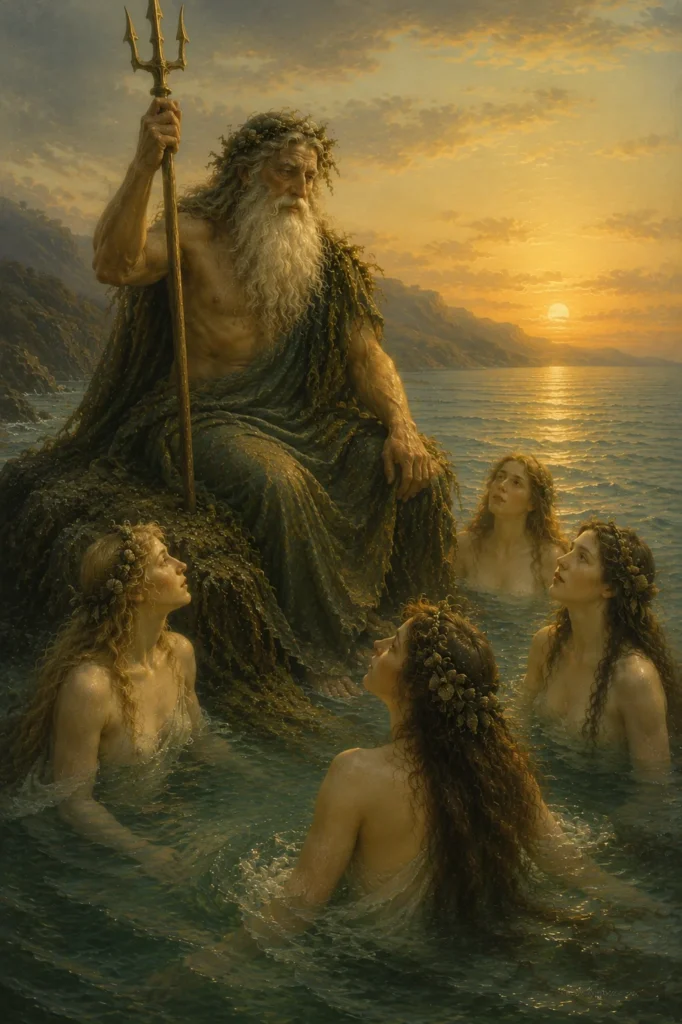
Nereus is regarded as a dignified old man with a staff, surrounded by his daughters.

Effect

Benevolent and unerring in his knowledge of the future, his gift of prophecy places him alongside Glaucus. As lord of abundant fish, he helps, provided one holds him fast.

Profile: Nereus

The most important aspects of the old man of the sea at a glance.

Tradition

Pre-Olympian sea god, father of the Nereids.

Responsible for

Abundance of fish and true knowledge of the future.

Depiction

Old man with staff, fish tail, seaweed.

Function

Guards the sea, prophesies only under compulsion.

Cult

Worship in Gytheion, incense with myrrh.

Related

Daughters Nereids, Amphitrite, plus Glaucus.

The wrestling match for the truth of the sea

Nereus, son of Pontos and Gaia, is the eldest among the sons of Pontos. With the Oceanid Doris he fathers the fifty Nereids, among them Amphitrite.

Famous is his wrestling match with Heracles: the hero holds the shape-shifting old man of the sea fast until he reveals the way to the Garden of the Hesperides.

The old man of the sea in art and interpretation

Nereus lives on as a symbol of the wise old man of the sea; Goethe features him in the Classical Walpurgis Night of Faust.

In religious studies, he is a personification of the calm sea, part of the pre-Olympian layer that precedes Poseidon, with local rather than large-scale temple worship.

Worship rather than warding off

The way people dealt with Nereus was worship, not warding off. In Gytheion he was worshipped as Geron; the Orphic Hymn mentions incense with myrrh and a request for prosperity. Holding him fast without being frightened by his transformations was the path to his knowledge. Amulets, holy water and salt draw on this.

Sea gods compared

Nereus stands alongside Glaucus as a shape-shifting seer, yet a god from birth. His wife Doris is a daughter of Oceanus; his daughters are the Nereids, including Amphitrite. Unlike Poseidon, he does not rule.

Frequently asked questions about Nereus

Is Nereus a Titan?

No, he is a son of the primordial deities Pontos and Gaia, without belonging to the Titans.

What distinguishes him from Poseidon?

Poseidon is the Olympian ruler of the sea, Nereus the older, peaceful personification without a claim to rule.

Further links

Recommended internal links:

Literature (selection)

Central source:
  • Hesiod: Theogonie. Um 700 v. Chr.

Further standard works in the bibliography.

Nereus the Old Man of the Sea, as known to Greek legend, remains the gentle side of the sea as father of the Nereids and a true seer.

Classification & Protection

ILEVEL
The Protection Compass assigns this being to influence level I, Minor influence.

Against its influence, cross-cultural tradition names these protective means:

Compare in the Protection Compass →

Recommended protective means

iWell Guard

The simplest protective means in this collection: 41 layers of fine gold 999, platinum, silver and silicon, manufactured in Ruhla, Thuringia. It requires no activation, is bound to no person, and is effective within a radius of around 50 meters, even without being worn.

All protective means at a glance →