Oceanus, the World Stream at the Edge of the Known
By Ralf Ittermann · last reviewed on
Oceanus is a god of the Greek tradition.
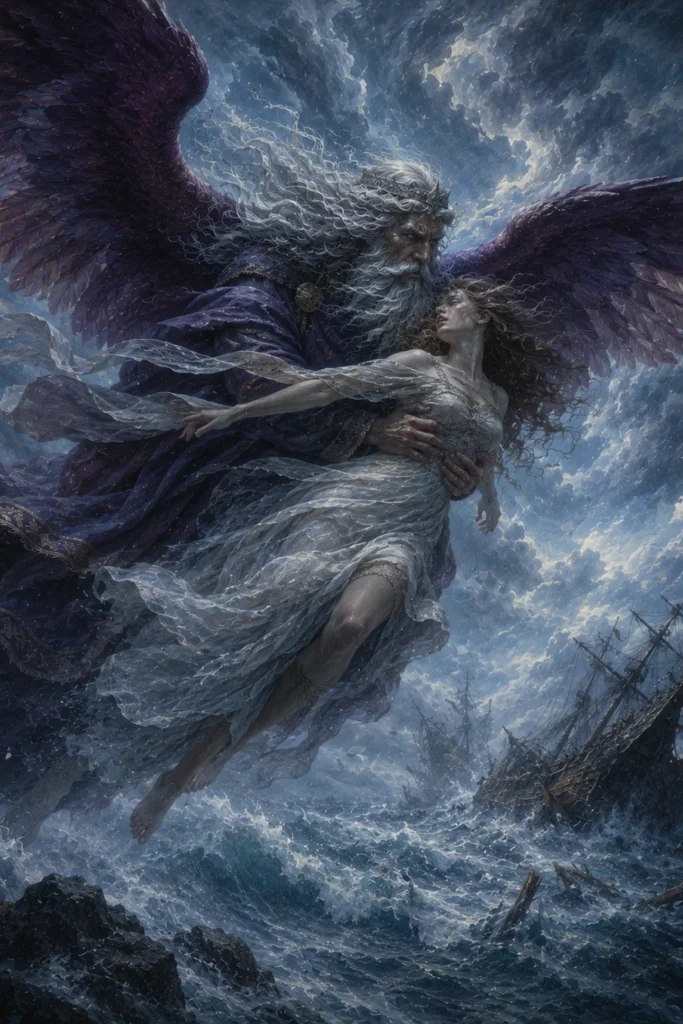
Titanic world stream that encircles the disc of the earth in a ring. Oceanus was known among the Greeks as the Titan embodying the World Stream.
Oceanus is the Titan of the world stream: the primordial water that encircles the disc of the earth in a ring. As the firstborn son of Uranus and Gaia, he fathers three thousand river gods and just as many Oceanids with Tethys.
Unlike his fellow Titans, he remains neutral against the Olympians and retains his position as lord of the world stream under Zeus.
Type: Titan of the world stream
Origin: son of Uranus and Gaia
Texts: Hesiod, Homer
Period: archaic early era
Appearance: bearded elder, bull horns, fish tail

Source context
Period of the Texts
Earliest layer in Homer and Hesiod, around 700 BC.
Area of Diffusion
Cosmological: the ring of water around the disc of the earth.
Sources
Well attested in literature, but rare and inconsistent in iconography.
Name and variants
Greek: the name is uncertain, probably pre-Greek; the word ocean derives from it.
Form Between River and Sea
Appearance
No fixed form: archaic vases show a serpent tail and bull horns at the same time.
Effect
Origin of all rivers and seas; acts only indirectly, marking, as a world boundary, the edge of the knowable.
Profile: Oceanus
Key facts about the world-stream Titan.
Firstborn Titan in Hesiod, without a cult.
Origin of all rivers and seas.
Bearded elder with bull horns and a fish tail.
Boundary between the known and the unknown.
No cult of his own; veneration was given to water deities.
Unlike the more active Nereus and Amphitrite: a cosmological layer.
The Neutral Titan Between Uranus and Zeus
Oceanus is the son of Uranus and Gaia, and in Hesiod’s account the firstborn Titan. With Tethys he fathers river gods and Oceanids; in Homer he is regarded as the origin of all things.
Unlike the other Titans, he remains neutral against the Olympians. This preserves his role as lord of the world stream under Zeus, a remnant of pre-Olympian cosmology.
Afterlife as Namesake of the Ocean
Oceanus gave the term ocean its name and appears in fountain art as a bearded water god.
In religious studies, he is the personification of a cosmological element. Bull horns and fish tail show the merging of river-god and sea-god imagery.
Veneration Without a Cult of Its Own
Okeanos had no cult of his own; worship was directed at river gods and the Oceanids. Fitting are holy water as a symbol of the primordial waters, salt as an ordering force and an amulet for water journeys.
World stream beside Poseidon's sea
Okeanos stands alongside Near Eastern conceptions of primordial waters, distinct from Nereus, Amphitrite and Glaukos. His daughters, the Oceanids, correspond to the Nereids.
Frequently asked questions about Okeanos
Is Okeanos a sea or a river?
Both and neither: the world stream from which all waters arise.
Who is his consort?
The Titaness Tethys, his sister; from her come the river gods and the Oceanids.
Further links
Further reading:
Literature (selection)
Further standard works in the bibliography.
Those searching for Okeanos Titan of Greek legend find a cosmological idea: the world stream of Greek mythology as the origin of all water, without a cult, its name preserved in the word ocean.