Boreas, the Stormy Son-in-law of Athens
By Ralf Ittermann · last reviewed on
Boreas is a god of Greek tradition.
The north wind that shattered the Persian fleet at Cape Sepias.
Boreas, in Roman tradition Aquilo, is the Greek god of the cold, stormy north wind and one of the four principal winds. From Thrace he brings winter cold and storms; at the same time he is a generative force and father of immortal horses.
To the Athenians he counted as a son-in-law, because he had abducted the Athenian Oreithyia and taken her as his wife. In this role he is said to have destroyed a large part of the Persian fleet, and he received his own cult in Athens.
Type: God of the cold north wind, one of the four principal winds
Origin: Greek mythology, son of Astraios and Eos
Texts: Hesiod, Theogony; Homer, Iliad; Herodotus, Histories
Period: Hesiod and Homer through to the imperial era
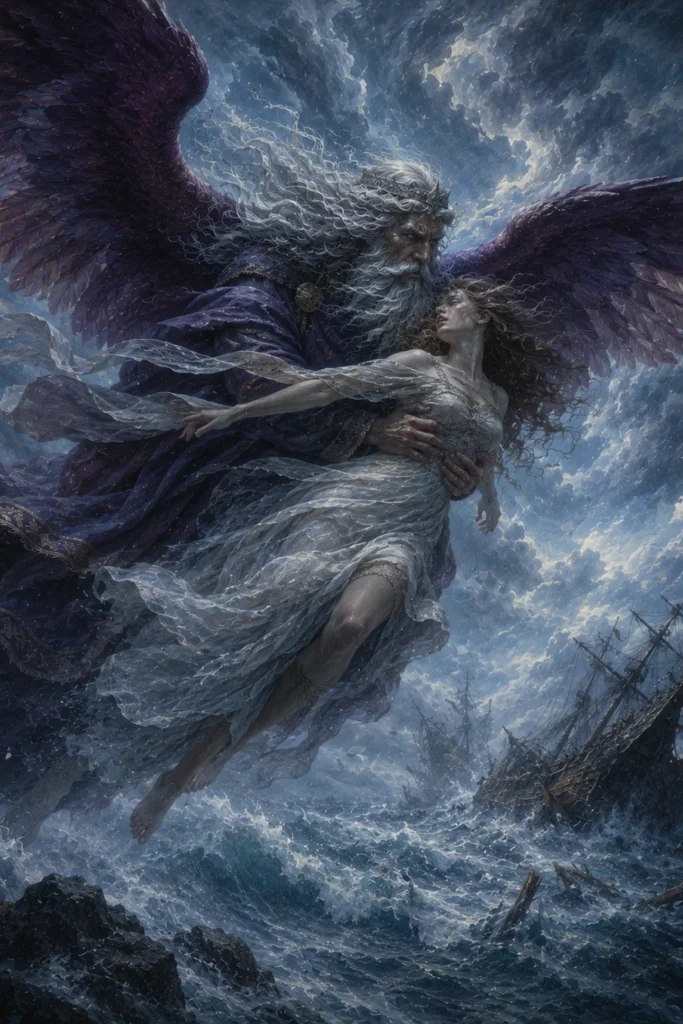
Appearance: bearded, powerful god, often with purple wings
Historical Background
Period of the Texts
Attested from Hesiod and Homer through to the imperial era; the Athenian cult begins with the Persian Wars of the 5th century BC.
Area of Diffusion
The Greek cultural sphere, especially Athens and Thrace: his cold and his storms come from the Thracian north.
Sources
Good: attested repeatedly with cult evidence, from the Theogony through the Iliad to Herodotus’s account of the Persian fleet.
Name and variants
Greek: Boréas, north wind; the exact derivation of the name is disputed. In Roman tradition he corresponds to Aquilo.
Beings and effect
Appearance
Boreas is depicted as a bearded, powerful god, often with purple wings; on the Chest of Kypselos he has serpent tails instead of legs, and in popular tradition he also appears in horse form.
Effect
As god of the winter wind, Boreas brings winter cold and storms from Thrace, according to Hesiod. He destroys enemy fleets and is at the same time a generative force: in the Iliad he sires twelve immortal foals as a stallion, and with Oreithyia he fathers the Boreads.
Profile: Boreas
The most important aspects of the north wind at a glance.
One of the four principal winds of the Greeks, son of Astraios and Eos, with his own sanctuary in Athens.
Athenians and seafarers: to some he was a son-in-law and saviour, to others a destroyer of fleets.
Bearded, powerful and often with purple wings; on the Chest of Kypselos with serpent tails instead of legs.
Winter cold and storms from Thrace; alongside this, generative force as a stallion and as father of the Boreads.
Sanctuary on the Ilissos after the Persian War, an altar there also attested by Plato, annual festivals in Megalopolis.
The Roman Aquilo; typologically the Vedic Vayu, the Lakota north wind giant Waziya and the Seneca bear Ya-o-gah.
The abduction of Oreithyia and the Boreads
Boreas is the son of Astraios and Eos, according to Hesiod, Theogony 378. His central myth is the abduction of Oreithyia: he carried off the daughter of Erechtheus to Thrace and took her as his wife. Their sons are the Boreads Zetes and Kalais, who sail as Argonauts.
Alongside this stands the equine side of the north wind: in the Iliad Boreas sires twelve immortal foals as a stallion. Through his marriage to Oreithyia, the storm god became a relative of the Athenians, and this very kinship became politically significant during the Persian War.
From vase painting to Waterhouse
The abduction of Oreithyia was a popular subject in Attic vase painting; in the modern era John William Waterhouse painted a Boreas. In meteorology the name lives on.
From a religious-studies perspective, Boreas is a prime example of a wind god with a genuine cult who is at once violent and friendly towards Athens. Two clarifications: the sacrifice for Boreas at Thurii is not recorded in Herodotus but in Aelian; and the twelve horses of the Iliad belong to Erichthonius of Troy, not to the Attic Erechtheus.
Athens's son-in-law and his sanctuary
The Athenian cult is well attested: according to Herodotus, the Athenians, on the advice of an oracle, invoked their son-in-law Boreas, whereupon the north wind destroyed a large part of the Persian fleet off Cape Sepias. Afterwards they built him a sanctuary on the Ilissos; an altar there also appears in Plato. In Megalopolis annual festivals were held for Boreas.
North winds of other peoples
Boreas is the brother of Zephyros, Notos and Euros, and corresponds to the Roman Aquilo. As a generative storm god he is comparable to the Vedic Vayu; as a personification of the north wind he is typologically close to the Lakota north wind giant Waziya and the Seneca bear Ya-o-gah. An overview of the wind-god family is given on the page of the Anemoi.
Frequently asked questions about Boreas
Why did the Athenians consider Boreas a son-in-law?
Because he abducted the Athenian Oreithyia and took her as his wife; this is why the Athenians invoked him as a relative.
What did he do against the Persians?
According to tradition, the north wind, when invoked, destroyed a large part of the Persian fleet off Cape Sepias.
Which wind is Boreas?
The north wind, in Roman tradition Aquilo, cold and stormy.
Further links
Further reading:
- Greece – all beings of the Greek cultural sphere
- Anemoi – the wind gods at a glance
- Zephyros, Notos – his brothers in the west and south
- Amulet, Protective candle, Salt – traditional protective means
- Protection Compass – protective means at a glance
Literature (selection)
Further standard works in the bibliography.
As the Greek north wind, Boreas combines two faces: the abductor who carries Oreithyia off to Thrace, and the ally who shatters Athens’s enemies. This dual role gave the god of the winter wind his own cult on the Ilissos.