Nyx, Goddess of the Greek Tradition
By Ralf Ittermann · last reviewed on
Primordial darkness, mother of personifications, ruler over all nights. Nyx is one of the oldest deities of Greek mythology, born from Chaos, not descended from other gods.
She gives birth to countless children: Thanatos, Hypnos, the Hesperides. Nyx is not a malevolent force but the necessary counterpart to light, without her there is no sleep, no rest, no renewal.
Nyx
At a Glance: Nyx
Type: Primordial goddess (primal power)
Tradition: Greek mythology (Hesiod, Orphic cosmogony)
Class: Titan / primordial god
Role: Goddess of night, emerged from Chaos
Sources: Hesiod’s Theogony, Orphic Hymns, Plato, Plutarch
Sphere of influence: Night, darkness, the unconscious, death, births
Central conflict: Chaos vs. Cosmos, the hidden vs. the open
Historical Classification
Period of the Texts
An in-depth text will be provided here once the secondary literature has been evaluated.
Mythological Classification
Nyx, the goddess of night, is one of the oldest and most primordial deities in Greek cosmogony, descending directly from Chaos and being a primordial force, not generated by other gods. She is older than Zeus himself and is even feared by him.
Her genealogy is immense: alone, without a male partner, she bore the children of darkness, Thanatos (death), Hypnos (sleep), Eris (strife), Nemesis (retribution) and many others.
These children embody all the negative and necessary aspects of existence. Nyx represents not evil but the unknown, the hidden, the unconscious, that field from which everything comes and to which everything returns.
Area of Distribution
Nyx belongs to the panhellenic body of gods and is not confined to any single region. Her most important attestation lies in the Boeotian poetry of Hesiod; beyond that she appears in the epic and Orphic literature of the entire Greek world. Pausanias mentions an oracle of Night at Megara, but temples of her own are otherwise scarcely attested for Nyx.
State of the Sources
The central source on Nyx is Hesiod’s Theogony, which presents her as one of the first beings to emerge from Chaos and lists her numerous children, including Hypnos, Thanatos, and the Moirai.
Homer mentions in the Iliad that even Zeus fears the Night and is unwilling to act against her will. In the Orphic poems, Nyx assumes an even weightier position and is regarded there as a primordial power and counselor of the gods.
Name and Variants
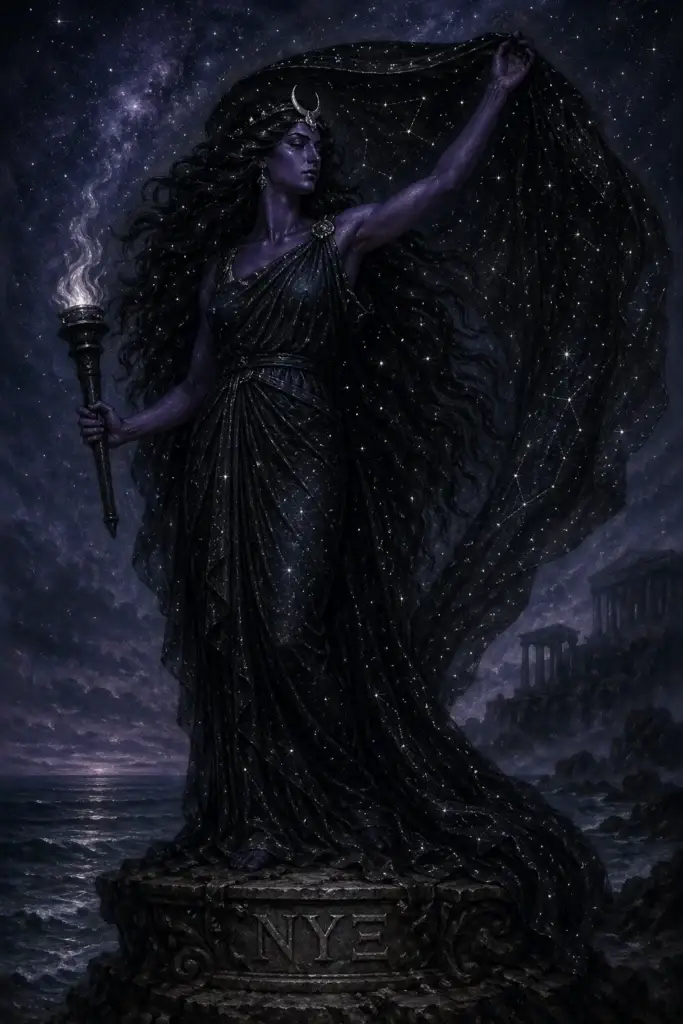
Nyx is depicted as a black, majestic woman, often with outspread wings that cover the sky. Her symbols are the crown of stars, the black night itself, and sometimes an oil lamp or a torch (night being the absence of light).
In some depictions she drives across the sky in a black chariot, a counterimage to the golden sun chariot of Helios. She wears dark, flowing robes.
Characteristics
Nyx is not the focus of temples or great rites, yet she is acknowledged everywhere. Sorcerers and seers invoke her because night is the time of insight, dreams, oracles and hidden knowledge reveal themselves in her domain. She is mentioned respectfully when people go to sleep.
She is also the protector of those who travel or work at night. Her worship is quiet and private, not public and festive as with other deities. She embodies the necessary darkness without which there is no life.
Appearance and Symbolism
Nyx is depicted as a dignified, majestic woman, often in dark robes, with stars in her hair or surrounding her figure. Sometimes she wears a crescent moon or is drawn by dark horses or owls, animals of the night. The star and the moon are her attributes, as are poppy and black sacrificial birds.
Her color is the deepest black, not the color of evil but of the unknown. In contrast to male gods, Nyx is portrayed as androgynous or feminine and powerful, not sexualized but commanding respect. She is older than language; her presence is indescribable.
Profile: Nyx
Nyx (Greek Νύξ, “Night”; Roman equivalent Nox) is one of the primordial deities of Greek mythology. According to Hesiod’s Theogony she arose directly from Chaos and thus belongs to the first beings of the world’s creation. Her sphere of influence is night in all its depth, darkness, concealment and origin.
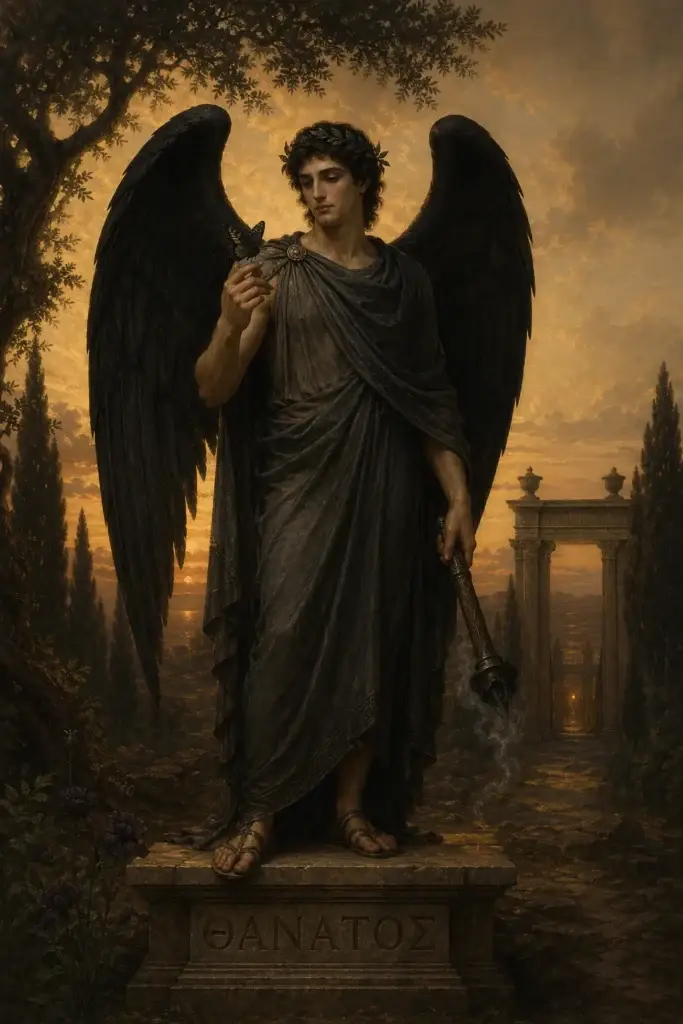
From her emerged numerous personifications, among them Hypnos (sleep), Thanatos (death), the Moirai, Nemesis and Eris. She is depicted in dark, star-strewn robes, veiled, at times winged or upon a chariot. The tradition attributes special dignity to her: according to Homer’s Iliad, even Zeus shrank from angering Nyx.
Genealogy: In Hesiod’s Theogony one of the oldest beings from Chaos. Not the daughter of another goddess but a primal force. Mother of Hypnos (sleep), Thanatos (death), Nemesis and many other beings of darkness. Hesiod: Nyx and Erebus (darkness) beget Aether (sky) and Hemera (day).
Function: Not merely “night” as a phenomenon, but a cosmic and psychological force. Represents the unconscious, the hidden, the limits of human knowledge and regeneration through rest. Mother of all who work in darkness, dreams, curses, healing, spirits.
Target group: Night workers, artists, poets, sorcerers, the dead.
Appearance: Usually a dark, veiled woman in black robes, often embroidered with a mantle of stars. Sometimes a crescent moon diadem or veil (symbolizing incomplete revelation). Later: wings similar to Hypnos and Thanatos. Depicted with her children. Black or deep violet is her color, the star and darkness itself a symbol.
Mythic effect: So powerful that even Zeus respects her, Homer’s Iliad: Zeus fears Nyx and does not dare to offend her. A primal power above the Olympian order. In Aeschylus, Nyx is the mother of the Erinyes, the spirits of vengeance; in Hesiod they arise from the blood of Uranus, castrated by Cronus. Mother of Strife and discord (Eris), who sows discord among humans.
Ancient tradition knows no specific practice for warding off Nyx, for she was regarded as a cosmic primal power, not a demoness, and one that cannot be opposed. Telling in this respect is the scene in the Iliad in which Hypnos reports that Zeus let go of his anger out of awe before Night. The Greeks met the dangers of darkness not with remedies against Nyx herself but by invoking protective deities such as Hecate or Apollo.
As the personification of night, Nyx has counterparts in many mythologies. The Romans adopted her almost unchanged as Nox, while in the Vedic tradition of India she corresponds to the goddess Ratri, to whom the hymns of the Rigveda dedicate a specific invocation.
The Egyptian sky goddess Nut, who swallows the sun every evening, also shares functional similarities with the Greek night goddess, without being related to her.
Practical Defense
Rituals of Worship
Women conducted night vigils to invoke Nyx for protection, healing and enlightenment. In magical practice, night operations (rituals after sunset) were dedicated to Nyx.
Invocations and Appeals
Orphic Hymn 3 is the central invocation formula: “Hear me, holy Night, dark Mother, eternal ruler of the stars…” Magical papyri from Egypt: invocations of Nyx for dreams and healing. Invocations during a lunar eclipse were considered especially potent.
Amulets and Protective Symbols
Night amulet (black stone with engraved stars). The star stone (μελάν ἄστρον) was regarded as the protection of Nyx. Moonstone served as a channel to Nyx.
Nyx, Parallels in Other Cultures
Similar goddesses and gods of the night are found everywhere: Hecate (Greece, later a night goddess), Nótt (Germanic), Nut (Egypt). In Indian traditions Ratri (Night) is a similarly fundamental and necessary force.
Nyx differs from Hecate in that she does not actively intervene in magic, but rather is the night itself. She is a basic cosmic force, not a goddess with a personal agenda.
Nyx in Hesiod's Theogony: the Genealogy of Night
The most important early source for Nyx is Hesiod’s Theogony, a Greek didactic poem of the late 8th or early 7th century before our era. There Nyx, the night, belongs to the very first beings to emerge from Chaos.
Alongside her arise Erebus, the darkness, as well as Gaia and Tartarus. Nyx thus stands at the beginning of the world’s creation, before the Olympian gods and even before the Titans.
Hesiod describes a twofold offspring. With Erebus, Nyx begets Aether, the bright upper sky, and Hemera, the day.
From herself, without a partner, she brings forth a long line of dark powers: Moros, doom, Ker and the Keres, Thanatos, death, Hypnos, sleep, the host of dreams, further Momos, blame, Oizys, misery, the Hesperides, the Moirai, Nemesis, Apate, Philotes, Geras, old age, and Eris, strife.
This genealogy is not coincidental. It assigns everything that threatens humans, that happens at night or that stands opposed to the bright, ordered life of day, to a single ancestress. In Hesiod’s system Nyx functions as the mother of the negative and fateful forces.
Scholarship emphasizes that this is less a narrated mythology than a theological systematics: through relations of kinship Hesiod brings order into the world of the invisible powers. Anyone wishing to follow up on individual children of hers will find separate entries, for instance on Hypnos and on Thanatos.
The Feared Goddess: Nyx in the Iliad
One of the few passages in which Nyx plays a role in a narrated episode appears in Homer’s Iliad (Book 14). Hera wishes to deceive Zeus and asks Hypnos, sleep, to lull him to sleep.
Hypnos hesitates and recalls an earlier incident: once before he had, at Hera’s command, put Zeus to sleep, whereupon the awakened father of the gods searched for him in fury.
Hypnos escaped only because he sought refuge with Nyx, the “subduer of gods and men.” Zeus refrained from punishment because he was loath to displease Nyx.
This brief passage is significant for the history of religion. It shows that even the highest Olympian god treats Nyx with respect, indeed with awe.
Nyx belongs to an older, pre-Olympian layer of the divine world, and her power is not abolished by the Olympian order. She is not part of the divine court on Olympus but an independent, primordial entity toward whom even Zeus acts with caution.
Scholarship sees in such passages traces of a stratification of Greek belief in the gods. The Olympian religion, as Homer portrays it in the foreground, did not displace older cosmic powers but pushed them to the margins and endowed them with a dignity of their own.
Nyx is a clear example of this: scarcely venerated in cult, little narrated in myth, yet acknowledged as a cosmic power of the highest rank. The scarcity of episodes is therefore no sign of unimportance, but an expression of her special position, removed from the narrating myth.
Nyx in Orphic Theology
In the Orphic tradition, a religious current with its own cosmogonies, Nyx occupies a markedly higher and more active position than in Hesiod.
The Orphic poems survive only in fragments and through later, in part Neoplatonic authors, which is why their reconstruction is contested. It is clear, however, that several Orphic cosmogonies place Nyx at the beginning or close to the beginning of the world’s creation.
In some Orphic versions Nyx is a prophetic power and a kind of primal mother who holds an oracular seat and even gives counsel to the later king of the gods.
In certain accounts Zeus receives his plan of rule by consulting Nyx. Thus Nyx here is no longer merely the ancestress of the dark powers but a knowing, advising entity at the root of the cosmic order.
One Orphic hymn is expressly addressed to Nyx and praises her as the mother of gods and men, as the origin of all things. The Orphic Hymns, a collection of cultic invocations probably of the imperial period, show that Nyx was indeed invoked in this religious milieu, unlike in the widespread civic cult.
Scholarship, such as the work of Martin L. West on the Orphic poems, has demonstrated that the Orphic elevation of night to a creative power is an independent theological achievement and not simply a variant of Hesiod.
It stands within a larger context of ancient Near Eastern and other cosmogonies in which darkness stands at the beginning.
Cult and Visual Art: the Rare Traces of Night
Unlike the Olympian gods, Nyx possessed scarcely any pronounced public cult. The ancient travel writer Pausanias mentions in the 2nd century only isolated references, for instance an oracle of Nyx near Megara.
A widespread temple cult with its own festivals, priesthoods and sacrifices, such as Athena or Apollo had, is not attested for Nyx. She belongs to those cosmic personifications that were theologically and poetically important but scarcely venerated institutionally.
In visual art Nyx is rare but not unknown. On some vase paintings she appears as a female figure, often in connection with the depiction of day and night or with her children Hypnos and Thanatos.
A well-known motif is Nyx as charioteer, who travels across the sky with her team and brings on the night, while Hemera or Eos brings the day. These depictions, however, are not always clearly distinguishable from related figures such as Selene, the moon goddess, which complicates iconographic research.
Famous is the depiction of Night on the so-called Pergamon Altar of the 2nd century before our era, where Nyx appears as a combatant in the Gigantomachy and hurls a vessel containing a serpent. On the whole, however, the evidence remains thin.
Nyx is a good example of the fact that the importance of a deity in Greek religion is not to be measured by the number of temples and images alone. Her weight lay in theological thought, in cosmogony and in poetry.
Further Links
Sources and Literature
Further standard works in the literature index.