Thanatos, God of the Greek Tradition
By Ralf Ittermann · last reviewed on
Thanatos is a god of the Greek tradition.
A calm messenger of death, brother of sleep, son of Nyx. Thanatos is the personification of death itself, not as chaos or torment, but as a gentle, inevitable passage into the afterlife.
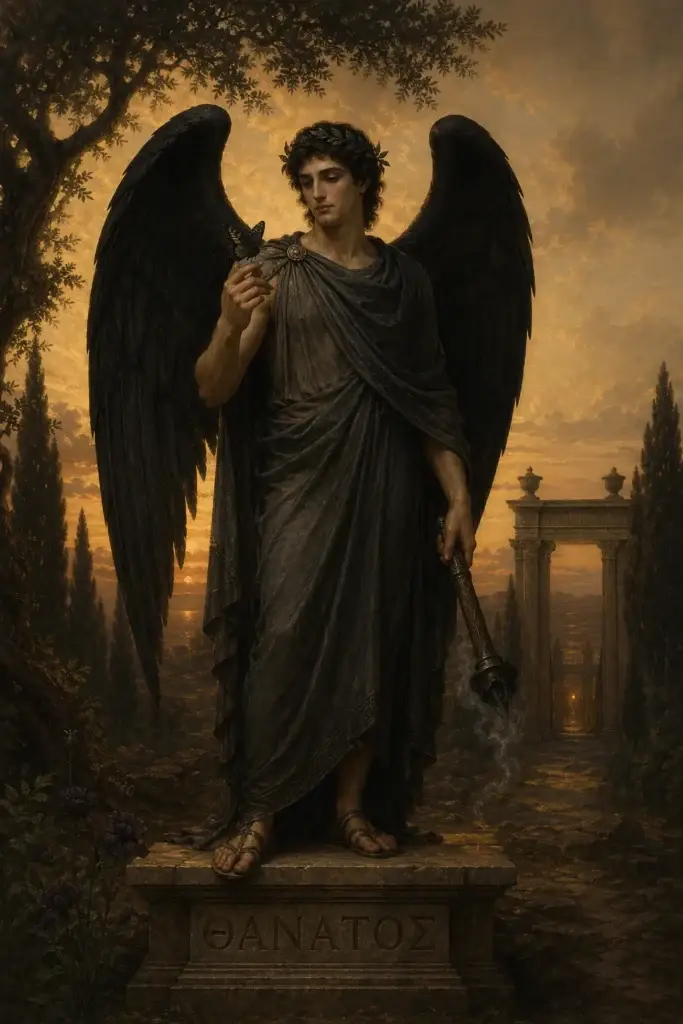
Unlike Hades, who rules over the underworld, Thanatos is the act of dying itself. With dark wings and an inverted torch, he attends people at the end of their lives.
Thanatos
Hesiod, Homer and the Divine Personification of Death
In the Theogony (ca. 700 BC), Hesiod describes Thanatos as the son of Nyx (Night) and the brother of Hypnos (Sleep). This cosmological positioning makes Thanatos not a malicious demon, but a primary force of order; the god of death is necessary for the structure of the universe.
In the Iliad, Homer treats Thanatos as an ambivalent figure: he is inescapable and no bribe can divert him, yet he is also not sadistic or evil in the manner of a demon.
This early characterization distinguishes Thanatos from Hades, the god of the underworld. Thanatos is the process of dying or of transition, not the dominion over the dead. Hades is the ruler of a realm, Thanatos is the force that crosses the boundary. This differentiation was preserved in ancient iconography and later in Christian theology.
Quick Overview: Thanatos
Thanatos already appears in Hesiod’s Theogony as a son of Nyx and brother of Hypnos, with whom he dwells in the underworld. In Euripides’ Alcestis he comes on stage as an acting character, whom Heracles overpowers in a wrestling match to snatch Alcestis from death. The myth of Sisyphus further relates that the cunning king of Corinth put Thanatos in chains, so that for a time no one could die.
Historical Classification
Hesiod’s Theogony, ca. 700 BC, is the oldest literary source. Homer’s Iliad XVI, 672, 682 describes Thanatos and his brother Hypnos as gentle beings who carry away the dead.
Apollodorus (1st to 2nd century AD) and Virgil expand on this. Greek tragedy: Thanatos as a metaphor for human mortality and the inevitable. Later the Stoics: a law of nature.
Area of distribution: Thanatos is primarily Greek and known throughout Hellas. The Romans adopted him as Mors and Letum.
Primary sources:
Hesiod, Theogony 211, 225
Homer, Iliad XVI, 672, 682
Sophocles, Antigone
Euripides, Alcestis
Apollodorus, Bibliotheca I, 3, 1; II, 5, 12
Secondary sources: Burkert; Dodds; Bremmer; Nilsson
Designation and Spellings
Thanatos is depicted as a winged demon or a youthful man, often with black wings similar to those of the sleep god Hypnos. His attributes are an inverted, extinguished torch (the end of life), and frequently also a sword.
His face is grave but not evil, rather melancholic. Some depictions show him with the urn of ashes, others with a butterfly, a symbol of the soul (psyche).
Characteristics
Thanatos is not the object of a cult, but rather an object of respect and cautious protective prayer. He is not worshipped, but accepted as necessary. Mortals appeal instead to Hades, Persephone or other gods to obtain mercy in the afterlife.
In Euripides’ drama Alcestis, Heracles wrestles with Thanatos to save the mortal Alcestis, a rare scene that shows even death can be repelled by force, but should not be. Thanatos represents acceptance and dignity in the face of mortality.
Appearance and Symbolism
Thanatos is depicted as a young, imposing man with wings (for the mobility of death) and sometimes with an inverted torch (a symbol of extinguished life) or a sword. Sometimes he wears dark robes. His color is dark gray or black.
In contrast to modern horror depictions of death, Thanatos is not terrifying; he is rather shy or sorrowful. His presence brings not fear, but a strange, peaceful relief.
Euripides and the Negotiation with the Inevitable
Euripides’ drama Alcestis (438 BC) presents Thanatos as a dramatic figure. He comes to fetch the dying Alcestis but is distracted by the sacrifice of another; Heracles strikes him down.
The drama presents Thanatos as a force that is respected and feared, yet under certain conditions can also be overcome. Euripides uses Thanatos not as an abstract concept, but as an acting character with will and motives.
This dramatic realization subsequently made Thanatos more relevant for non-religious contexts as well. Writers and philosophers could engage with Thanatos without having to take a specific theological position. The Alcestis became the standard reference for literary figures of death.
Profile: Thanatos
Thanatos is the Greek personification of death, neither evil nor merciful, but necessary and inevitable. As the son of Night (Nyx), he represents a cosmic force older than the Olympian gods and respected even by Zeus.
Genealogy: Son of Nyx and, as such, brother of Hypnos (Sleep). His family includes Charon (the ferryman), the Erinyes (spirits of vengeance), Nemesis (justice) and all the other children of Nyx. This family represents the inescapable forces of existence.
Distinctive feature: Unlike other gods, Thanatos has no offspring; he is terminal, not productive.
According to Greek belief, Thanatos comes to every mortal, since death is regarded as the inescapable fate of all humans. In poetry he is especially associated with gentle, fated death, while violent death on the battlefield was more often attributed to the Keres. Euripides’ Alcestis portrays him as a figure who comes specifically to fetch the person whose allotted lifespan has run out.
In the visual arts, the appearance of Thanatos changes markedly over the course of antiquity. On the white-ground lekythoi of the 5th century BC, the classic grave vessels of Athens, he appears together with his brother Hypnos as a bearded, winged man who gently carries the deceased to burial.
In the Hellenistic and Roman periods, the image of a youthful, winged genius increasingly prevails, holding a lowered, extinguished torch, an emblem of extinguishing life. Unlike in the modern conception, the ancient Thanatos is rarely depicted as frightening; the tradition emphasizes gentle, inevitable death in contrast to the violent dying attributed to the Keres.
Mythical effect: In Euripides’ Alcestis, Thanatos appears as a dramatic figure, a priest in black robes who comes to fetch Alcestis.
Heracles fights him physically and defeats him to bring Alcestis back, one of the few instances in which Thanatos is defeated, and it demonstrates his absolute power. Homer’s Iliad: Thanatos and Hypnos gently carry away the dead Sarpedon. Hesiod: inevitable but not actively hostile.
Greek religion knew no lasting defense against Thanatos, for death was considered part of the order laid down by the Moirai. The myths tell only of temporary exceptions: Sisyphus bound Thanatos through cunning, and Heracles overpowered him in a wrestling match for Alcestis. In cult, the Greeks met death less with protective magic than with correct burial rites meant to secure the soul’s passage into Hades.
The closest parallel to Thanatos is his own brother Hypnos, with whom he carries the fallen Sarpedon to Lycia in the Iliad. As personified death he can be compared with the Roman Mors, who is largely a transfer of the Greek figure. Unlike judges of the dead such as Yama or Yanluo, Thanatos does not pass judgment on the deceased but merely carries out the transition from life to death.
Defense in Everyday Life
Rituals for Defense and Worship
Although Thanatos could not be directly warded off, there were rituals for appeasement and a dignified handover. Burial rituals were central. In households, regular commemorative festivals (Anthesteria) honored Thanatos and the deceased.
Incantations and Invocations
Direct invocations of Thanatos were rare, but there were prayers for a gentle death. At deathbeds: “Come gently, Thanatos, and let my passage be painless.” Orphic Hymn 87 describes Thanatos as necessary and respected. Magical papyri: formulas against an evil death and pleas for a sweet death.
Amulets and Protective Symbols
The pomegranate amulet (a symbol of the underworld and of transition) was widespread. Late antique Roman rings: Thanatos and Hypnos, their duality serving as protective symbols. Black stones were used as Thanatos amulets for a dignified death.
Thanatos, Parallels in Other Cultures
Similar personifications of death are found everywhere: the Roman Mors and the Germanic Hel. In Eastern traditions, Yama (Hindu) or Dharmaraja (Buddhism) is the judge of the dead, while the West depicts Thanatos as almost poetic.
Charon (the ferryman) is his associated god, Hades his commissioner. Thanatos differs from malevolent deities in that he does not punish; he only carries out.
Hellenistic Iconography and Freud’s Death Drive
In the Hellenistic period, Thanatos and his twin Hypnos were frequently depicted in sculpture, often as winged youths who watch together over the deceased.
This iconographic stability suggests that Thanatos was anchored not only in literature but also in religious and aesthetic terms. Roman sarcophagus decoration adopted these pictorial motifs and spread them across the empire.
In modern psychoanalysis, Sigmund Freud (Beyond the Pleasure Principle, 1920) introduced the idea of a death drive, which others later called Thanatos. This death drive stands for unconscious destructive tendencies.
This analytical reading placed ancient mythology in a new context, with Thanatos becoming a metaphor for psychological processes. Whether this connection is justified historically or only etymologically remains disputed in scholarship.
Thanatos in the Myth of Alcestis
The most detailed narrative encounter with Thanatos in ancient literature is found in the Alcestis of Euripides, performed in 438 BC. The play opens with a prologue in which Apollo and Thanatos meet on stage.
Apollo has granted King Admetus an escape from death, provided that another dies voluntarily in his place. His wife Alcestis has agreed to do so, and Thanatos now appears to fetch her.
It is notable that Thanatos here appears as an acting, speaking figure, which is rare in Greek poetry. He curtly rejects Apollo’s request for a delay and insists on his right.
He describes himself as the one to whom the deceased belong and emphasizes that it is precisely from the young and beautiful that he gains his honor. Apollo prophesies to him that a man will come into the house of Admetus who will wrest the woman from him by force.
This man is Heracles. In a later scene, which is not shown on stage but reported, Heracles lies in wait for Thanatos at the grave of Alcestis as the latter wants to drink the blood of the funeral offerings, seizes him and wrestles him down until he releases the dead woman.
This episode is one of the few testimonies that Thanatos can be overpowered, and it stands alongside the tale of Sisyphus, who bound Thanatos.
Scholarship debates whether Euripides himself created the stage figure of Thanatos or whether he drew on an older tradition. What is certain is that the drama presupposes the conception of death as a negotiable, physically tangible power, a conception that differs markedly from the later philosophical abstraction.
Thanatos in the Visual Arts of Antiquity
The iconographic tradition of Thanatos is narrower than that of many other Greek deities, but it is significant. The most famous depiction is found on the so-called Euphronios krater, a red-figure calyx krater from the late 6th century BC, which is now exhibited once again in the archaeological museum of Cerveteri.
It shows Thanatos and his brother Hypnos carrying the dead Sarpedon from the battlefield, supervised by Hermes. Both brothers are depicted as winged, bearded warriors, following the Homeric scene from the 16th book of the Iliad.
In later vase painting and especially on white-ground lekythoi, the oil vessels that served as grave goods, Hypnos and Thanatos frequently appear as winged youths carrying a deceased person to the grave stele. These images belong to the fixed repertoire of Attic grave pottery of the 5th century.
A separate tradition developed in the Roman imperial period. On sarcophagi, death now often appears as a winged boy with a lowered, extinguished torch, a motif that continued to resonate in modern funerary art into the 19th century.
Whether this figure is directly identical to the Greek Thanatos or represents an independent Roman personification is disputed in scholarship.
A much-discussed single piece is a column drum from the later Temple of Artemis at Ephesus, which according to an old but unconfirmed interpretation shows a winged figure with a sword that has been addressed as Thanatos.
The attribution rests on a nearby inscription and is considered uncertain. Overall, the evidence shows that Thanatos rarely stood at the center of a cult image, but almost always appears in narrative or funerary contexts.
Position in the Genealogy of the Night
In Greek poetry, Thanatos has no father. In the Theogony, Hesiod assigns him to the children of Nyx, the Night, whom she bore without a consort.
In this enumeration, Thanatos stands beside Hypnos, Sleep, beside Moros, Doom, beside the Keres, the spirits of death, beside Momos, Blame, beside Nemesis, Retribution, and beside further somber powers such as Apate, Geras and Eris.
This genealogy is more than a statement of kinship. It assigns death to a realm that is opposed to the Olympian realm of light and that brings forth from within itself, without a male principle.
Hesiod describes that Hypnos and Thanatos dwell in the far west, where the sun sets, and that the sun never looks upon them with its rays. He expressly contrasts the gentleness of Sleep with the iron hardness of Death, who has a merciless heart and never again releases anyone he has once seized.
The close bond with Hypnos runs through the entire tradition. The two are regarded as twins or at least as inseparable brothers, and their depiction as a pair, for instance in carrying Sarpedon, emphasizes the kinship of sleep and death as a fundamental motif of Greek thought.
Thanatos differs from the Keres in character. The Keres are bloodthirsty, violent spirits of death who hunt for victims on the battlefield.
Thanatos, by contrast, embodies death as such, as an inevitable end, without the connotation of cruel, premature dying. This distinction is not sharp everywhere, and ancient texts occasionally use the terms in overlapping ways.
From Myth to Abstraction: Thanatos in Philosophy and Psychology
Already in antiquity, Thanatos increasingly lost his mythical form and became merely a word for death as a concept. In philosophical literature, for instance in Plato and the Stoics, thanatos appears as a factual term, not as a person.
The transition from a personal being to an abstraction can be traced in the history of the word and is an example of how personifications in Greek culture oscillate between figure and concept.
The name made a second, influential career in the 20th century. In his work Beyond the Pleasure Principle of 1920, Sigmund Freud introduced the notion of a death drive that stands opposed to the life drive.
Freud himself did not use the term Thanatos in his published writings; it was introduced into the discussion by his pupil Wilhelm Stekel and later by others, and it established itself as the counterpart to Eros.
In the psychoanalytic tradition, Thanatos has since stood for the tendency toward aggression, destruction and a return to the inorganic state.
This usage is far removed from the ancient deity and rests on a modern appropriation. It has nevertheless led to many people today knowing the name Thanatos more from psychology than from Greek mythology. The technical term thanatology for the scholarly study of dying and death is also derived from here.
In modern popular culture, Thanatos appears in novels, games and comics mostly as a personified death, often blended with traits of other death figures. This reception rarely draws on the specifically Greek sources, but serves a general image of death as a figure.
Sisyphus and the Binding of Death
In addition to the episode with Heracles, the Greek tradition knows a second tale in which Thanatos is overcome: the story of Sisyphus, the king of Corinth. It survives in several, partly contradictory versions, among others in the mythographer Pherecydes and in later compilations.
According to the most widespread version, when Thanatos came to fetch him, Sisyphus is said to have outwitted Death himself and put him in chains. As long as Thanatos was bound, no human could die anymore.
This state threw the order of the world into disarray, for the dead belong in the underworld, and the cessation of dying also affected the practice of sacrifice and the relationship between the living and the gods.
It was only the war god Ares who freed Thanatos and handed Sisyphus over to him, since Ares in particular had an interest in dying being possible again in war.
Sisyphus escaped death yet another time by instructing his wife not to make a funeral offering for him, and then persuading Persephone to send him back to life to reprove the neglect.
For his repeated defiance of the order of death, he was finally given the well-known punishment in Hades of rolling a stone up a slope, which always rolls down again.
The tale belongs to a group of myths that negotiate the relationship between human cunning and inevitable mortality. It shows Thanatos not as omnipotent, but as a power that can be temporarily suspended, yet whose function is indispensable for the cosmic order.
Scholarship has pointed out that such tales of bound death are not a triumph over mortality, but rather confirm its necessity precisely through the chaos of the exception.
Cult and Ritual: Was Thanatos Worshipped?
Unlike the great Olympian gods, and also unlike Hades, Thanatos had hardly any independent cult. The source situation yields almost nothing for actual temples or fixed sacrificial festivals.
The geographer Pausanias reports in the 2nd century AD of a sanctuary in Sparta in which Hypnos and Thanatos were depicted together, and mentions elsewhere that the Spartans had erected images for Death and Laughter as well as similar personifications.
There is also said to have been a statue in Gythium. These reports are brief and reveal no elaborated cult practice.
This fits the character of the figure. Thanatos is less an addressee of requests than a power that one encounters without being able to change its mind.
Unlike Hades, who rules over the realm of the dead and plays a role in mystery cults, Thanatos is the process of dying itself, and a process is harder to address in cultic terms than a ruler.
Thanatos is, by contrast, tangible in funerary practice, that is, in the actions surrounding burial and commemoration of the dead. The white-ground lekythoi with the depiction of Hypnos and Thanatos were placed in the grave or set up at the grave monument.
Here the image of the gentle pair of brothers had a consoling function: death is brought close to sleep, and the carrying away of the deceased appears as a careful act.
Overall, the evidence shows that the Greeks acknowledged death as inevitable but hardly attempted to influence it through cult. Where religious hope was directed toward an afterlife, for instance in the Eleusinian mysteries, it was directed toward Demeter and Persephone, not toward Thanatos.
Further Links
Research Literature
- Dodds, E.R.: The Greeks and the Irrational. 1951
- Bremmer, Jan N.: Greek Religion. 1994
- Rohde, Erwin: Psyche. 1925
Further standard works in the literature index.
Frequently Asked Questions about Thanatos
Who is Thanatos in Greek mythology?
Thanatos (Greek Thanatos, death) is, in Greek mythology, the personification of peaceful, nonviolent death, son of Nyx (Night) and brother of Hypnos (Sleep). In contrast to the Keres (violently killing spirits of fate), Thanatos gently takes the dying out of life.
He is typically depicted as a winged youth with an extinguishing torch. Unlike Hades (the realm of the dead) and its ruler of the same name, Thanatos is an independent being, death itself, not the realm of the dead.
How does Thanatos differ from Hades?
In Greek thought, these two concepts are clearly separated. Hades is the god of the realm of the dead and at the same time the name of this realm; he receives the dead and rules over them. Thanatos is death as an action, the moment in which life ends.
In the Alcestis myth (a tragedy by Euripides), Heracles wrestles with Thanatos in person to bring back Queen Alcestis, a scene that shows Thanatos is an independent figure with whom one can negotiate or fight. The term Thanatos was later used in psychoanalysis for the death drive.