Oceanids: Three Thousand Daughters Between Spring and Underworld
By Ralf Ittermann · last reviewed on
The Oceanids are spirits of the Greek tradition.
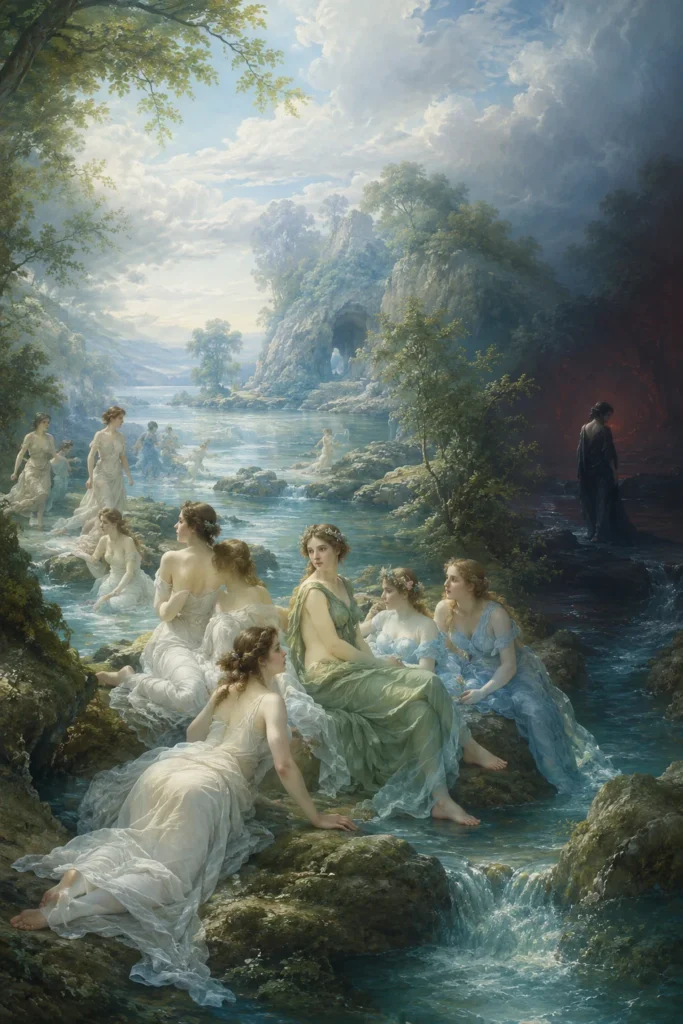
Three thousand nymphs of fresh water and clouds. Between spring and underworld, three thousand daughters of Oceanus are said to move freely.
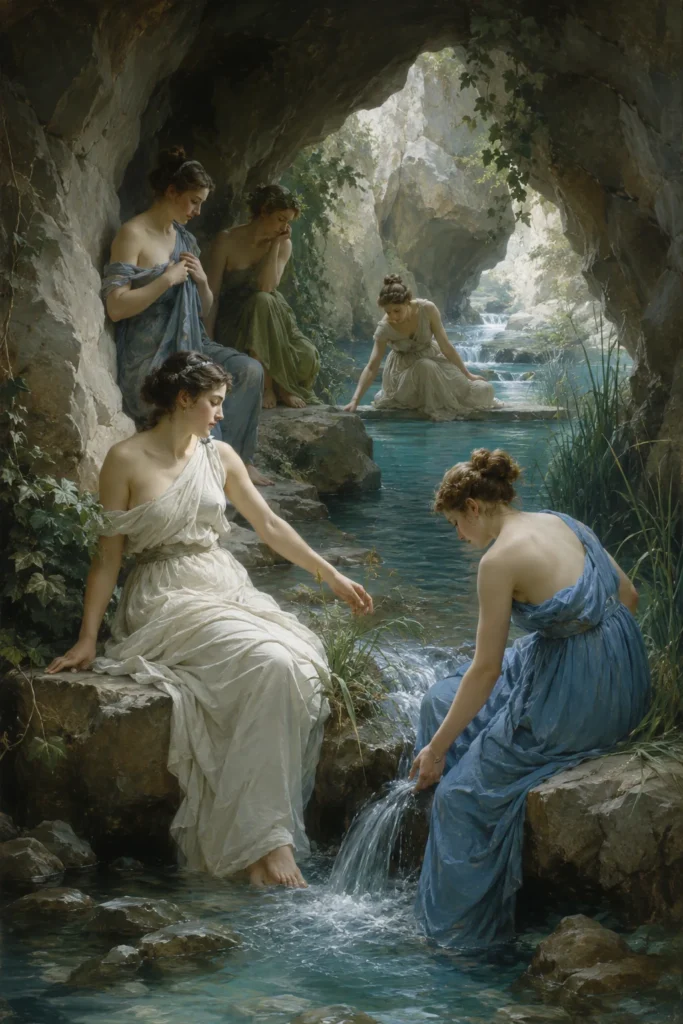
The Oceanids are the three thousand daughters of the Titan Oceanus and Tethys, nymphs of fresh water, springs and clouds. Their number is said to be innumerable; Hesiod names forty-one of them.
Some stand out individually: Styx embodies the river of the underworld and the most sacred oath of the gods, Metis is the mother of Athena. Unlike the Nereids, they are not confined to a single function.
Type: collective of freshwater and spring nymphs
Origin: daughters of Oceanus and Tethys
Texts: Hesiod, Apollodorus, Hyginus
Period: archaic to late antiquity
Appearance: youthful nymphs, mostly as a collective
Textual history
Period of the Texts
From Homer and Hesiod to Apollodorus and Hyginus, usually as a list of names.
Area of Diffusion
Thought of worldwide, wherever springs or clouds require a nymph.
Sources
Collective and list-like: Hesiod and Apollodorus give names.
Name and variants
Greek: the Oceanids are the daughters of Oceanus, the world-encircling primordial stream. The words ocean and oceanid derive from the same name.
Form and Role
Appearance
No uniform image exists: the Oceanids appear as youthful nymphs, some with their own distinct traits, such as Styx.
Effect
As guardians of fresh water, some are regarded as protectors of the young, mostly benevolent. Metis acts as the mother of Athena, Styx as guarantor of unbreakable oaths.
Profile: the Oceanids
The key aspects of the spring nymphs at a glance.
Titanic water layer, older than the Olympian gods.
Fresh water, springs and clouds, along with oath and wisdom.
Youthful nymphs, usually as a chorus or list of names.
Nourishing water; in the case of Styx, the unbreakable oath.
Spring sanctuaries and grottoes, votive offerings alongside Pan and Achelous.
Freshwater collective, distinct from the marine Nereids.
Styx, Metis and the Number of Springs
The most significant of the daughters is Styx: she was the first to side with Zeus in the Titanomachy, and he made her river the most sacred oath of the gods. Metis, the first wife of Zeus, was swallowed by him, after which Athena emerged from his head.
Doris, wife of Nereus, is the mother of the Nereids, evidence of how the collective branches out.
From Ocean to the Underworld Oath
The words ocean and oceanid derive from the name; Styx still lives on in the expression of swearing by the Styx.
In religious studies, the Oceanids are a collective personification of fresh water, part of the titanic water layer, with Oceanus as the origin of all waters.
Spring Cult and Votive Offerings
As spring nymphs, the Oceanids were venerated locally at springs and in caves, together with Pan and Achelous. Styx held a special cultic-oath role, since the gods’ oath by her water was considered unbreakable. Holy water, salt and an amulet are linked to this tradition.
Freshwater Nymphs and Their Relatives
Frequently Asked Questions about the Oceanids
How many Oceanids are there?
Traditionally three thousand, meaning innumerable. Hesiod names forty-one of them.
What distinguishes them from the Nereids?
The Oceanids are daughters of Oceanus for fresh water, while the Nereids are the fifty daughters of Nereus for the sea.
Further links
Further reading:
Literature (selection)
Further standard works in the bibliography.
Oceanids, nymphs of fresh water and clouds, are above all this: the countless daughters of Oceanus, in whom every spring of the Greek imagination gains its own voice.