Silenus, the drunken sage on the donkey
By Ralf Ittermann · last reviewed on
Silenus is a spirit of Greek tradition.
The drunken tutor of Dionysus and captive sage.
Silenus is the old companion and tutor of Dionysus: drunken, potbellied, riding on a donkey, and at the same time bearer of a famous, unfathomable wisdom. When King Midas caught him, he revealed that the best thing for a human being would be never to have been born at all.
In the satyr play, he leads the chorus of satyrs as Papposilenus. From the young, unruly crowd of satyrs, this one Silenus stands out as an individual figure: the elder of the retinue, whose effect lies not in terror but in words.
Type: Old companion and tutor of Dionysus, individual figure from the band of Sileni
Origin: Greece, Phrygia, Macedonia
Texts: Homeric Hymn to Aphrodite, Herodotus, Plato, vase painting
Period: 7th/6th century BC to Late Antiquity
Appearance: old, bald, potbellied man with horse ears, often on a donkey

Source context
Period of the Texts
The Sileni already appear in the Homeric Hymn to Aphrodite; the individual figure of Silenus stands out from the archaic period onward and remains present into Late Antiquity.
Area of Diffusion
Greece, Phrygia and Macedonia: the legend of Midas is attached to real places such as the rose gardens on Mount Bermion and the spring of Midas in Asia Minor.
Sources
Well attested: the Hymn to Aphrodite, Herodotus, Xenophon, Plato and Ovid, along with the Attic vase painting studied by Hedreen.
Name and variants
Greek: silenos, plural silenoi. On Attic vases, the horse-tailed retinue beings of Dionysus are called Silenoi; they are barely distinguishable from the satyrs, and the names alternate. Only the individual figure of the old Silenus, called Papposilenus in the satyr play, is clearly defined.
Description
Appearance
Silenus bears the features of cheerful old age: a bald head, snub nose, round belly and white hair, along with horse ears and often a horse’s tail; during the festive procession he rides swaying on a donkey and must be supported. An ivy wreath and wineskin link him to Dionysus, the aulos to music; the Silenus Marsyas also belongs to this type.
Effect
Silenus acts as tutor and guardian: he raises the young Dionysus and accompanies the god through every festive procession. Captured or bound, he becomes a source of knowledge: Midas draws from him the teaching on the human condition, and in Virgil’s sixth Eclogue the bound Silenus sings an entire song of the world’s origin. He is never threatening; tradition knows no harmful magic performed by Sileni.
Profile: Silenus
The key aspects of the old companion of Dionysus at a glance.
A figure between spirit being, stage role and philosophical symbol: nurse and tutor of the wine god, chorus leader of the satyr play, comparative image for Socrates.
Kings and seekers of wisdom in myth, foremost among them Midas; alongside them the theatre audience of the Dionysia.
An old, bald, potbellied man with horse ears and white hair, swaying on a donkey; ivy wreath, wineskin and aulos as attributes.
Tutor of the young Dionysus and bound seer: prophetic speech and teaching on life, along with the role of the wise fool who speaks truth while drunk.
Not a warding practice but a capturing one: mixing wine into the spring, binding the intoxicated one; whoever honours the captive and brings him back is rewarded.
Midas and the captive sage
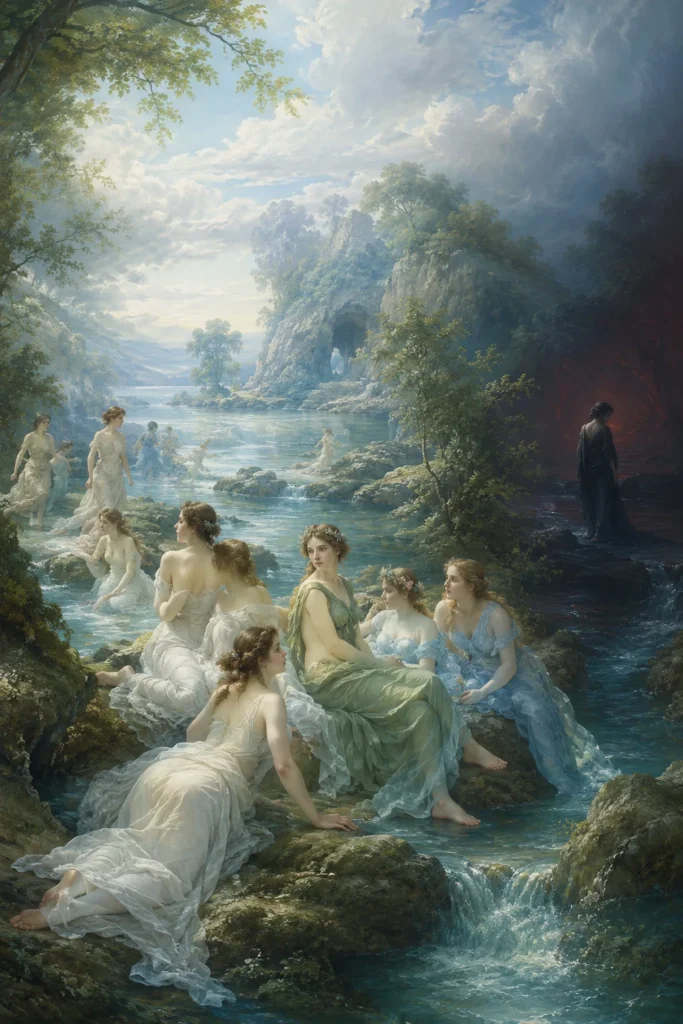
The plurality of Sileni is older than the individual figure: already the Homeric Hymn to Aphrodite names the Silenoi alongside Hermes as lovers of the mountain nymphs, the Oreads, in the grottoes. From this band, the one Silenus stands out from archaic times onward: nurse, tutor and constant companion of the wine god. His best-known story links him to King Midas. Herodotus places the capture in the rose gardens on Mount Bermion in Macedonia; Xenophon knows of the spring of Midas in Asia Minor, into which the king is said to have mixed wine to catch the being.
Ovid tells the continuation: Midas hosts the old man honourably for ten days and brings him back to Dionysus, for which the god grants him a wish, the fateful golden wish. The teaching wrung from the captive is preserved by Aristotle in a fragment handed down by Plutarch: the best thing is not to be born at all, the second best to die soon. In the satyr play, finally, Silenus appears as Papposilenus, the aged father of the satyrs, as in Euripides’ Cyclops.
From the Socrates comparison to Nietzsche
The figure gained lasting fame through Plato: in the Symposium, Alcibiades describes Socrates as one of those carved Silenus figures that can be opened and that hold images of gods within, ugly outside, divine inside. Erasmus and Rabelais took up the image, and painting loved the drunken old man right down to Rubens. Nietzsche placed the wisdom of Silenus at the beginning of The Birth of Tragedy and made it the touchstone of the Greek affirmation of existence; Schopenhauer had earlier read the saying as evidence for his pessimism.
From the perspective of religious studies, Silenus shows how permeable the boundary between spirit being, stage figure and philosophical symbol can be. Guy Hedreen has reconstructed the Sileni of vase painting as their own narrative world alongside drama. The Midas complex points to cultural contact between Greece and Phrygia; the legend is attached to real places. In the history of religion, the bound sage belongs to the type of the being forced to prophesy, a type ranging from the sea-elder Proteus to the captured wild men of Europe. A distinct cult of Silenus remained marginal; he lives on within the cult of Dionysus.
Capture, honour, return
With Silenus, the usual relationship is reversed: it is not the human who protects themselves from the being, but who seeks to capture it in order to gain its wisdom. The recorded capturing practice is precise: mix wine into the spring where the Silenus drinks, then bind him while intoxicated in his sleep; this is reported by Herodotus, Xenophon and Ovid. Equally well attested is the counter-rule: whoever honours, hosts and returns the captive is rewarded, as Midas was by Dionysus. Rudeness towards Dionysian beings, on the other hand, brings the wrath of the god. As household protection, masks with Silenus-like features served at wells and doors, following the same logic as the satyr masks of the vineyards.
Captive sages of other traditions
The motif of the captured being forced to reveal wisdom is old and widespread. Rome told it of Faunus and Picus, whom King Numa catches with wine to obtain knowledge of expiation; see the culture page Rome. Jewish tradition knows of Solomon’s binding of a demon that supplies knowledge for building the Temple; the culture page Judaism offers an introduction. The Wild Man of European legend is likewise captured and gives up counsel.
Frequently asked questions about Silenus
What is the difference between Silenus and Satyr?
In the imagery and language of the classical period, hardly any; Attic vases call the horse-tailed companions of Dionysus Silenoi, while literature often uses Satyrs. Only the individual figure is clearly defined: Silenus is the old, wise tutor of the god, while satyrs appear as a young, unruly band.
What is the wisdom of Silenus?
When Midas asks what is best for a human being, Silenus answers: never to have been born, and, having been born, to die as soon as possible. The saying is preserved through Aristotle as quoted by Plutarch; Nietzsche made it famous.
How did Midas capture Silenus?
The king mixed wine into the spring from which the being used to drink and had it bound while intoxicated and asleep. Because Midas treated the captive with honour and returned him, Dionysus rewarded him with a wish.
Further links
Literature (selection)
Further standard works in the bibliography.
Hardly any being links Greek mythology and philosophy as closely as Silenus: the wisdom that Midas wrung from his captive has occupied European thought from Plato through Schopenhauer to Nietzsche.