The Oreads are spirits of Greek tradition.
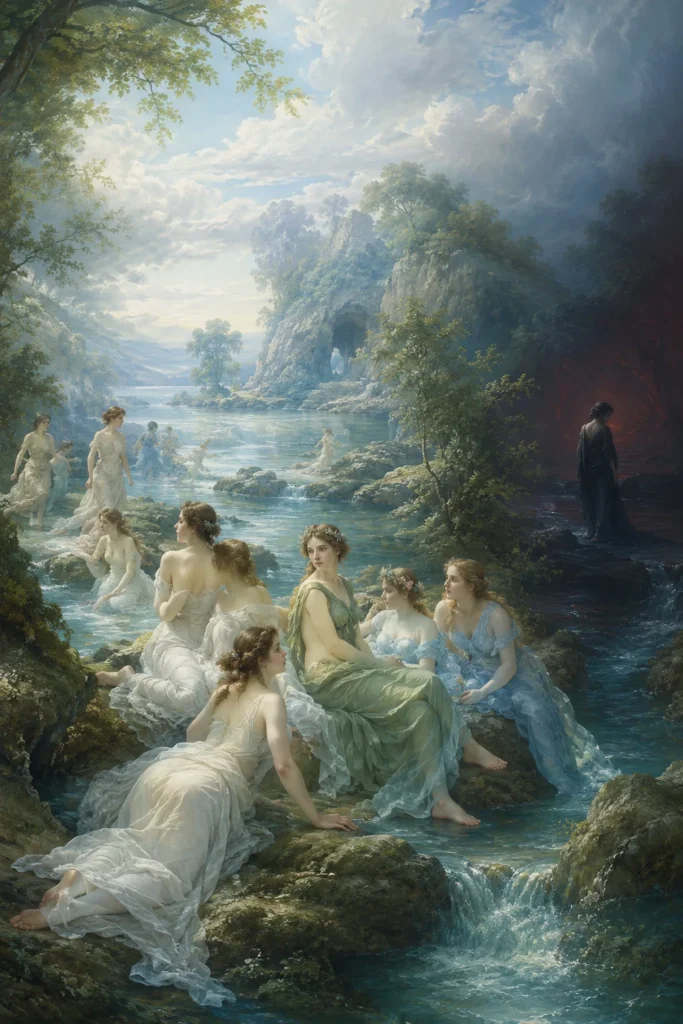
Shy mountain nymphs, companions of Artemis on the hunt. The Oreads were counted among the mountain nymphs revered by the Greeks.
The Oreads are the mountain nymphs of Greek mythology: nymphs of the mountains and grottoes who accompany Artemis on the hunt. Each of them is bound to a specific mountain or grotto; well-known examples are Echo and Kyllene.
Hesiod already names the mountains in the Theogony as the graceful dwellings of the divine nymphs who live in the mountain ravines. As a group, the Oreads appear in Homer, Virgil and later mythography; individual figures are named after their mountain.
Type: Mountain nymphs, a subgroup of the nymphs
Origin: Greek cultural area
Texts: Hesiod’s Theogony, Homer, Virgil, later mythography
Period: Hesiod to late mythography
Appearance: young, beautiful female figures of mountain and grotto
The evidence ranges from Hesiod to late mythography: the Theogony already knows the nymphs of the mountains, and as a group the Oreads appear in Homer and Virgil.
The Greek cultural area; individual Oreads are bound to specific mountains, such as Kyllene to the mountain of the same name in Arcadia.
Well documented: the nymph cult is broadly attested, alongside literary sources from Hesiod to Ovid and the study by Larson.
Greek: From ancient Greek óros, mountain, comes Oreiás, plural Oreiádes, those belonging to the mountain, Latinised as Oreads. They are a subgroup of the nymphs; individual figures are named after their mountain.
Appearance
The Oreads are young, beautiful female figures, half-divine and long-lived, but not necessarily immortal. Each is bound to a specific mountain or grotto.
Effect
As companions of Artemis on the hunt, the Oreads are connected with herds, springs, caves and the wilderness of the mountains. Echo, a mountain nymph in Ovid, and Kyllene, associated with Mount Kyllene in Arcadia, are well-known examples.
The key aspects of the mountain nymphs at a glance.
Subgroup of the Greek nymphs, attested since Hesiod’s Theogony; there the mountains are held to be the graceful dwellings of the divine nymphs.
The wilderness of the mountains with herds, springs and caves, along with accompanying Artemis on the hunt.
Young, beautiful female figures of mountain and grotto, half-divine and long-lived, but not necessarily immortal.
Each Oread belongs to her mountain or grotto; some, like Kyllene, bear the name of their mountain.
Veneration through the general nymph and Artemis cult, with nymphaia, spring and cave sanctuaries, and votive offerings.
Dryads and Hamadryads of the trees, Naiads of the springs; beyond Greece, the Albanian Zana and the South Slavic Vila.
From ancient Greek óros, mountain, comes Oreiás, plural Oreiádes, those belonging to the mountain, Latinised as Oreads. Hesiod already names the mountains in the Theogony as the graceful dwellings of the divine nymphs who live in the mountain ravines; as a group the Oreads appear in Homer, Virgil and later mythography.
Individual Oreads are named after their mountain: Kyllene belongs to Mount Kyllene in Arcadia. The best-known figure of the type is Echo, who appears in Ovid as a mountain nymph. So the group as a whole remains nameless, while individual nymphs gain contour through their mountain or their story.
Oread is the namesake of a fantasy and role-playing game being; in 1914 the poet Hilda Doolittle titled a well-known imagist poem Oread.
From a religious-studies perspective, the Oreads are shy, essentially harmless nature spirits; danger arises only when sacred places are disregarded. Three clarifications: Oread is not a single goddess but a type. Echo is often reduced to a mere personification of the echo, but mythologically she is a mountain nymph. And the Oreads are not to be confused with the male mountain gods, the Ourea.
The nymph cult is well attested: nymphaia, spring and cave sanctuaries, and votive offerings testify to the veneration. A specifically delineated Oread cult is not independently attested as such; veneration ran through the general nymph and Artemis cult. This should honestly be noted. Anyone wishing to approach the mountain nymphs therefore did so wherever all nymphs were at home: at spring, grotto and sanctuary.
The Oreads stand alongside the Dryads and Hamadryads of the trees and the Naiads of the springs. Beyond Greece, they are related to the Albanian Zana and the South Slavic Vila; the Georgian mountain figure Dali also belongs to this neighbourhood of female mountain beings. Their male counterparts are the Ourea, the mountain gods.
What are the Oreads?
The mountain nymphs of Greek mythology, companions of Artemis, bound to mountain and grotto.
Is Oread a single goddess?
No. It is a type, not a single figure; individual Oreads such as Echo or Kyllene bear their own names.
Are the Oreads the same as the Ourea?
No. The Oreads are mountain nymphs, while the Ourea are the male mountain gods of Greek primordial times.
Recommended internal links:
Further standard works in the bibliography.
As Greek mountain nymphs and companions of Artemis, the Oreads stand for the living wilderness of the mountains: not great goddesses, but the quiet inhabitants of mountain and grotto.
Against its influence, cross-cultural tradition names these protective means:
Compare in the Protection Compass →Recommended protective means
The simplest protective means in this collection: 41 layers of fine gold 999, platinum, silver and silicon, manufactured in Ruhla, Thuringia. It requires no activation, is bound to no person, and is effective within a radius of around 50 meters, even without being worn.
Related Beings

The Wiedergänger, the restless dead of Germanic tradition. Origin, physical return, warding off b...

Hiisi, the Finnish mountain and wilderness spirit. Origin from the sacred grove to the demonised ...

Ragnarök is the end-of-the-world myth of Norse tradition: the fall and renewal of the world. A re...

Ngayurnangalku, the man-eating ancestor beings of the Martu beneath the salt lake. Origin, the av...

Ammit, "the Devourer," is one of the most distinctive figures in Egyptian concepts of the afterlife.

The Fänggen, the wild, ambivalent mountain folk of the Alps. Origin, their bond with trees and th...