The Meliai, Ash Nymphs from the Blood of Uranus
By Ralf Ittermann · last reviewed on
The Meliai are spirits of Greek tradition.
Ash nymphs born from the blood of Uranus.
The Meliai are the ash nymphs of Greek mythology. According to Hesiod, they arose from the drops of blood of the emasculated sky god Uranus and thus belong to the oldest layer of beings in Greek myth.
Their name links the tree, in Greek melia, the ash, with a strikingly dark origin: from the same blood arose the Erinyes and the Giants. What distinguishes the Meliai from the oak Dryads is therefore not just the tree, but the lineage.
Type: ash nymphs, spirit beings bound to their tree
Origin: Greece, particularly Boeotia and Crete
Texts: Hesiod’s Theogony and Works and Days, Callimachus, Pindar, scholia
Period: c. 700 BC to late antiquity
Appearance: female figures, bound to ash trees

Traditional context
Period of the Texts
The earliest and authoritative source is Hesiod’s Theogony from around 700 BC; the tradition extends through Pindar and Callimachus into late antiquity.
Area of Diffusion
Greece, particularly Boeotia and Crete: Callimachus names the Dictaean Meliai on Crete, while Thebes knows a single nymph named Melia.
Sources
Well attested: Hesiod, Callimachus, Pindar and the ancient scholia; mythography since Roscher secures the evidence of these passages.
Name and variants
Greek: meliai, plural of melia, the ash tree; in Homer the word also denotes the spear made of ash wood. In Callimachus’ Hymn to Zeus, there is also a play on words with meli, honey, especially since the manna ash exudes a sweet sap.
Form and effect
Appearance
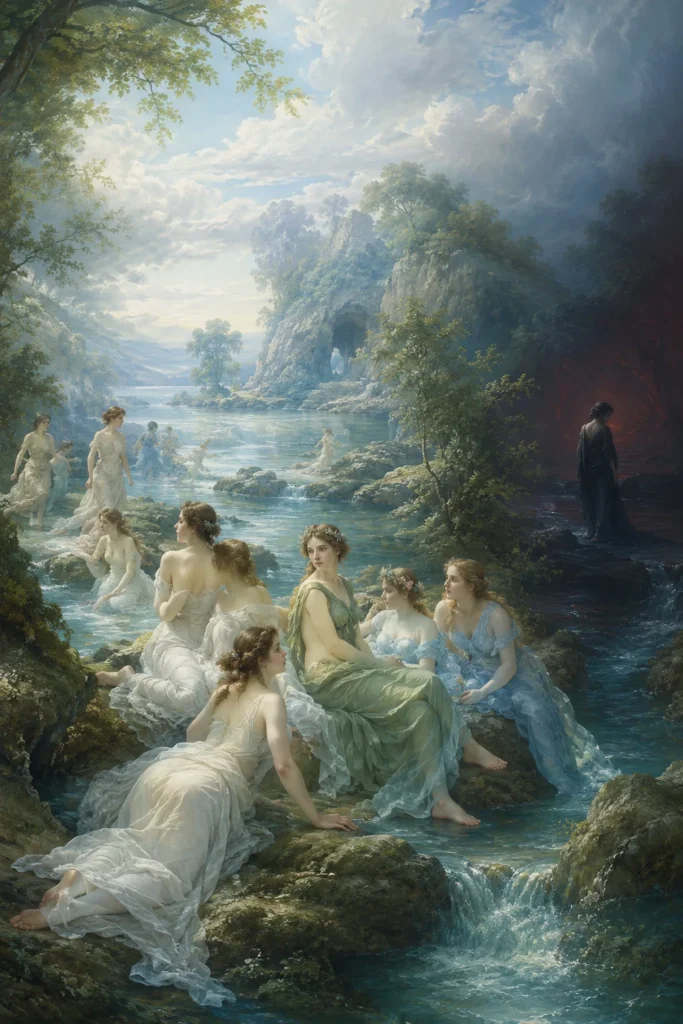
Pictorial depictions that can be securely attributed to the Meliai are rare; the literature describes them as youthful female figures, bound to their tree as the Dryads are to the oak. The idea that a tree nymph’s life begins and ends with her tree was transferred to them.
Effect
The Meliai carry a double nature. On one side stand nourishment and sweetness: honey, the manna ash, the office of nurse to the child Zeus. On the other side stand war and punishment, for their wood supplies spears, their sisters are the Erinyes, their brothers the Giants. They are not an elaborated figure of terror; the warning concerns offences against the tree, which brings down divine punishment.
Profile: Meliai
The key aspects of the ash nymphs at a glance.
The oldest layer of beings in Greek myth: children of an act of violence and sisters of the goddesses of vengeance, arising even before the Olympian gods.
Shepherds, farmers and users of wood; in myth also the child Zeus, whom the Diktaian Meliai on Crete nourish with goat’s milk and honey.
Youthful female figures, bound to ash trees; secure pictorial evidence is rare, the tradition is carried mainly by literature.
Nourishing and protective, nurses of Zeus; at the same time ancestral mothers of the bronze race, which Hesiod has arise from ash trees.
Offerings at nymph sanctuaries: milk, honey, oil and cakes, often explicitly wineless gifts (nephalia), along with votive offerings and dedicatory reliefs.
The Dryads and Hamadryads of the oaks are closest to the Meliai within Greece.
Blood of Uranos, the bronze race and the nurses of Zeus
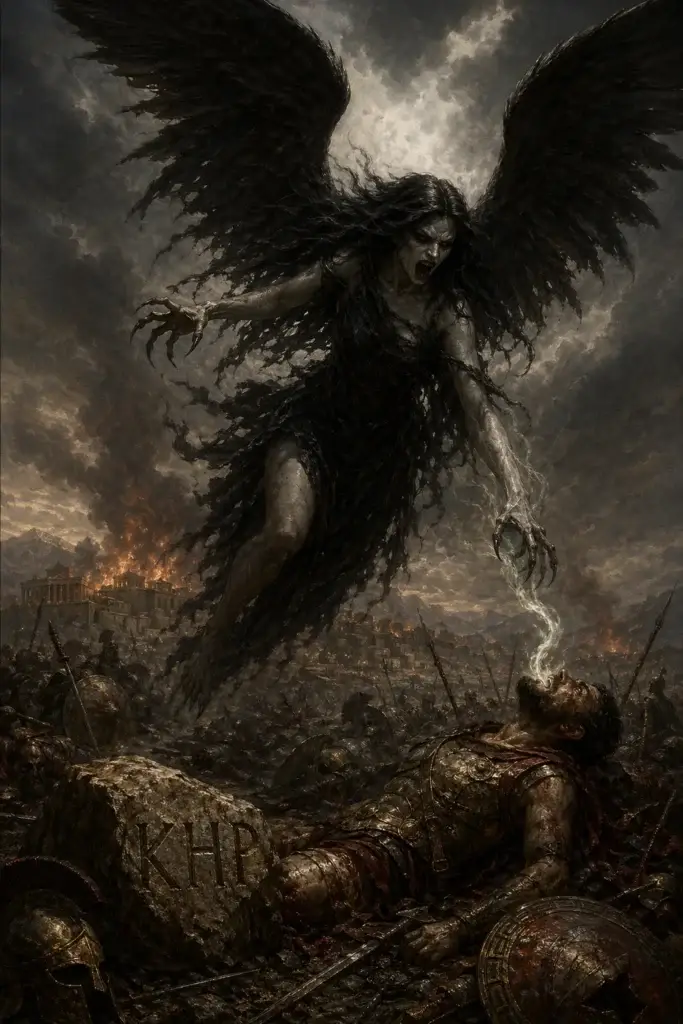
The earliest and most authoritative source is Hesiod’s Theogony: when Kronos emasculates Uranos, drops of blood fall onto the earth goddess Gaia; from them arise the Erinyes, the Giants, and the nymphs called Meliai upon the boundless earth. The ash nymphs are thus no gentle marginal figures, but children of an act of violence and sisters of the goddesses of vengeance. In the Works and Days, Hesiod has the third race of humankind, the bronze race, arise from ash trees; ancient and modern commentators alike relate this to the Meliai. Behind this stands a concrete connection, since ash wood was the preferred material for spear shafts.
In the Hymn to Zeus, Callimachus names the Diktaian Meliai on Crete as nurses of the child Zeus, whom they nourish with the milk of the goat Amaltheia and with honey; here the wordplay with meli, honey, resonates. Thebes also knows a single nymph named Melia, who appears in Pindar as the beloved of Apollo and mother of the seer Teneros. Thus, from the blood of the sky, nurses of Zeus also emerged.
The quiet nymphs of scholarship
The Meliai remained the lesser-known nymphs compared to the Dryads and Naiads. The mythography of the nineteenth century, such as Roscher’s lexicon, secured the record of ancient sources; Wilhelm Mannhardt’s Wald- und Feldkulte made the idea of the tree soul a starting point for comparative folklore studies. In modern fantasy literature and in games, ash nymphs occasionally appear under their ancient name, though usually without the dark origin from the blood of Uranos. In classical studies, the Meliai are still discussed today when it comes to Hesiod’s sequence of human races.
From the perspective of religious studies, the Meliai combine two layers: the widespread type of the tree soul, as described by Mannhardt and later James Frazer, and a genealogical mythology that ties vegetation spirits back to cosmic violence. Jennifer Larson has shown that nymphs in everyday Greek life were not merely a literary ornament but recipients of real cult practice at springs, grottoes and trees. Scholarship interprets the connection between ash, spear and the third human race as an aetiology: the myth explains the martial harshness of an era through its raw material. At no point has any demonisation occurred with the Meliai.
Cult tending rather than warding off
The ancient approach to tree nymphs was one of cult tending, not warding off. Offerings at nymph sanctuaries are well attested; milk, honey, oil and cakes were common, often explicitly wineless gifts (nephalia). In addition there were votive offerings and dedicatory reliefs, as well as the sparing of sacred trees and groves, whose harming was regarded as a punishable offence, as the Erysichthon tale of Callimachus shows. Wool bands and ribbons on sacred trees are likewise attested for Greek tree cult. No amulet or banishing custom specifically directed against the Meliai has been handed down, and by ancient understanding it would have been unnecessary: it was the tree that needed protection from humans, not the human from the tree.
Ash trees, world trees and lords of the forest
Many traditions know tree-bound spirit beings. Within Greece, the Dryads and Hamadryads of the oaks are closest to the Meliai. In Slavic tradition, the Leshy watches as lord of the forest over trees and game and punishes trespasses. Japanese tradition knows tree souls in ancient trunks; an overview is given on the culture page Japan. In Germanic mythology, the world ash Yggdrasil bears the cosmos; see the culture page Germanic.
Frequently asked questions about the Meliai
Where do the Meliai come from?
According to Hesiod’s Theogony, they arose from the drops of blood of the emasculated Uranos, which fell upon the earth goddess Gaia. From the same blood arose the Erinyes and the Giants. The Meliai thus belong to the oldest layer of beings in Greek mythology.
Are the Meliai dangerous?
No tradition of harm has been handed down; in myth they appear as nurses and nourishers. From an ancient perspective, only offences against the tree needed to be taken seriously: whoever felled sacred trees committed a religious transgression and had to expect punishment.
What connects the Meliai with the bronze race of humankind?
Hesiod has the third, bronze race arise from ash trees, which has since antiquity been related to the ash nymphs. Ash wood supplied the spear shafts of Greek warfare; the myth derives the martial character of this race from its ancestral mothers.
Further links
Further reading:
- Greece – all beings of the Greek tradition
- Dryads – the tree nymphs as a collective figure
- Hamadryads – the nymphs bound to a single tree
- Smoke cleansing, Salt, Amulet, Juniper – traditional protective means
- Protection Compass – protective means at a glance
Literature (selection)
Further standard works in the bibliography.
As ash nymphs sprung from the blood of Uranos, the Meliai are the darkest among the tree nymphs of Greece: nymphs of the ash tree, whose lineage reaches back to the Erinyes and whose wood supplied the spears of an entire era.