Keres, Spirit of the Greek Tradition
By Ralf Ittermann · last reviewed on
Keres is a spirit of the Greek tradition.
Demons of the battlefield, death-bringers of Greek mythology.
Keres on Hesiod’s battlefield
The Keres are battlefield demons of Greek mythology who, according to Hesiod (Shield of Heracles 248-257; Theogony 211), descend together with Thanatos and Hypnos from the family of Nyx.
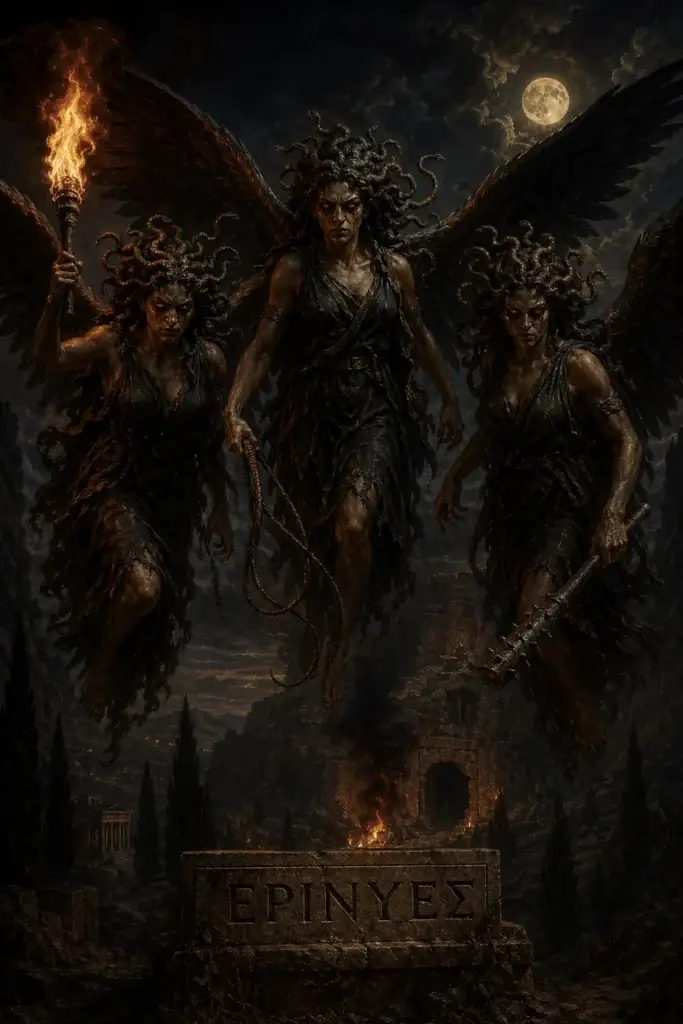
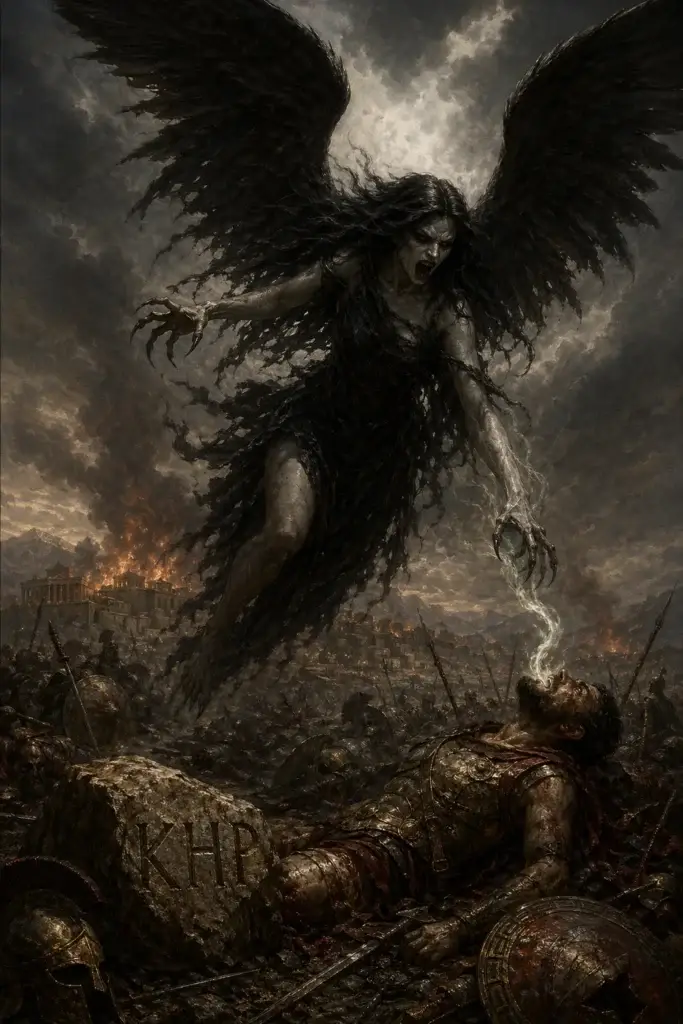
They are black, with long claws and fangs, in blood-soaked garments, hovering over battlefields and tearing the souls out of dying warriors. Unlike the Erinyes, they do not pursue moral or judicial offences, but embody the statistical violence of war.
In the Shield of Heracles they fight over corpses like carrion birds. In the Pandora narrative, Keres escape from the jar opened by Pandora as spirits of disease and ill alongside toils, cares and sicknesses.
Pausanias reports temple images that show Keres as ribbed, starving figures of the night. Related figures: the Moirai (spinners of fate), Eris (strife), Achlys (the mist of death).
The Keres are the death demons of the Greek tradition. They usually appear in a throng, show themselves above battlefields and collect the souls of the dying.
Homer already describes them in the Iliad, and Hesiod fixes their iconography. Unlike individually named figures, the Keres are largely anonymous, a class rather than a single being.
Typically they appear where death occurs suddenly and violently: in war, during plagues, in tragic accidents. They personify violent death itself, and their number and form change accordingly. In the reception of late antiquity they grow closer to the Erinyes; some authors use the terms interchangeably.
Keres in Homeric cosmology
In Homer’s Iliad 18.535 the Keres are described as demonic entities that hover above the battlefields and rob mortals of their lives.
They are not deities with a cult of their own, but instrumental forces, personified tendencies toward death and ruin. Homer names them in the plural as well as in the singular: they act as a swarm, and their presence means immediate mortal danger.
Hesiod’s Works and Days and Theogony classify them as daughters of Night, kin to Ker (the function of death in the singular). In this early epic they still lack a fixed form, more abstraction than apparition. Their function is cosmically necessary: they embody the boundary between life and death.
Short profile: Keres
Type: death demons, gatherers of souls
Origin: Nyx (Night), Hesiod; or from the primordial age of creation
Texts: Homer, Hesiod, vase painting
Period: Archaic period to late antiquity
Distribution: the Greek cultural sphere
Defence: burial rites; no specific apotropaic magic, since the Keres appear where death is already present
Context
First mentioned in Homer (Iliad). Hesiod (Theogony, Shield of Heracles) develops their iconography. The tragedians use them as vivid metaphors for death. In the late Classical and Hellenistic periods they grow closer to the Erinyes in literature.
The Greek heartland. No independent history of migration; the motif remains bound to the Homeric and Hesiodic tradition, yet continues to work as a motif into Roman and Byzantine literature.
Epic and tragic literature; descriptions on Hesiod’s “Shield of Heracles”; iconographically in vase painting. Unlike Lamia or Empusa, a folk-magical culture of amulets against them is lacking.
Name and variants
Greek: Κήρ (Ker, singular), Κῆρες (Keres, plural).
Etymology: connected with terms for “ruin” and “blow of fate”.
In antiquity the number fluctuates. In Hesiod they are countless and malleable; the tragedians also use “Ker” metaphorically for death itself. There is no single individual with a name and a biography; the Keres remain an anonymous class.
Description
Appearance
Winged women in dark garments, with long fangs and bloodstained claws. Hesiod describes their teeth as white and their eyes as glittering. They appear in a throng, often circling over battlefields.
Behaviour
They collect the souls of the dying, drink their blood and quarrel over corpses. Unlike Thanatos, who brings a peaceful death, the Keres are figures of violent, bloody, chaotic dying.
Sphere of activity
Battlefields, places of pestilence, catastrophes. They act where people die in great numbers and by violence. In times of peace they are largely absent.
Mythological origin
In Hesiod they are daughters of Nyx, sisters of the Moirai and of Thanatos. Some traditions make them offspring of Chaos. In either case they belong to the archaic, nocturnal layer of creation.
Keres and concepts of corruption in Hellenistic theology
Hellenistic theology, especially in the Orphic and Neoplatonic tradition, distinguished between high deities and lower demonic powers, among which the Keres ranked as demons of death.
They were no longer understood as mere Homeric attributes of battle, but as a genuine ontological class: beings that mediated between gods and humans, with specialised functions in the metabolism of life and death. From this perspective the Keres became examples of the demiurgic division of the world: each force had its cosmological niche.
Profile: Keres
The most important aspects of the Keres at a glance. You will find the detailed treatment of name, description, defence and parallels in the following sections.
Daughters of Nyx, the Night. Sisters of the Moirai and of Thanatos, belonging to the nocturnal, archaic layer of creation.
Soldiers, those stricken by plague, victims of accident and catastrophe. They appear where death is violent and sudden.
Winged women, dark garments, long fangs, bloody claws. In a throng, often circling over battlefields.
They collect souls, drink blood and tear at corpses. They bring about violent death.
No specific apotropaic magic; the Keres are part of death itself. Protection lies only in avoiding the battlefield, the place of pestilence, the violent situation.
Erinyes (a fluid transition), Valkyries (Germanic), Gallû (Mesopotamian), Tzitzimime (Aztec), motifs of the Grim Reaper.
Demonology in everyday life
Rituals of defence
Individual Keres are not addressed or warded off; they belong to death, which is not negotiable. What matters ritually is correct burial and the lament for the dead, which regulate what the Keres do not: the dignity of the farewell.
Invocations
No specific invocations against Keres. In magical papyri and curse tablets, “Keres” can occur as a term for the misfortune of a curse formula, but not as individual addressees.
Amulets and protective symbols
General defence against death through apotropaia (the Gorgoneion, the phallus, the evil eye). Specific Keres amulets are absent. Protection lies rather in avoiding the situations in which Keres appear.
Keres, parallels in other cultures
Rome: the Dirae or Furiae take over the avenging aspect, while the Keres as pure figures of death are less present in the Roman pantheon. Instead, Mors (Death) takes over the function as a single figure.
Germanic tradition: the Valkyries collect the fallen from the battlefield. Structurally close, within a different theological framework.
Mesopotamia and beyond: the Gallû, executors of the underworld, are functionally related, even if within an entirely different mythical framework. In numerous cultures one finds messengers of death who appear in a throng and collect souls.
Keres in magical papyri and magical practice
In the Hellenistic magical papyri (PGM) the Keres are rarely invoked directly, yet the concept of demons of death and corruption runs through magical curse texts. Papyri containing curses of tearing apart, drying out or paralysis often invoke anonymous chthonic powers whose function corresponds to that of the Keres: separation, destruction, the theft of vitality.
The papyri show that magicians of late antiquity possessed a differentiated theory of lower powers; not all were evil, but all were specialised. The Keres belonged to the class of necessary forces that needed no morality, because their commission derived from the cosmic architecture.
A magician who wished to make someone ill or weak invoked such powers not as enemies but as technical tools, whose use presupposed ethical justification.
The Keres in Homer: death on the battlefield
The oldest and densest evidence for the Keres comes from the Homeric epics, above all from the Iliad. There the Keres are not abstract personifications, but closely bound up with the experience of violent death in war.
The Greek word kēr first denotes the lot of death allotted to a person, the ruin that reaches him. In the plural the Keres then appear as ghostly figures who bring about or embody this death.
A famous passage is the weighing of the lots of death: in the twenty-second book of the Iliad, Zeus places the Keres of Achilles and of Hector in his scales, and the heavier lot sinks toward the underworld, by which Hector’s death is decided.
Here the Ker is almost synonymous with the personal fate of the hero. Elsewhere, in the eighteenth book, a gruesome Ker appears in the turmoil of battle on the shield of Achilles, in a bloodstained garment, dragging the fallen and the wounded out of the fight by their feet.
From these passages a twofold image emerges. On the one hand the Ker is the individual destiny of death, fixed already at birth; Achilles speaks of the two Keres between which he can choose, a short and glorious life or a long and inglorious one.
On the other hand the Keres are acting, bloodthirsty beings that roam the battlefield. Scholarship has long debated whether two different conceptions are present here or whether these are aspects of a single one.
Much suggests that the Greeks could experience death both as an allotted measure and as an attacking power, without seeing a contradiction in this.
Keres, Moirai and Thanatos: distinguishing related powers of death
In Greek thought the Keres stand beside several other powers concerned with death and fate, and their exact distinction was not always clear even to ancient authors. Most important is the distinction from the Moirai, the three spinners of fate.
While the Moirai, in Hesiod and in the later tradition, allot, measure and cut off the span of life, and thus embody the ordering side of fate, the Keres stand more for the concrete, often violent and calamitous event of death.
In the Theogony, Hesiod brings both into the proximity of Nyx, the Night, who bears them without a father; in his enumeration the Keres, the Moirai, Thanatos, Hypnos and further gloomy figures appear as siblings.
This genealogy assigns the Keres to the nocturnal, uncanny side of the cosmos. They differ from Thanatos, the calm personification of death itself, by their active, predatory character. Thanatos collects, the Keres tear.
In the Aspis, the shield poem transmitted under Hesiod’s name, there is a particularly drastic depiction: there the Keres are described as dark and baring white teeth, quarrelling over the fallen, sinking their claws into their bodies and drinking the dark blood.
This vampire-like portrayal is among the most detailed of antiquity. Scholarship has pointed out that the Keres thereby come closest to what was imagined as blood-drinking battlefield demons, and that precisely in this they set themselves apart from the more nobly conceived Moirai.
The Athenian festival of the Anthesteria and the expulsion of the Keres
Beyond epic poetry, the Keres are connected with the Athenian festival calendar, namely with the Anthesteria, a spring festival in honour of Dionysus in the month Anthesterion. The three-day festival had a markedly ambivalent character.
It celebrated the new wine, yet at the same time was regarded as a time in which the dead and uncanny spirits walked about the city. The last day, the Chytroi, was dedicated to the deceased and to chthonic powers.
From the ancient tradition, above all from later lexicographers and scholia, the phrase is known: “Out, you Keres, the Anthesteria are over”. It was apparently spoken at the end of the festival in order to drive the spirits admitted or tolerated during the festive period back out of the houses and the city.
Some sources read “Kares”, that is, Carians, instead of “Keres”, which has led to differing interpretations. Scholarship in the history of religion, for example in the classic works of Erwin Rohde and Jane Harrison, has discussed the passage intensively.
If the reading “Keres” is correct, an important finding emerges: the Keres were not merely literary figures of epic, but part of lived ritual practice. During the Anthesteria the doorposts were smeared with pitch and certain customs were observed that framed the uncanny festive period.
The Keres appear here as an open class of spirits of the dead and powers of misfortune, tolerated for a limited time and then ritually expelled.
The Keres thereby belong to the broad Greek circle of ideas about spirits that enter the human world at threshold times of the year and must be banished again through a fixed ritual.
Broadening of the term: Keres as demons of disease and misfortune
In post-Homeric literature the concept of the Ker broadens beyond death on the battlefield. In Hesiod and in later texts, kēr can denote any form of ruin: disease, old age, hunger, madness, every ill that befalls a person. The Keres thereby become a collective category for everything that shortens, damages and ends life.
This extension of meaning shows itself particularly clearly in the Pandora narrative. From the opened vessel that Pandora brings with her in Hesiod, the ills pour out over humanity; in ancient interpretation these plagues were frequently equated with the Keres or brought into their vicinity.
In pictorial art, too, winged figures associated with disease and death appear that are connected with the Keres, even if the iconographic attribution often remains uncertain, because Keres, Erinyes, Harpies and Sirens overlap in their depiction.
This conceptual openness is central to understanding the Keres. They were never a clearly delimited pantheon with fixed names and functions, as the twelve Olympian gods were.
Scholarship describes the Keres rather as a category of ideas: the personified multitude of kinds of death and ills of life. It was precisely this indeterminacy that made them useful to Greek poets and thinkers.
Wherever it was a matter of grasping misfortune as an acting power, without granting it the full rank of a named deity, one could speak of a Ker or of the Keres.
They thus stand at the boundary between personification, the concept of fate and demonology, and it is precisely at this boundary that their interest for the history of religion lies.
Afterlife of the Keres in the tradition of late antiquity and modern Greece
The question of whether and how the Keres lived on after the end of ancient religion has been much discussed in folklore research. A frequently cited line connects the ancient Keres with the modern Greek Charos or Charontas and with further figures of death in Greek folk tradition.
Indeed, the name of the ancient ferryman Charon has, in modern Greek folk belief, turned into an active, often mounted figure of death who comes for people.
Researchers of the 19th and early 20th centuries, among them Bernhard Schmidt in his work on the folk life of the modern Greeks, have attempted to see in such figures a continued effect of the ancient demons of death. Today’s scholarship is more cautious here.
It emphasises that no unbroken line between the ancient Keres and modern Greek conceptions of death can be demonstrated, and that Christian, Byzantine and folk-cultural layers lie in between. A direct identity of the ancient Ker and the modern Greek Charos cannot be proven.
What can be said responsibly, by contrast, is this: over the centuries Greek culture has retained an inclination to conceive of death as an acting, often threatening figure rather than merely as a condition.
The Ker stands at the beginning of this long line. In modern reception, in lexica of mythology, in fantasy literature and in computer games, the Keres have reappeared, mostly as winged spirits of death or as generic battlefield demons.
These depictions take up above all the drastic portrayal of the Aspis and largely leave out the more difficult aspects, the concept of fate and the ritual embedding. For the study of religion it remains essential to distinguish the popular simplification from the many-layered ancient tradition.
Sources and literature
Further standard works in the literature index.
The protective practice described here is a religious-studies classification of historical traditions. iWell Guard ties in with this cultural-historical line of wearable protective objects and represents a contemporary form of it. More about the iWell Guard →