Satyrs, the wild retinue of Dionysus
By Ralf Ittermann · last reviewed on
The satyr is a spirit of Greek tradition.
A wild, drink-loving herd being in the train of the wine god.
Satyrs are the wild, animal-like nature spirits in the retinue of Dionysus: fond of drink, musical, forward and averse to work. On archaic vases they bear a horse’s tail and horse’s ears; only later do they grow goat’s legs.
From their chorus Athens developed a theatrical genre of its own, the satyr play. Unlike the old, wise Silenus, satyrs appear as a young, unruly troop, and unlike the god Pan, they themselves received no cult.
Type: Wild nature spirits in the retinue of Dionysus
Origin: the whole Greek world, centred on Attica
Texts: Hesiod fragment in Strabo, vase painting, satyr plays
Period: 7th/6th century BC to late antiquity
Appearance: hybrid beings with horse’s tail and horse’s ears, later with goat features
Historical Background
Period of the Texts
The oldest literary mention appears in a fragment of the Catalogue of Women attributed to Hesiod; the tradition spans from the 7th/6th century BC to late antiquity.
Area of Diffusion
The whole Greek world, centred on Attica, where the Dionysia gave the satyr chorus a fixed stage.
Sources
Very well attested: the Hesiod fragment in Strabo, Attic vase painting and the satyr plays; fully preserved is Euripides’ Cyclops.
Name and variants
Greek: satyros, plural satyroi. The Hesiod fragment in Strabo names the satyrs as a sibling group of the mountain nymphs and the Curetes, useless and fit for no work. Terminologically, Satyroi and Silenoi are largely interchangeable; the names vary depending on the source.
Appearance
Appearance
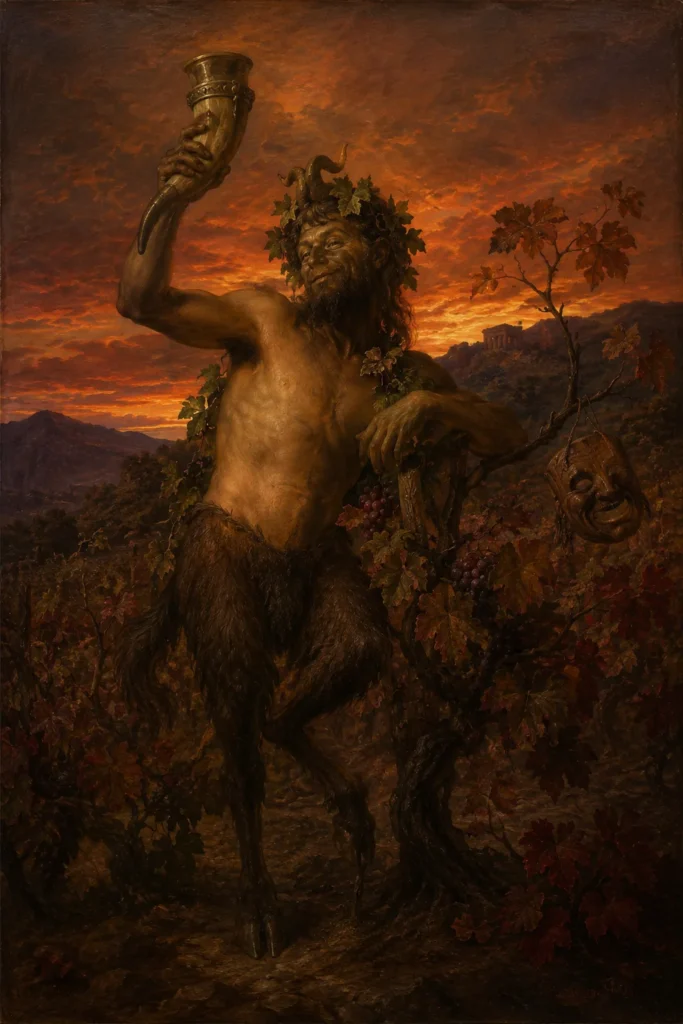
The archaic and classical satyr is horse-like: a human body with a horse’s tail and horse’s ears, a snub nose, usually depicted ithyphallic. The assimilation to the goat-shaped Pan and the Roman fauns only takes hold in Hellenistic and Roman times. Attributes are the wineskin, drinking horn, thyrsus staff, aulos and ivy wreath; in the theatre the chorus members wore masks and an apron with an attached tail.
Effect
Satyrs accompany Dionysus at the grape harvest, the wine press and the procession, embodying the reversal of the civic ideal: excessive instead of restrained, driven by instinct instead of civilised. Towards nymphs and maenads they are notoriously forward; for humans they were taken seriously above all in encounters in the wilderness, as the tale of the satyr island in Pausanias attests.
Profile: Satyr
The key aspects of the wild nature spirit at a glance.
Companion beings of the cult of Dionysus: in the festive procession (thiasos), satyrs travel with maenads, tread the wine press, play the aulos and dance the boisterous sikinnis.
Vintners and theatre audiences; in myth, women encountered alone, as well as nymphs and maenads whom they harass.
Human body with a horse’s tail and horse’s ears, snub nose; attributes are the wineskin, drinking horn, thyrsus staff, aulos and ivy wreath.
Festivals of Dionysus, the grape harvest and encounters in the wilderness: wherever satyrs appear, the rules of festivity and the world turned upside down apply.
Oscilla, small masks hung in the vineyards, served as protective and blessing images; in myth, invoking the gods offers help, as with the spring nymph Amymone.
From the Hesiod Fragment to the Satyr Play
The oldest literary mention appears in a fragment of the Catalogue of Women attributed to Hesiod, quoted by Strabo: there the satyrs appear as a sibling group of the mountain nymphs and the Curetes, useless and fit for no work. Their great stage is the cult of Dionysus: in vase painting, satyrs travel with maenads in the festive procession of the wine god. Athens turned these choruses into an institution: at the Dionysia, a satyr play followed the tragedies of a poet, its chorus made up of satyrs led by the old Papposilenus. Pratinas of Phlius was regarded as the founder of the genre; fully preserved is only Euripides’ Cyclops, along with large portions of Sophocles’ Ichneutai.
That satyrs were not taken merely as stage figures is shown by Pausanias: he recounts the report of the seafarer Euphemus, whose ship was driven to islands whose wild, red-haired and tailed inhabitants, called Satyroi, fell upon a woman left behind. Rome equated satyrs with its own fauns.
From the Satyr Chorus to Nietzsche
The Renaissance and the Baroque made satyrs and fauns a fixture of mythological painting, from Titian to Rubens. Friedrich Nietzsche, in The Birth of Tragedy (1872), declared the satyr chorus the origin of Attic tragedy and the satyr an emblem of the Dionysian. Medicine borrowed the term satyriasis from the being as early as antiquity; in modern fantasy, satyrs live on as friendly forest beings, clearly softened compared with the ancient tradition.
In religious studies, satyrs are not recipients of a cult but beings of imagination: figures through which Greek culture made intoxication and transgression representable. Guy Hedreen has analysed the silen and satyr images on Attic vases as an independent pictorial narrative, while François Lissarrague has described their function as a playful anthropology of the city. Terminologically, Satyroi and Silenoi are largely interchangeable; the goat image is secondary. In the history of religion, satyrs represent the rare case of a being situated between myth, the ritual of the Dionysia and popular belief in real encounters in the wilderness.
Oscilla: Frightening Faces in the Vineyard
Well attested by sources is the custom of the oscilla: small masks and swinging faces, often bearing Bacchic and satyric features, hung on trees in vineyards; in the Georgics, Virgil describes how vintners hang them so that blessing falls on the vines and the hills. The frightening face here acts as a protective and blessing image, following the same logic as the Gorgoneion on gates and shields. Masks with satyr and silen features also served as stone guardians at wells, doors and tomb structures. Against forward satyrs themselves, myth offers the invocation of the gods as help, as with the spring nymph Amymone, who calls on Poseidon for aid against a satyr. No distinct banishing rite has been recorded.
Wild Men and Lords of the Forest Compared
Wild, instinct-driven forest beings in male form are widespread. Rome knew, alongside the equated Fauns, the field god Faunus himself; an overview is given on the culture page Rome. The Wild Man of Central European tradition, hairy and living outside the order, carries the type forward. The Slavic Leshy shares the connection to the wilderness and the crossing of boundaries.
Frequently Asked Questions about the Satyr
What is the difference between a satyr and a faun?
The satyr is Greek and originally horse-like, the faun is Roman and goat-shaped, associated with the god Faunus. Since Hellenistic times the two images have merged, so that today the goat-legged hybrid type is usually meant.
Did satyrs have their own cult?
No temples or regular offerings for satyrs have come down to us; it was Dionysus, in whose retinue they appear, who was worshipped. Nevertheless, they were present everywhere: in the theatre, on drinking vessels, as masks in vineyards and on buildings.
Are satyrs dangerous?
According to tradition, they are above all forward: they harass nymphs, maenads and, in Pausanias’ account, also a woman from a ship. Antiquity does not attribute deadly attacks or possession to them.
Further links
Further reading:
- Greece – all beings of the Greek tradition
- Silenus – the old sage of Dionysus’ retinue
- Pan – the goat-shaped shepherd god
- Faun and Faunus – the Roman counterparts
- Amulet, Talisman, Threshold protection, Protective circle – traditional protective means
Literature (selection)
Further standard works in the bibliography.
Thus the satyrs connect Greek mythology, theatre and folk belief: from the satyr play of the Dionysia to the protective mask in the vineyard, the wild retinue of the wine god remained a constant presence throughout the ancient world.