Faun, goat-legged local spirit of the wild woodland
By Ralf Ittermann · last reviewed on
The Faun is a spirit of the Roman tradition.
Goat-legged forest spirit, followed by panic terror. As a local spirit of the wild woodland, the Faun embodies sudden terror and rural fertility.
Fauns are the goat-legged forest, pasture and field spirits of Rome, the Latin counterpart to the Greek satyrs. As local spirits of the untamed woodland, they are linked to fertility, wilderness and the sudden, panic terror of solitude.
They arose as the plural multiplication of the one god Faunus, analogous to the small Pans in the retinue of the Greek Pan. The Faun in the singular is thus the individual forest spirit of this class, not the god himself.
Type: Goat-legged forest, pasture and field spirits, local spirits of the wilderness
Origin: Latium and Roman Italy
Texts: Roman literature from the 3rd and 2nd centuries BC, Virgil, Ovid
Period: Antiquity
Appearance: hybrid being, half man, half goat, with horns and a tail
Origin and sources
Period of the Texts
Well attested in Roman literature from the 3rd and 2nd centuries BC; classical poetry from Virgil to Ovid preserves the figure.
Area of Diffusion
Latium and Roman Italy; as a pictorial motif the Faun spread throughout the empire.
Sources
Good: Roman poetry, above all Virgil and Ovid, together with a rich pictorial tradition.
Name and variants
Latin: Fauni, the plural multiplication of the one god Faunus, formed analogously to the small Pans in the retinue of the Greek Pan. The name of the class of spirits thus derives directly from the god from whom it takes its origin.
Appearance and behaviour
Appearance
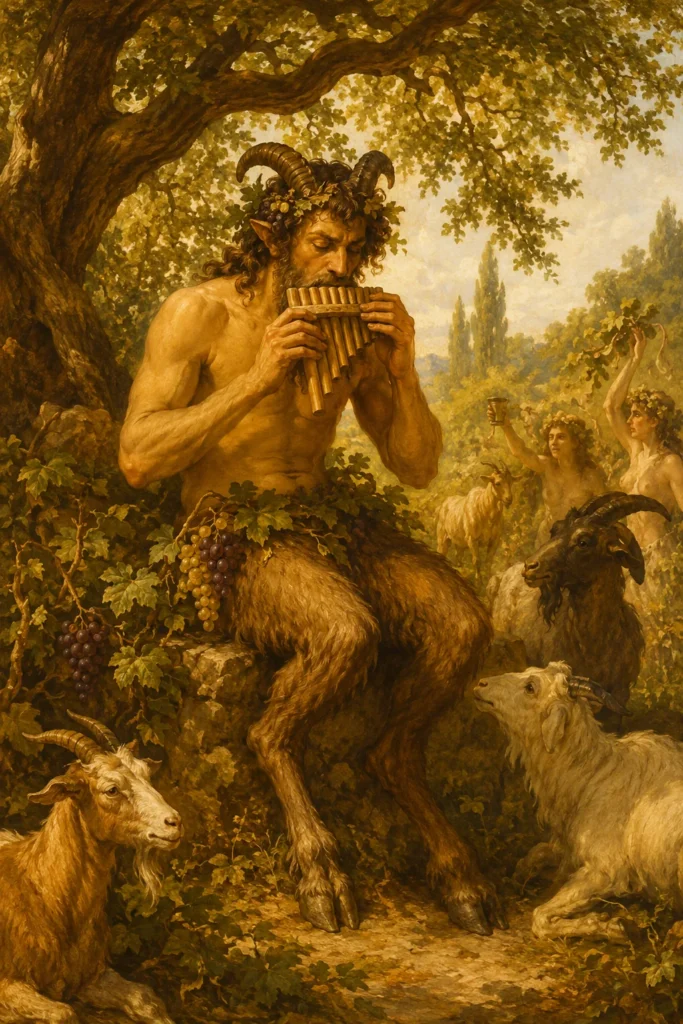
Fauns were depicted with horns and the hairy legs of a goat as well as the torso of a man, in classical iconography often shown with a pan flute, grapes or a shepherd’s staff. It is important to distinguish: the Roman faun has goat legs and represents fertility, while the Greek satyr often has horse or donkey ears and represents excess more strongly; the merging of the two is a later assimilation.
Effect
As local spirits, fauns inhabit groves, clearings and remote stretches of woodland. Symbolically, they represent fertility, a bond with nature and the ambivalent, wild power of untouched landscape. They are credited with the sudden fright that overcomes travellers in the wilderness, the Latin motif of panic terror, adopted from the Greek Pan.
Profile: Faun
The key aspects of the Roman woodland spirits at a glance.
Local spirits of Rome’s untamed woodland, the plural form of the god Faunus; educated, Hellenising Romans associated them with the Greek satyrs.
Shepherds, farmers and travellers in the forest and wilderness who encounter fauns in groves, clearings and remote stretches of woodland.
Hybrid beings, half man, half goat, with horns and a tail; in classical iconography often shown with a pan flute, grapes or a shepherd’s staff.
Fertility and wilderness, along with the sudden, panicked fright that overcomes travellers in the solitude of the forest.
No independent state cult: veneration took place through Faunus, with the festivals of Faunalia and Lupercalia; in rural practice, rustic offerings and dances were part of it.
From the god Faunus to the host of fauns
The fauns are the plural multiplication of the single god Faunus, analogous to the small Panes in the retinue of the Greek Pan. They are regarded as local spirits of uncultivated woodland, inhabitants of that landscape which the Roman farmer had not brought under the plough.
Educated, Hellenising Romans associated their fauns with the Greek satyrs, the wild followers of Dionysus, although both figures were originally of different origin. The equation of faun and satyr common today is thus the result of a literary assimilation, not the shared starting point of both traditions.
Reception and distinction
Faun and satyr remain established motifs in art, literature and fantasy to this day, prominently in Guillermo del Toro’s 2006 film Pan’s Labyrinth and in C. S. Lewis’ Narnia as the friendly faun Mr Tumnus.
In religious studies, the faun is a nature spirit and genius loci of the forest, a collective plural form of a forest deity. Two clarifications are important: faun and satyr are not the same, they were assimilated at a later stage and differ in origin, appearance and meaning. And the faun as a class of spirit is to be distinguished from the god Faunus, from whom it is merely derived.
Appeasing the woodland spirits
Fauns had no independent state cult; veneration took place through the god Faunus, with the festivals of Faunalia and Lupercalia. In rural practice, rustic offerings and dances were part of appeasing the woodland spirits. Against the panic terror of forest solitude, the sound of bells was considered a protective sign, and a worn protective symbol accompanied dealings with the spirits of the wilderness.
Faun, satyr, Pan: the relationship
Frequently asked questions about the faun
Are faun and satyr the same?
No. They were assimilated at a later stage, but differ in origin, appearance and meaning: the faun is Roman and represents fertility, the satyr is Greek and represents excess more strongly.
Do fauns have goat legs or horse legs?
Goat legs and horns. Horse or donkey features belong more to the Greek satyr.
What is feared?
The panic terror that overcomes travellers in the solitude of the forest; it was attributed to fauns as local spirits of the wilderness.
Further links
Further reading:
- Rome – all beings of the Roman cultural sphere
- Faunus – the god from whom the fauns derive
- Satyr, Pan – the Greek counterparts
- Amulet, Bells, Smoke Cleansing – traditional protective means
- Protection Compass – protective means at a glance
Literature (selection)
Further standard works in the bibliography.
As Roman woodland spirits, fauns represent the wild side of Latium: goat legged nature spirits who grant fertility while also striking travellers with the panic terror of solitude.