Witch-vampire of the Roman night, a blood-sucking night bird and early form of later vampire and witch figures.
Striga (Latin strix, plural striges) is one of the most consequential motifs of Roman demonology. Originally understood as a nocturnal bird of prey, a demonic owl or a bird-like hybrid being that attacks newborns and pregnant women. It sucks blood, swaps infants for straw, and enters houses through windows and keyholes.
At the same time, the Striga merged early on with the notion of the witch: a woman who turns into a bird at night.
This double nature, animal and woman, runs through all of antiquity, becomes in the Middle Ages the foundation of the notion of the witch and the origin of the vampire motif. The Slavic word strzyga and the Romanian strigoi go back directly to the Latin strix.
Type: Nocturnal bird demon, later also a witch
Origin: Roman folk belief, probably going back to Greek precursors (Strix)
Texts: Ovid (Fasti VI), Petronius, Apuleius, Pliny
Period: Republic to late antiquity, with medieval and early modern reception
Distribution: Italy, the Empire, Slavic and Balkan folk traditions
Warding off: Hawthorn, the bulla amulet, rituals at the threshold, trails of salt
First attested in the Republic, described in detail by Ovid (Fasti VI) for the year 6 AD. Pliny, Petronius and Apuleius develop the figure further. In the Middle Ages, the notion of the witch and the vampire grew out of this, and in the Slavic region the strzyga or strigoi.
Mythological classification
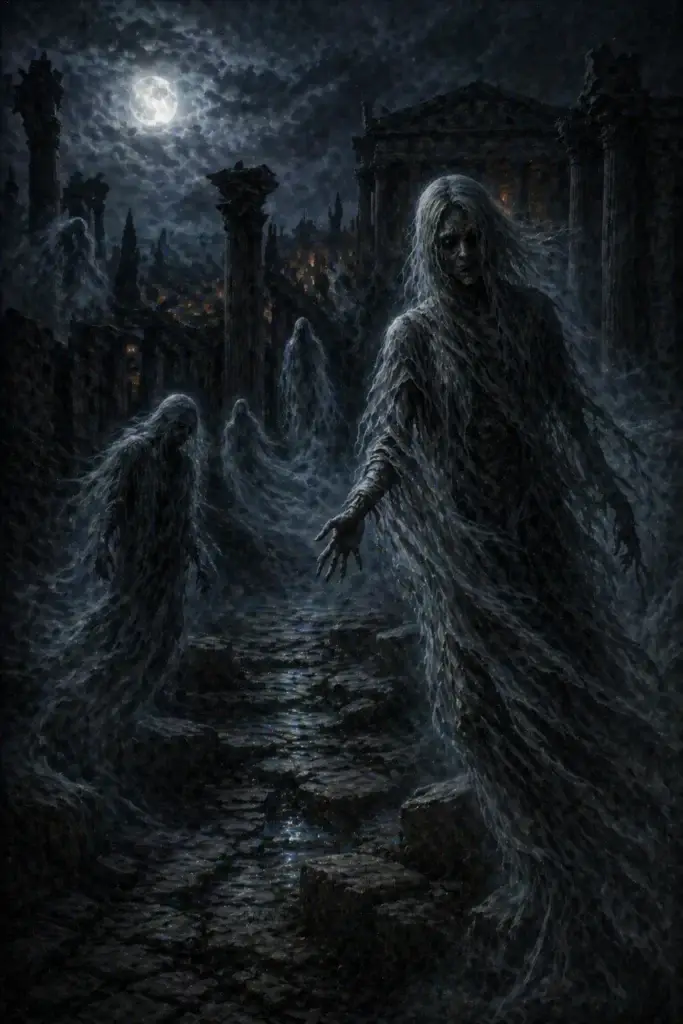
In Roman and later European tradition, the Striga is a night demon or witch who drinks blood and digs up corpses. In Eastern European traditions she is the origin of the vampire myth. Strigae are shape-shifters who roam at night. They are not necessarily dead, but rather damned.
The Italic cultural sphere as the origin; anchored in all the provinces through the Empire. In the Middle Ages and the early modern period, a strong presence in the Slavic region, the Balkans and Romania. The Strigoi tradition continues to influence modern vampire literature.
In literature: Ovid, Pliny (Naturalis Historia), Petronius, Apuleius, patristic authors. Densely attested in folklore within Slavic and Balkan traditions. Frequent in medieval witch-trial documents.
Latin: strix (singular), striges (plural), later striga.
Slavic: strzyga (Polish), strigoi (Romanian).
Greek: στρίγξ (strinx), a night bird.
The name originally refers to a nocturnal bird, presumably an eared owl or a similar species of owl. By folk etymology the screeching (“stridere”) was interpreted as the source. From the animal name arose the myth, and from the myth the medieval witch, in Italy the strega.
Appearance
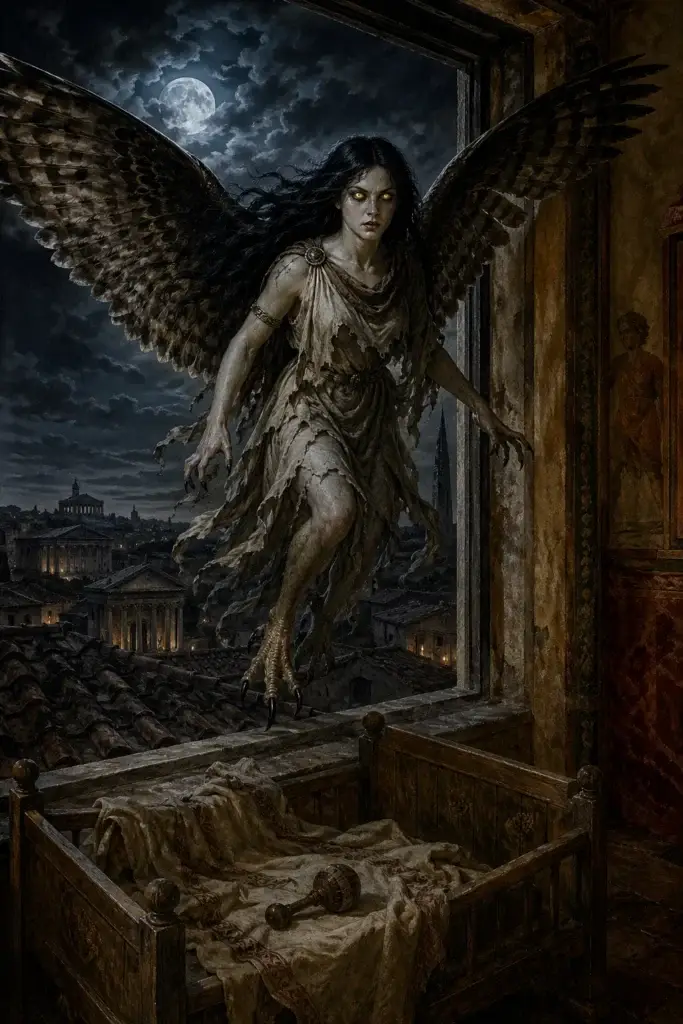
Animal form: a large night bird, owl-like, with curved talons and a sharp beak. In the witch form: an old woman who turns into the bird at night. Mixed forms are reported, a woman with bird wings, a bird with a human face.
Behavior
The Striga flies at night, enters houses (through windows, chimneys, keyholes), seeks out infants and pregnant women, sucks their blood, or steals the child and replaces it with straw or a bundle of rags.
Sphere of action
Night, the bedroom, the childbed. Especially dangerous in the first days after birth, as long as the child is still “not yet bound” into the community.
Mythological origin
No clearly formulated mythic genealogy. Ovid tells a primal scene in which the nurse Crane drives the strix away from an infant with hawthorn, an aetiological narrative that legitimizes the protective rite. In Slavic tradition the Striga arises from a person with two hearts or two souls.
Appearance and symbolism
Strigae are described as hideous old women with bird features and enormous breasts. They can take on human form. Owls and night shadows accompany them. Blood and the desecration of corpses are their urge. An aura of age, hunger and damnation emanates from them.
The most important aspects of the Striga at a glance. The detailed account of name, description, warding off and parallels can be found in chapters 2, 3, 5 and 6.
From Roman folk belief, with Greek precursors. Later merging with the notion of the witch, a woman who turns into a bird.
Above all infants and small children, and secondarily women in childbed. In the later witch discourses the victim spectrum expands to the whole population, with illness, the dying of livestock and weather damage all attributed to the Striga.
A large night bird (owl-like) or an old woman who transforms. Mixed forms: a woman with bird wings, curved talons, a bloody muzzle.
Blood-sucking, child theft, the swap for straw. A slow wasting away of the infant, often noticed only after days or weeks.
Hawthorn branches at windows and doors, salt on the thresholds, burning lamps in the bedroom. A bulla amulet for the child. Ovid describes the hawthorn rite of the nurse Crane.
Rituals for warding off
Ovid describes the rite of the nurse Crane: she taps the doorpost with a hawthorn branch, sprinkles the dwelling with water, lays the entrails of a young pig on a dish and calls on the Striga to fall upon those instead. After that the child is protected.
Invocations
Short folk formulas at the threshold, especially at night. In curse tablets (defixiones) the Striga is named as an instrument of attack against enemies. In the later Slavic region, long protective formulas against the strigoi develop.
Amulets and protective symbols
A bulla amulet for Roman children, filled with magical contents. Salt, hawthorn, laurel, garlic. Later Slavic traditions add crosses, images of saints and special burial rites for those suspected of being strigoi.
Cult and veneration
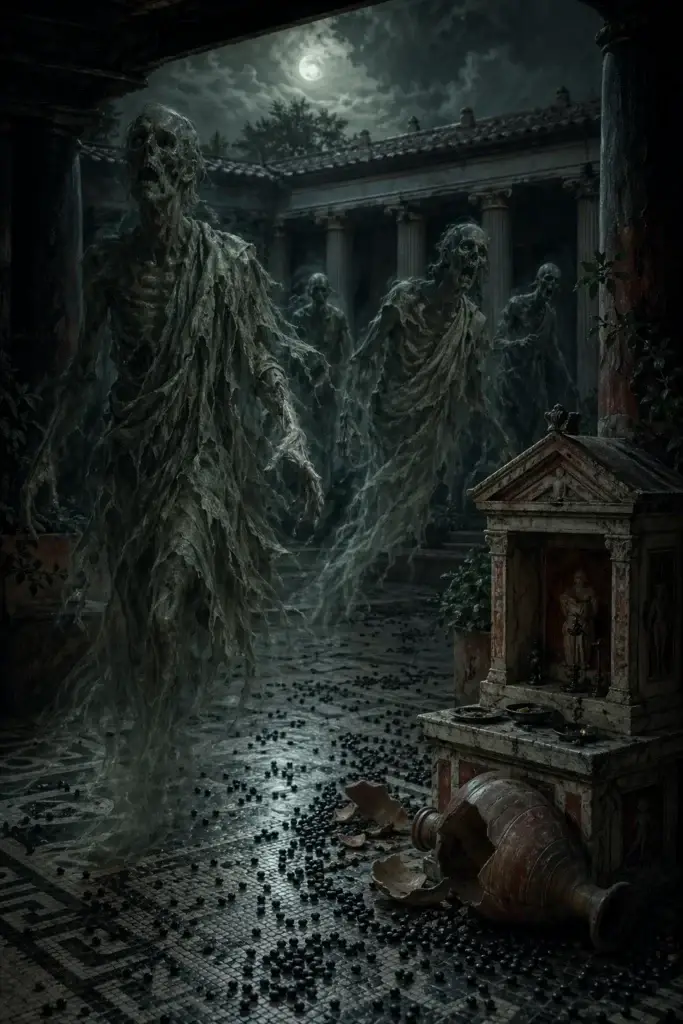
Strigae are not venerated but warded off. Iron under the bed, red threads and garlic were common. Graves were guarded. Priests and magicians could banish them. In some cultures there was an attempt to treat them respectfully.
Models and relatives: The Mesopotamian Lilītu and the Jewish Lilith, the child-murdering demoness as a widespread motif of the Ancient Near East. The Greek Lamia and Empusa as literarily related figures.
The Middle Ages
The medieval witch inherits many Strix features: nocturnal flight, transformation, attack on infants. The Italian strega (“witch”) derives directly from Strix.
The modern vampire figure
The Romanian strigoi is the immediate precursor of the modern vampire figure. Bram Stoker’s Dracula and his successors carry Strix elements within them, especially the entry through a window, the bite at the neck and the draining of blood.
The striga or strix is one of the few Roman figures of misfortune for which several independent ancient sources survive. The most detailed account is given by Ovid in the Fasti, the festival calendar, in the entry on the events of June.
There he describes the striges as nocturnal birds with a large head, fixed eyes, a hooked beak and grey feathers, which fly in the darkness and seek out infants whose entrails or blood they suck out.
Ovid then tells of the threat to the little prince Proca and of the warding off by the goddess Carna or Cardea, who drives away the bird with an arbutus branch and a pig sacrifice.
In the Satyricon, Petronius has the figure of Trimalchio and his guests tell of the strigae: in one episode the corpse of a boy is swapped by witches and replaced with a bundle of straw, and a man who tries to disturb them is badly mauled.
Here the strigae are already female sorceresses, not merely birds. Pliny the Elder mentions the strix in the Naturalis historia in a zoological context and notes that the legend has it that they give infants the breast with their milk, but he expresses skepticism about the existence of the bird.
These sources show the figure in the decisive suspension between animal and human, between natural history and haunting. Already in antiquity it was unclear whether the strix was a real night bird with an uncanny cry, a demon or a woman who turns into a bird.
This ambivalence is not a flaw of the tradition but its core: the Romans themselves debated the status of the being.
The ambiguity of the strix has a long history of research. Linguistically, strix is at first a bird name, related to the Greek strinx, and probably denotes a species of owl; the uncanny, screeching cry of nocturnal owls is regarded as the starting point of the notion.
Out of the real night bird with its cry, felt to be gruesome, came a bird of ill omen, then a blood-sucking demonic being.
In parallel, the meaning shifted toward the human. In the Latin literature of the imperial period, and especially in the late antique and medieval tradition, striga increasingly means a sorceress-woman who goes out at night to cause harm.
The notion that such women can transform themselves or send out their spirit connects both strands: the witch takes on the form or the properties of the bird.
This development cannot be described as a simple line. In the sources, the purely animal belief, the demonological interpretation and the human witch coexist side by side, often within the same text.
Research, such as the studies on Roman folk religion and on the prehistory of European witch belief, therefore sees in the striga an important junction: through her one can study how, over several centuries, the notion of the harmful sorceress grew out of an animal omen.
Medieval Latin then often uses striga and strix synonymously for “witch,” and in several Romance languages the word lives on in precisely this meaning.

A distinct trail leads the striga into early medieval legal history. The word appears in several of the so-called folk laws, the recorded tribal laws of the early Middle Ages.
Particularly well known is the provision in the Lex Salica, the law of the Franks, which sets a fine for anyone who wrongly insults another as a stria or accuses them of having “eaten” a person. The Lex Salica thus punishes not witchcraft itself but the unfounded accusation.
Even more revealing is a provision connected with the Lombard king Rothari: his edict from the seventh century expressly forbids killing a maidservant or a free woman as a striga, and declares that a Christian must not believe that a woman can devour a human being from within.
Here secular legislation turns against folk belief and protects the accused.
These legal testimonies are of high value for research, because they show that belief in man-eating witches was alive and consequential in the early Middle Ages, long before the great witch persecutions of the early modern period. At the same time they document an official skepticism toward this belief, in part supported by the church.
The famous Canon episcopi, a text of canon law, classified the belief in nocturnal flights of women as a delusion. The line from the Roman strix through the folk laws to these ecclesiastical statements is one of the most important prehistories of the later image of the witch.
The word striga has a remarkably long later history in the languages of Southeastern Europe. In Romanian, strigă developed from it, and above all strigoi, a term for a returning dead person or a living person with a harmful supernatural power.
The strigoi of Romanian folk tradition is a complex figure: there is the strigoi viu, the living one, and the strigoi mort, the dead one, who returns from the grave, haunts the livestock and relatives and drains their life force.
This tradition was documented by folklorists in the nineteenth and twentieth centuries and later entered international vampire research. The strigoi belongs to the East-Central European notions of the revenant that helped shape the Western image of the vampire, even though the folk figure is far more multilayered than the literary one.
Linguistically related terms are found in the wider Balkan region, which points to an old common layer. From the perspective of religious studies, it is interesting that this word history reveals a long shift of meaning: from the Roman night bird through the medieval witch to the modern revenant.
The word remained stable while the notion adapted to the respective fears and needs for explanation. Whoever places the striga of antiquity and the strigoi of the Romanian villages side by side sees not an identical figure but a continuous line of transmission.
Related notions of the blood-sucking dead are also found in the Slavic region, for example with the Upir.
Recommended internal links:
The protective practice described here is a religious-studies classification of historical traditions. iWell Guard ties into this cultural-historical line of wearable protective objects and represents a contemporary form of it. More about the iWell Guard →
Against its influence, cross-cultural tradition names these protective means:
Recommended protective means
The simplest protective means in this collection: 41 layers of fine gold 999, platinum, silver and silicon, manufactured in Ruhla, Thuringia. It requires no activation, is bound to no person, and is effective within a radius of around 50 meters, even without being worn.
Related Beings

The Alicanto, the glowing mining bird of Chilean folklore. Origin, the testing motif and the reli...

Tikbalang, the horse-headed being of the Philippines that leads travellers astray. Origin, the wa...

Sila is the Arctic world principle of weather, air and reason. A religious-studies analysis with ...

Mamu, the evil spirit power of the Anangu in the Australian Western Desert. Origin, function and ...

Umibōzu, the giant black monk's head from calm seas: yōkai of seafarers, the Tokuzō legend, the b...

The Golem, a creature of clay brought to life by sacred names. Origins in Jewish folk belief and ...