The Bulla: the Roman Protective Amulet for Children
By Ralf Ittermann · last reviewed on
The Bulla was the protective amulet of freeborn children in ancient Rome. Worn around the neck from birth, it was meant to shield the child from the evil eye and from harmful forces, while also marking the child’s free status.
The Bulla was a Roman children’s amulet intended to protect boys until they came of age.
Classification
The Bulla was a protective amulet from ancient Rome. It was worn by children who were considered freeborn. It was especially closely associated with boys, though girls could also wear a Bulla.
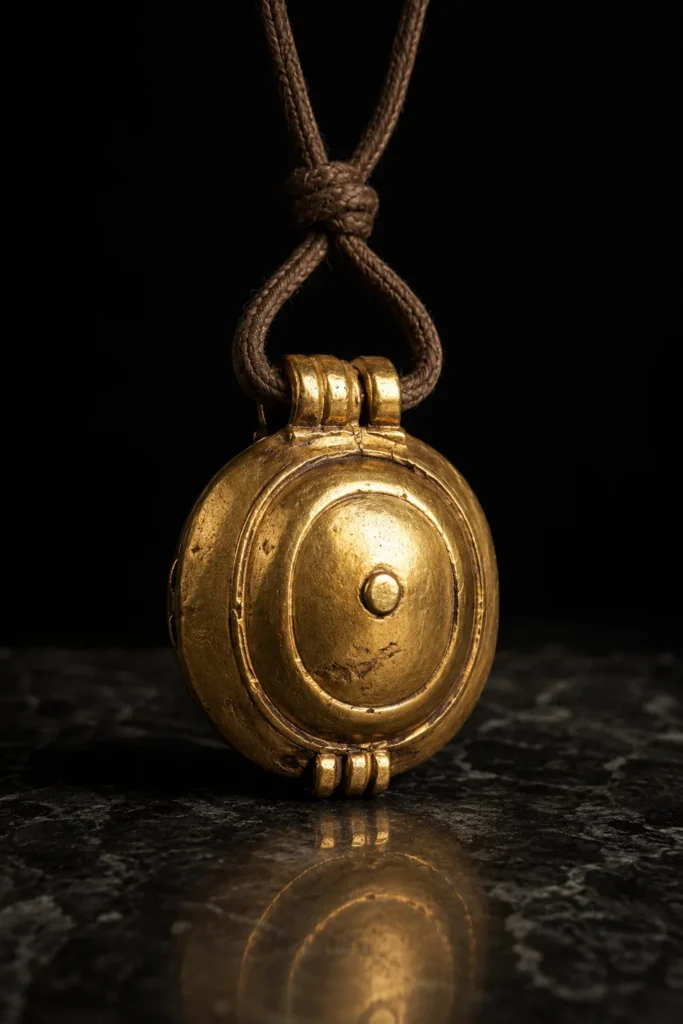
The Bulla was a small container worn around the neck on a cord or chain. It enclosed a protective content. Its form and construction make it an example of the widely attested category of amulet capsules.
The Bulla carried a twofold significance. It was a protective object meant to keep the child safe from harm. At the same time it was a status marker that made the child’s free, non-servile standing visible.
In religious studies and in the study of Roman everyday culture, the Bulla is a well-attested example of a children’s amulet. It shows how closely the protection of children and the protective customs of a society are intertwined.
The Bulla accompanied the child through the first years of life up to a defined point. When and how it was laid aside is recorded in the sources and belongs to the most revealing aspects of this custom.
The Bulla was thus a protective object closely tied to the course of a life. It was put on after birth and laid aside at the transition to adulthood. Wearing it was bound to a specific phase of life.
Name and Form
The Latin word bulla originally denotes something round, a bubble or a boss. The name thus refers to the shape of the amulet, which typically had a rounded, convex form.
The Bulla generally consisted of two convex halves joined together to form a flat, round container. This lens shape is the most common appearance of the Bulla. It resembles a small, flat case.
The Bulla had a loop through which a cord or chain was threaded. This allowed the amulet to be worn around the neck, resting on the child’s chest.
The size of the Bulla was modest, since it was intended for a child and needed to be worn comfortably. It was a small, handy object that the child carried at all times.
Inside, the lens-shaped Bulla offered a small hollow space. This hollow space was decisive for its protective function, as it held the actual protective content.
The Bulla was therefore not a solid sign but a container. Its form followed this purpose. It was designed to enclose a content and to be worn on the child’s body.
The Amulet of Freeborn Children
The Bulla was tied to a particular social standing. It was the amulet of freeborn children, that is, children who came into the world as free citizens rather than as unfree persons.
The putting on of the Bulla happened early, in the first days after birth. For boys, it was often linked to the day on which the child received its name. From that point on, the Bulla accompanied the child.
The Bulla was therefore not only a protective object but also a visible sign. Anyone who saw a child wearing a Bulla recognised the child’s freeborn status by it. The amulet distinguished freeborn children from the unfree.
This combination of protection and status marker is instructive. It shows that a protective object could simultaneously carry a social statement. The Bulla protected the child and at the same time placed it within society.
The Bulla was especially closely associated with boys, since wearing it was linked to the course of a boy’s life up to a certain point. But girls of freeborn families could also wear a Bulla or a related amulet.
The Bulla was thus a marker of childhood within free Roman society. It belonged to that phase of life in which the child was not yet an adult and stood under particular protection.
Material: Gold and Simpler Substances
The Bulla was made from various materials. The choice of material depended on the family’s means. This shows that the custom encompassed all strata of the free population.
Wealthy families had the Bulla for their children made from gold. A golden Bulla was a precious piece and also indicated the family’s wealth and standing.
Poorer families could not afford gold. For their children the Bulla was made from simpler materials, such as leather or base metal. Even such a Bulla fulfilled its purpose as a protective amulet.
Importantly, the value of the material did not alter the protective significance. The leather-bound Bulla of the poor child protected just as much as the golden Bulla of the wealthy child. What mattered was the amulet itself, not its material.
This range from gold to leather is a common feature of protective objects. Other amulets too were produced in precious and in plain versions, depending on the means of those who wore them.
The Bulla was therefore not a privilege of the wealthy. It was a protective custom that encompassed the entire free population. Every freeborn child was to receive a Bulla, regardless of how wealthy its family was.
The Hidden Content
The Bulla was a container, and its protective effect was closely connected to its content. Inside the hollow of the Bulla there was a protective object.
The sources give hints about the nature of this content. It could be a small amulet, an object to which a warding power was attributed. Such protective objects were widespread in the ancient world.
The content was concealed inside the Bulla. From outside one saw only the rounded container, not what it enclosed. This concealment is a recurring feature of amulet capsules.
In this the Bulla follows a pattern found in many cultures. What is truly efficacious is not visible but protected within a container. The casing carries and preserves; the hidden core acts.
The same pattern appears in the Tibetan amulet box and the Japanese protective pouch. They too enclose a hidden, protective core. The Bulla is the Roman expression of this widespread idea.
The Bulla thus shows that the protective traditions of the world share related basic forms. The portable container for a hidden, protective content is a solution that many cultures have arrived at independently.
Protection against the Evil Eye
The Bulla was meant to protect the child from harm. One particular danger it addressed was the evil eye. Belief in the evil eye was firmly rooted in the Roman world.
According to this idea, a gaze could cause harm, often carried by envy. The Romans had their own term for this harmful effect of the gaze. Small children were considered especially vulnerable.
Precisely because children were perceived as both vulnerable and enviable, they required, in the Roman view, particular protection. The Bulla provided this protection. It accompanied the child through the first years of life, which were regarded as especially dangerous.
The evil eye was not, however, the only danger. The Bulla was meant to protect the child from harmful forces and from misfortune in general. It was a comprehensive protective object for the period of childhood.
With this orientation toward the protection of children, the Bulla stands in a broad, cross-cultural tradition. In very many cultures the most important protective objects are directed toward birth and early childhood.
The Bulla is the Roman response to this widespread concern. It shows that even in the highly developed Roman society the protection of the child was an urgent matter, to which its own amulet was dedicated.
Laying Aside the Bulla
The Bulla was not worn throughout one’s entire life. Wearing it was bound to childhood. At the transition to adulthood the Bulla was laid aside.
For boys this transition was associated with a fixed custom. When the boy had reached a certain age, he set aside his children’s clothing and put on the garment of the adult man, the plain white toga.
On this day the Bulla was also laid aside. The young man no longer needed the children’s amulet, since he was now considered an adult. Laying aside the Bulla was one of the visible signs of this transition.
The set-aside Bulla was not discarded. It was dedicated to the household gods, the Lares, who watched over the house and the family. The page on the Lares describes these protective spirits in more detail.
This dedication of the Bulla to the Lares is instructive. The amulet that had protected the child returned, as it were, to the protective powers of the house. The protection of the child was thereby solemnly concluded.
Laying aside the Bulla shows that this amulet was closely embedded in the course of a life. It was put on after birth and laid aside in a ritual upon reaching adulthood. The Bulla accompanied precisely the period in which a person, as a child, needed special protection.
Etruscan Origins and the Lunula
The custom of the Bulla did not originate in Rome itself. Much suggests that the Romans adopted it from the Etruscans, a people who lived in Italy before and alongside Rome.
The Etruscans had a rich culture, and the Romans adopted numerous customs and symbols from them. The Bulla belongs to this Etruscan heritage that entered the Roman world.
Within Roman protective customs the Bulla did not stand alone. While the Bulla was especially associated with boys, girls frequently wore a different amulet, the Lunula.
The Lunula was a crescent-shaped pendant. Its form, the crescent of the moon, is an ancient protective sign found in many cultures. The Lunula was the female counterpart to the Bulla.
Bulla and Lunula together show that Roman society had carefully regulated the protection of children. There were specific amulets, and their use was tied to the sex and the life course of the children.
The Bulla is therefore part of a whole system of children’s amulets. It was not an isolated object but fitted into an ordered protective practice intended to encompass every freeborn child.
Reception Today
The Bulla is no longer a living custom today. With the end of Roman antiquity, the wearing of the Bulla disappeared. It is a protective object of the past.
Nevertheless, the Bulla is well documented. It is attested by numerous finds, and ancient writers report on it. From these sources the custom can be traced in precise detail.
Bullae are preserved in the collections of many museums, above all the precious pieces in gold. They testify to the care with which the Romans provided their children with a protective amulet.
For the study of Roman everyday culture the Bulla is an important source. It shows how an ancient society organised the protection of children and how closely this protection was linked to the course of a life and to social standing.
The Bulla is also an instructive example within the world’s protective traditions. It combines several basic patterns: the container with a hidden core, protection against the evil eye, and an orientation toward the child.
Even though the Bulla is no longer worn today, it remains a striking testimony. It shows that the need to accompany children with a protective object is very old and found a particularly well-considered form in the Roman Bulla.
Selected Bibliography
Related key terms: Bulla Rome children’s amulet apotropaion evil eye Lunula toga Lares Etruscans.
iWell Guard and Protective Traditions
iWell Guard stands in the cultural-historical lineage of wearable protective objects, to which the Bulla also belongs. A modern companion for people who live with protective symbols: made in Germany, 41 layers of solid gold, platinum, and silver, with a 30-day right of return.
Individual experiences may vary. Not a medical device. No health claims made.