The protective tattoo places a protective sign permanently in the skin. Unlike an amulet, it cannot be set aside or lost; it is bound to the body of the person who bears it. This article situates the protective tattoo within the study of religion and traces its history from antiquity to its reception today.
In doing so, it distinguishes between historically documented custom and modern interpretation.
A protective tattoo is a sign placed in the skin to which a warding meaning is attributed. It is created by introducing pigment permanently beneath the surface of the skin.
What is special about the protective tattoo is its permanence and its binding to the body. An amulet can be set aside, lost or forgotten. The tattoo, by contrast, remains bound to the one who bears it.
The motifs of protective tattoos vary widely. Signs, symbols, lettering, religious images and geometric patterns have all been handed down. Their selection depends on the particular culture.
The tattoo combines two ideas of protection. First, it is a sign with an attributed meaning, and second, it is a permanent mark that accompanies its bearer for a lifetime.
Within the protective symbols, the protective tattoo is a special case. It is not a separate object but has become a part of the body. In this it differs from all means of protection that can be set aside.
The protective tattoo is at the same time often a sign of belonging. It can indicate that a person belongs to a group, a religion or a place, and this belonging can be understood as part of the protection.
The protective tattoo stands between ornament, profession of faith and means of protection, without committing itself to any one of these sides. The same sign can adorn, indicate a belonging and carry a protective meaning all at once. This multilayered quality belongs to the very nature of the tattoo.

The tattoo is among the oldest known forms of working the body. Finds of preserved bodies from prehistoric times show that people were tattooed many thousands of years ago.
The best-known find is a glacier mummy from the Alps, whose body bears numerous tattoos. There are various interpretations of the precise meaning of these signs, and no certain statement is possible.
Tattooed bodies are known from pharaonic Egypt, above all those of women. The interpretation of these tattoos is contested in scholarship, and a protective reference is among the possibilities considered.
In the Greek and Roman world the tattoo was widespread, though often with a negative valuation. It served partly to mark the unfree and was partly worn by certain groups.
In many cultures outside Europe the tattoo has a rich and positively valued history. In parts of Asia, in the Pacific and in other regions it is deeply rooted in religious and social life.
Overall it becomes clear that the tattoo extends across very long periods and many cultures. Its valuation, however, varied greatly, from rejection to high esteem.
In Europe the valuation of the tattoo changed several times. In the Middle Ages and the early modern period it was little widespread; in the nineteenth century it was regarded as a mark of certain occupational groups; and in the twentieth century it was gradually taken up into general fashion.
This shifting valuation shows how strongly the tattoo is bound to social conceptions.
The conceptual core of the protective tattoo is permanence. The sign is placed in the skin and remains there. It cannot be mislaid or forgotten, and it was precisely this durability that was regarded as an advantage.
A second idea is inseparability from the body. A worn amulet is an object alongside the body. The tattoo, by contrast, has become part of the body and accompanies it without a gap.
In addition there is the idea of the pain of tattooing. In some accounts the pain bound up with the tattoo was itself regarded as significant and as part of what was meant to make the sign effective.
The tattooed sign carries the same meanings as the corresponding motif on an amulet. A tattooed eye sign or a tattooed inscription draws on the interpretation of these motifs.
To this is added its significance as a visible profession of faith. The tattoo openly indicates a belonging. This visible binding to a group or a religion was partly understood as protection in itself.
The conceptions described here are cultural-historical explanations. They describe why a protective meaning was given to the permanent sign, and they document a belief. They are not proof of an effect. Scholarship describes the conception without confirming it.
In addition there is the idea that the sign ages with its bearer and passes away with them. Unlike an amulet, which outlasts a person, the tattoo is bound to a single life. This close binding to one person was partly understood as itself part of its meaning.
The Alpine glacier mummy bears a multitude of tattoos in the form of lines and dots. Whether these signs had a protective sense is not certain; a medical interpretation is also considered.
Tattooed female bodies are known from pharaonic Egypt. Some researchers connect these tattoos with protection in pregnancy and childbirth; others interpret them differently.
In the Greek and Roman world the tattoo was known but was mostly regarded as a mark of low standing or foreign origin. A protective use is less to the fore in this area.
From the Near East tattoos are handed down that were connected with belonging to a sanctuary or a religious community. Such marks were regarded as signs of binding.
Among Christian pilgrims there later developed the custom of having oneself tattooed at holy places. This pilgrim tattoo joined the permanent sign to a religious journey.
These examples show that the tattoo was known in the ancient Mediterranean world and the Near East. Its valuation and its meaning varied greatly from culture to culture.
Tattooed bodies are also known from the realm of the Scythians, which were preserved in burial mounds of the Eurasian steppe. Their skin bears artful depictions of animals whose meaning is discussed in scholarship. These finds show that the tattoo was widespread in antiquity far beyond the Mediterranean world.
In Europe the tattoo was for a long time little widespread and often negatively valued. Unlike in many cultures outside Europe, it played a lesser role in European domestic custom.
An important European example is the pilgrim tattoo. Pilgrims had a sign tattooed on them at places of pilgrimage that documented the journey and was at the same time understood as a sign of religious binding.
In some regions of South-Eastern Europe an older tradition of Christian protective tattoos is handed down. Crosses and religious signs were placed in the skin and connected with a protective interpretation.
These South-Eastern European tattoos were partly worn in times of religious distress. The permanent sign openly indicated belonging to a community of faith.
Reports of such tattoos document the expectations of those who bore them and not a proven effect. They show that the permanent sign was understood as an expression of binding and security.
In the nineteenth and early twentieth centuries the tattoo was widespread in Europe above all among certain occupational groups, such as sailors. Protective motifs played a certain role in this.
From the Holy Land a workshop is handed down since the late Middle Ages in which pilgrims had a sign of their journey marked on them.
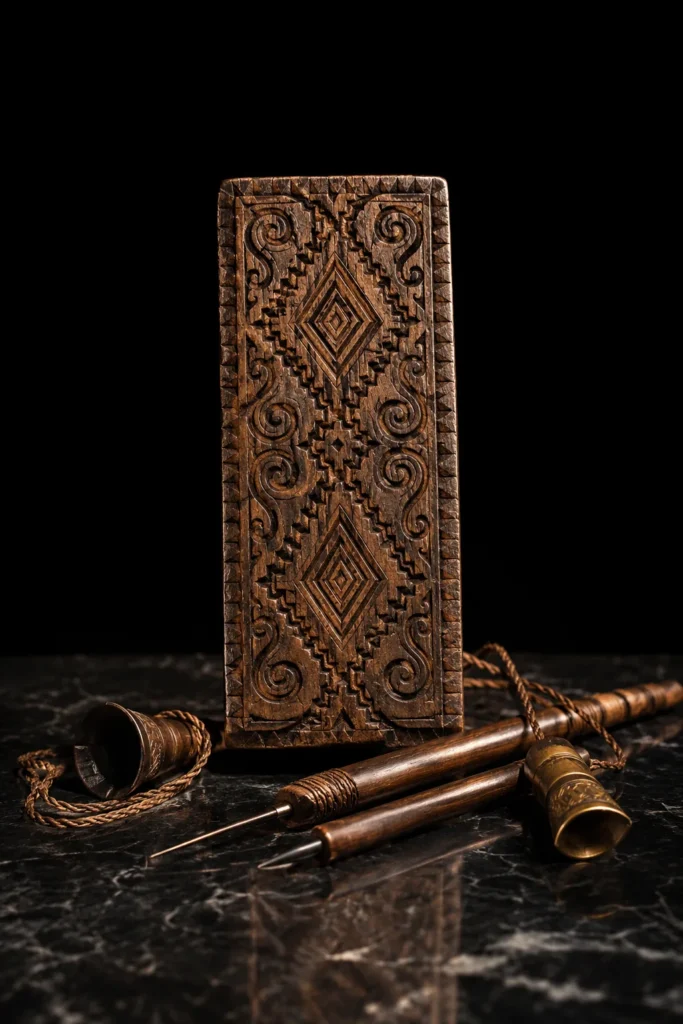
Over generations the same families worked there, and their wooden printing stamps have been preserved. The pilgrim tattoo thereby joined the permanent sign to a fixed place and a long tradition.
In South-East Asia the protective tattoo has a rich and living tradition. In several countries of the region tattooed characters, signs and images are worn to which a protective meaning is attributed.
Such tattoos are in some traditions marked by religious specialists and connected with sayings and blessings. Their making follows a handed-down order.
In Japan the tattoo has its own artful history. Large-area tattoos with religious and mythological motifs are known there, and their valuation has differed over the course of time.
In the Pacific region the tattoo is deeply rooted in social and religious life. Tattooed patterns indicate a person’s belonging, rank and history and carry manifold meanings.
Across these regions it becomes clear that the protective tattoo is not a motif of a single culture. In very different traditions a protective meaning was given to the permanent sign.
The diversity of the examples makes clear that the protective tattoo is to be understood as a principle. It arises wherever a protective sign is to be bound permanently to the body.
In parts of North Africa and the Near East the tattooing of women was widespread well into the twentieth century. Patterns of dots and lines on the face and on the hands were connected with protection, healing and belonging. This tradition has largely declined today, but it is well documented in folkloric records.
The protective tattoo begins with the marking. In many traditions this process is itself a ritual carried out by a religious specialist and accompanied by sayings and blessings.
Often the motif, the place on the body and the time are fixed. Certain signs are placed on certain parts of the body, and the occasion of tattooing can be bound to a stage of life.
Unlike an amulet, the tattoo need not be renewed or carried along. After the marking it is permanently present and accompanies its bearer without any further action.
In some traditions the protective tattoo is bound to rules of conduct. Whoever bears such a sign is to behave according to certain prescriptions so that the sign retains its attributed meaning.
The pilgrim tattoo was bound to the religious journey. It was marked at the destination of the pilgrimage and documented the completed journey permanently on the body of the pilgrim.
There is no uniform ritual order for the protective tattoo. The precise form depended on region, religion and tradition, as folkloric and ethnological research has recorded several times.
The care of the fresh tattoo was also regulated in some traditions. Certain foods, actions and places were regarded as to be avoided during the time of healing. Such prescriptions show that the protective tattoo was not concluded with the marking but remained embedded in a longer custom.
The protective tattoo stands in close kinship with the image amulet. Many tattooed motifs correspond to the motifs that are also worn as an amulet or talisman. The motif is the same, the bearer is different.
Closely connected is the tattoo with the script amulet. Tattooed inscriptions, formulas and signs draw on the conception that script itself can carry a protective meaning.
From the worn amulet the tattoo differs through its inseparability. An amulet is an object alongside the body and can be set aside. The tattoo has become part of the body.
The tattoo is also related to other permanent body signs, such as scarification. This too places a sign indelibly in the skin and can carry a protective meaning or one related to belonging.
A boundary exists toward the tattoo as pure ornament or as an expression of personal design. Not every tattoo carries a protective interpretation. What is decisive is the warding function attributed to it.
Situating it within this neighbourhood helps to define the protective tattoo precisely. It is a protective sign bound permanently to the body and differs from the amulet that can be set aside and from pure body ornament.
A boundary exists furthermore toward the tattoo as punishment or compulsory marking. In several cultures people were tattooed against their will in order to mark them. This enforced marking follows a history of its own and is to be sharply distinguished from the freely borne protective tattoo.
The tattoo is today widespread in many societies and is mostly understood as an expression of personal design. The old protective interpretation has thereby receded into the background.
In South-East Asia protective tattoos continue to be marked in religious contexts. They also attract international attention, which raises questions about the appropriate handling of a foreign tradition.
In modern esotericism some tattoo motifs are connected with protective or strengthening properties. Such attributions are not proven and should be viewed critically.
In popular culture protective tattoos frequently appear as a narrative motif. Films, novels and games show tattooed signs that are meant to grant their bearers special properties.
For the study of religion the protective tattoo is an instructive example. It shows how a protective sign could become, from a separate object, a permanent part of the body.
Anyone who concerns themselves today with the protective tattoo will find in it above all a cultural-historical theme. A factual approach separates the documented history of the tattoo from modern promises of effect that do not stand up to examination.
In research on bodies preserved in ice, bog and desert the tattoo is a recognised object of study. With imaging methods even faded signs are made visible again and described. In this way the history of the tattoo remains tangible even where written sources are lacking.
Related key terms: protective tattoo, tattoo, skin sign, pilgrim tattoo, Sak Yant, body sign, permanent protective sign, scarification, apotropaic, tattoo.
iWell Guard stands in the cultural-historical line of wearable protective objects, to which the protective tattoo also belongs. A modern companion for people who live with protective symbols: made in Germany, 41 layers of solid gold, platinum and silver, with a 30-day right of return.
Personal experiences may vary. Not a medical device. No promise of healing.