The Lares are among the most familiar figures of Roman everyday religion. As guardian spirits they watched over the home, the family, and the crossroads of the roads. Their cult connected the private household with the public sphere.
The Lares rank among the most characteristic figures of Roman religion. They were not great deities with elaborated myths but guardian spirits closely bound to specific places and social units.
At the centre stood the Lar familiaris, the guardian spirit of the individual household and its members, who, in the Roman understanding, included the enslaved. Alongside them stood the Lares compitales, venerated at the compita, the crossroads, where they protected the neighbourhood.
In the history of religion, the Lares are an example of the close connection between religion and social order in Roman thought. Wherever people lived together or boundaries met, the Lares were thought to be active. The cult was therefore less tied to doctrine than to practice and place.
In older scholarship the Lares were frequently interpreted as ancestral spirits; more recent work, represented among others by John Scheid, emphasises their character as local spirits that secured the flourishing of a particular domain. The precise distinction from the Roman Manes and Penates remained fluid even in antiquity.
The significance of the Lares extended from the smallest farm to the capital itself. Emperor Augustus attached the Lares cult to his reform of the city districts and linked it to his own Genius. A popular household cult was thereby incorporated as an element of the state religious order.
The name Lar, plural Lares, has not been fully clarified linguistically. Antiquity itself knew several interpretations without any one prevailing.
A widespread hypothesis in modern scholarship connects the word with an Etruscan root, since lar occurs in Etruscan as a component of personal names and as a designation for lord or prince. Whether a religious term emerged from this, or whether conversely a Latin word was borrowed, cannot be determined with certainty.
Another line of interpretation connects the name with terms for the dead or for burial, supporting the older thesis of the ancestral spirit. The sources themselves speak at one point of Lares as sons of a goddess named Mania or Lara, which in turn points to a connection with the underworld.
The Romans preferred the plural form. Even when the Lar familiaris is spoken of in the singular, two Lares figurines typically appear in the household shrine.
The plurality corresponded to the idea that these were a group of similar guardian spirits rather than a single individual with a biography. The term thereby remained flexible and could be applied to various domains, from the house to the crossroads, to fields, sea routes, and entire journeys.
The visual depiction of the Lares is well documented through numerous finds from Pompeii, Herculaneum, and other sites. The typical Lar appears as a youthful male figure in a short, belted tunic, often in a dancing step or with a raised leg, full of lively movement.
In his hands he usually holds a drinking horn, a rhyton, and a flat offering dish, the patera, sometimes also a bucket.
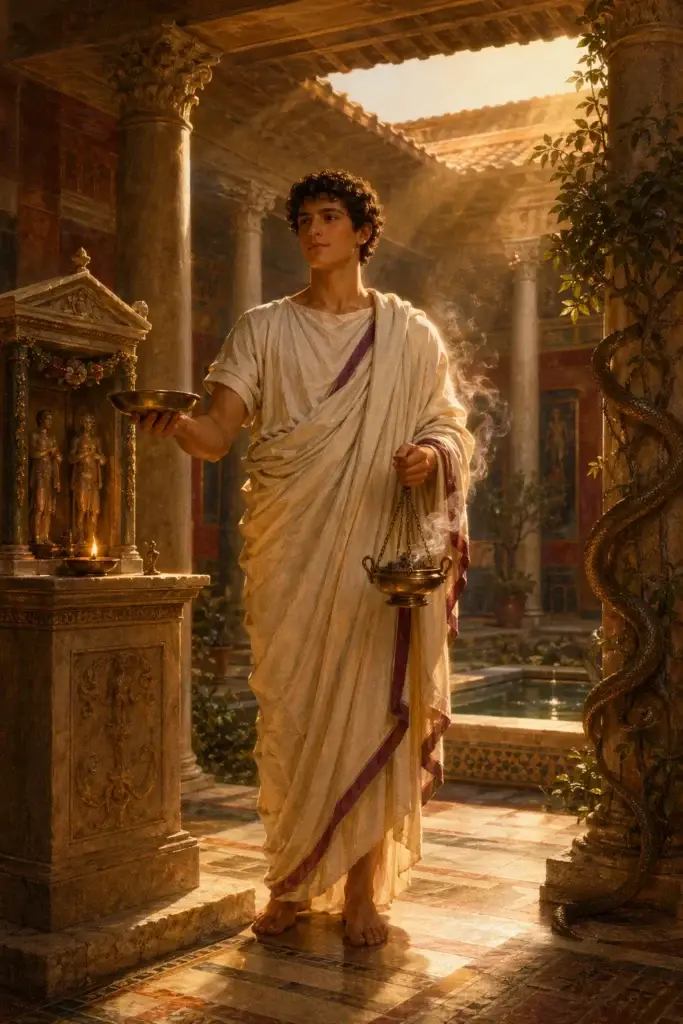
The figurines stood in the Lararium, the household shrine, which was fashioned according to the family’s means as a painted niche, a small wooden temple, or an elaborate wall painting. Two dancing Lares flanking a central figure are frequently depicted.
This central figure is usually the Genius of the paterfamilias, shown in toga with veiled head in the act of sacrifice. Below the scene a serpent often winds its way, interpreted as the guardian spirit of the place or as the embodiment of the household’s fertile power.
The animated quality of the Lares figurines is striking and sets them apart from the calm dignity of many other Roman divine images.
They appear more like serviceable, lively spirits than sovereign deities. This iconography remained remarkably stable over centuries and was widespread throughout the Roman West, indicating a well-established pictorial tradition for the household cult.
Unlike the great deities, the Lares possessed almost no elaborated myths. They were functional spirits whose significance lay in practice rather than in narrative. Nevertheless, there are some literary passages that provide them with a pre-history.
The poet Ovid recounts in his Fasti the story of the nymph Lara, who is punished by Jupiter for her talkativeness and sent to the underworld.
On the way there, Mercury fathers twins with her, the Lares, who thereafter keep watch at the crossroads. This narrative is a literary construction of the imperial period, intended to provide the Lares cult with a mythical origin.
In the comedy of Plautus, a Lar familiaris even appears as a speaking stage character. In the prologue to the Aulularia, he explains that he watches over the house and a treasure hidden within it, and that he attends to the household members in proportion to the care with which they honour him.
This passage is valuable for the history of religion because it shows how the household spirit was understood in everyday life: as an attentive observer who rewards piety and takes offence at neglect.
Overall, the tradition of the Lares remained fragmentary. Their history is better reconstructed from archaeological finds, inscriptions, and incidental remarks in literature than from a closed mythological cycle. This very character of the sources makes them an important testimony to the fact that Roman religion was, in large part, a religion of action.
The Lares cult was deeply rooted in the domestic sphere. On any given day the paterfamilias or materfamilias could offer the Lares small gifts: some food, incense, wine, or flowers. Special attention was given to the Lares on the Kalends, the Nones, and the Ides of each month, as well as at family turning points.
When a young man put on the toga virilis, when a bride moved into her new home, or when someone returned from a journey, a sacrifice to the Lares was part of the occasion.
In the public sphere stood the Lares compitales. At the crossroads there were small shrines whose cult was maintained by neighbourhood associations. The annual festival of the Compitalia in winter was a moveable feast whose date was set each time by the magistrate.
On this occasion the shrines were adorned, and the local residents came together for sacrifices and communal celebration. These associations, the collegia compitalicia, at times carried considerable political weight, which is why they were repeatedly restricted during the late Republic.
Augustus reorganised the Compitalia cult from 7 BCE onward. He divided the city into districts and had the Lares Augusti venerated at the crossroads alongside his own Genius.
The administration lay with the vicomagistri, often freedmen, who were thereby assigned a religious and social role. In this way the household cult was integrated into the framework of imperial religion.
The temporal depth of the Lares cult extends, according to the tradition, far back into the early period.
The Compitalia belonged to the fixed dates of the republican festival calendar, but their exact date was not rigidly determined; instead it was announced afresh each year shortly after the Saturnalia by a proclamation of the praetor or another magistrate.
This moveable arrangement connected the festival with the close of the rural working year. Cato the Elder mentions in his agricultural treatise the veneration of the Lares by the estate manager and his wife, demonstrating that the cult had its firm place on the great landed estate as well.
Dionysius of Halicarnassus attributes the establishment of the crossroads shrines to King Servius Tullius, an aetiological back-projection intended to underscore the high standing of the cult.
In the late Republic the collegia compitalicia were dissolved several times by senatorial decree because they were regarded as focal points of urban unrest, and were restricted again under Caesar.
The Augustan reorganisation from 7 BCE transformed this potentially turbulent institution into an orderly element of urban administration. Rome was divided into fourteen regions and numerous vici, and at every developed crossroads there stood henceforth a shrine of the Lares Augusti.

The Lares were regarded as guardians over the well-being of a clearly defined domain. Within the house, they were thought in the Roman understanding to secure the flourishing of the family, the preservation of property, and the orderly conduct of daily life.
The household shrine was thus a religious centre of the dwelling, at which the bond between residents and protective powers was tended.
Protective practice consisted above all in regular attentiveness. Whoever provided for the Lares could, in the Roman understanding, trust that they watched over the house.
Whoever neglected them risked their displeasure, as the stage figure in Plautus makes clear. This was therefore a relationship of mutual obligation, corresponding to the general Roman principle of gift and counter-gift in dealings with the gods.
At the crossroads the Lares cult carried an additional, spatially oriented significance. Crossroads were regarded as places where boundaries met and movement converged. The Lares compitales were meant to bring order to this open and uncertain space and to secure the surroundings of the neighbourhood.
At the festival of the Compitalia, woollen dolls and woollen balls were hung up in some places, a custom interpreted in scholarship as a protective or expiatory rite. Common to all these practices is that they aimed less at warding off individual threats than at the sustained maintenance of an ordered, protected space.
The Lares represent a type of guardian spirit with counterparts in many cultures. Within Roman religion itself they are closely associated with the Penates, the guardian spirits of the larder, and with the Genius of the paterfamilias.
Penates and Lares were often venerated together in the household shrine but remained conceptually distinct. The Penates were more closely tied to the substance of the house and its food stores; the Lares to place and community.
A Greek parallel can be found most readily in concepts of household deities and protective spirits, such as the agathos daimon, the good spirit, who in some Greek contexts was depicted as a serpent and venerated for the well-being of the household.
No direct equivalence exists, however. The Lares are a specifically Roman phenomenon, one likely also shaped by Etruscan ideas.
From the perspective of religious studies, the Lares belong to the broad field of household and local spirits, ranging from household gods of various cultures to ancestral spirits and threshold spirits.
What these figures share is that they do not address the great cosmic questions but protect the immediate living space. The Lares are a particularly well-documented example of this, because the archaeological tradition of the Roman world makes domestic piety vividly tangible.
The Lares also played a distinct role in movement across boundaries. There were not only the Lares familiares and compitales but also Lares viales as guardian spirits of the roads, Lares permarini for the sea routes, and Lares praestites, regarded as guardians of the entire city, who possessed their own sanctuary.
This variety shows that the concept of the Lares could be applied wherever a space or a route was to be placed under protection.
Ovid mentions in the Fasti an ancient temple of the Lares praestites on the Via Sacra, whose image showed two figures accompanied by a dog, with the dog interpreted as a symbol of watchfulness.
In modern scholarship the Lares are a much-discussed topic, above all because they provide insight into lived religion beyond the great state cults. Georg Wissowa already treated them in his account of Roman religion, and Kurt Latte took up the question of their origin.
An older line of research interpreted the Lares as deified ancestors; a more recent line, represented among others by John Scheid, places greater emphasis on their character as local spirits.
The archaeological investigation of the Larariums of Pompeii and Herculaneum has considerably sharpened the picture of the household cult. It shows that almost every house, regardless of wealth, possessed a Lares shrine, and it makes the connection between Lar, Genius, and serpent vividly apparent.
The Augustan Compitalia cult is also well attested through inscriptions and reliefs and is regarded as a model example of the incorporation of popular religion into the imperial order.
In contemporary general culture the Lares are less well known than the great gods, but they appear regularly in representations of Roman daily life, in museums, in historical education, and in popular books about ancient Rome.
For the study of religion they remain an important example of the fact that Roman religion was primarily a matter of practice, place, and social community.
Related key terms: Lares Lares familiares compitales Lararium Penates Compitalia household crossroads.
iWell Guard draws on the cultural-historical tradition of wearable protective objects, in the tradition of Rome and many other cultures worldwide. 41 levels, real gold, platinum, silver, crafted in Germany. 30-day return policy.
Individual experiences may vary. Not a medical device. No healing promises.
The most important Roman household spirits and household gods are: the Lares (guardian spirits of the home and the crossroads, present at threshold and hearth), the Penates (protective gods of the larder and domestic provision), the Manes (deified spirits of deceased family members), and the Genius and the Iuno (personal guardian spirit of man and woman respectively).
Together they constituted the Lararium, the household shrine, at which daily offerings were made: bread, wine, incense. Lares and Penates thus belong to a single network of meaning that structures Roman domestic religion.
Roman religion recognises four main classes of household spirits: Lares (guardian spirits at threshold and hearth), Penates (gods of the larder and domestic provision), Manes (deified ancestors), and Genius or Iuno (personal guardian spirit). All were venerated together at the Lararium, the household shrine.
The Lares watched over the home and the family as a whole, especially at the threshold, the hearth, and the crossroads. The Penates were specifically responsible for the larder and domestic provision. Both were venerated together at the Lararium but served complementary functions: Lares for protection, Penates for provision.