iWell Guard
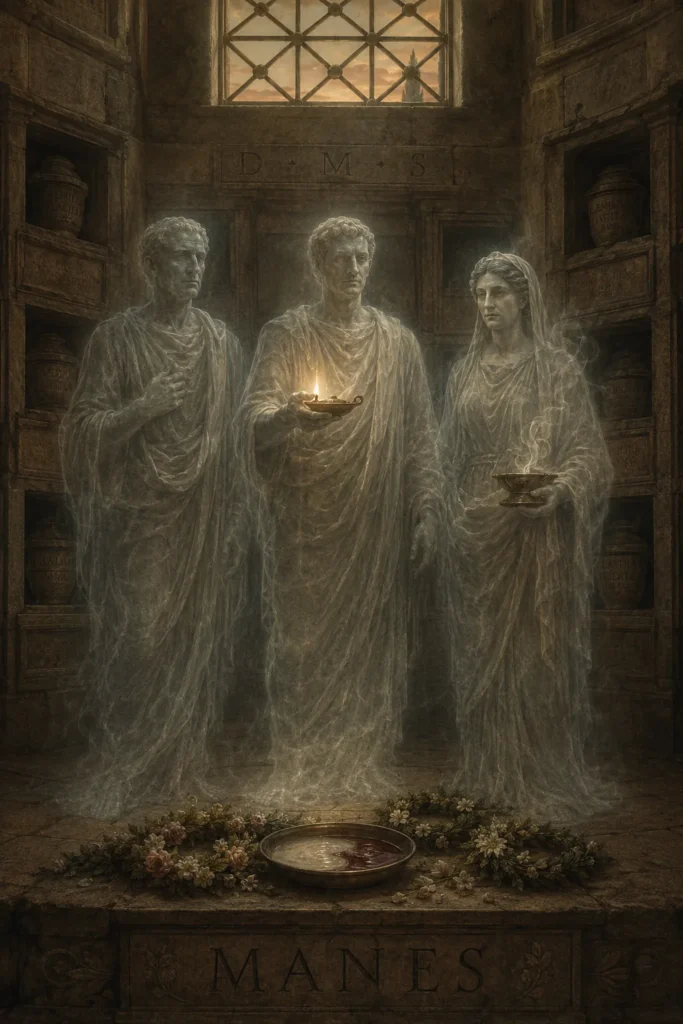
Manes - spirits from the Roman tradition, historical illustration

Di Manes: the spirits of the dead in Roman religion

Spirits of the DeadRomeAncestral Spirits
The Manes (Latin: Di Manes) were, for the Romans, the deified spirits of the deceased, to whom divine veneration was offered. Their cult shaped the treatment of the dead from the early Republic well into the imperial period. The Manes were regarded as protective beings of the family and were invoked in domestic rituals such as the Lemuria and the Parentalia.

Classification

The Di Manes, commonly known as the Manes, belong to the foundational conceptions of Roman religion. The term designates the deified ancestors who after death passed into a collective, divinely conceived state and received cultic veneration.

Unlike some other religions, the idea of the individual’s fate after death was not elaborated in any great detail in Rome. The focus lay on the ancestral collective as a whole, to whom care and veneration were owed, rather than on the single soul.

From the perspective of the history of religion, the Manes are an example of the close connection between family, memory, and religion in Rome.

The care of the dead was a duty of the living kinship group, and its neglect was regarded as a religious and social failure. The cult of the Manes was thus firmly embedded in the fabric of the family and its continuity.

The Manes stood in a fluid relationship to other otherworldly powers in the Roman world, such as the Lares and the Larvae and Lemures, who were considered malevolent.

While the Manes generally appear as recipients of dutiful veneration, the unburied or neglected dead could be conceived of as restless, dangerous spirits. This range reflects the importance of proper engagement with death in Roman thought.

Linguistically and legally, the Manes were firmly anchored in public life. The Twelve Tables, the oldest written Roman law, already contained provisions on burial rights, thereby indirectly protecting the domain of the dead.

The term Di Manes appears in formulae of dedication, in funerary epigraphy, and in legal language alike, demonstrating how naturally the concept permeated the entire community.

Name and Etymology

The term Manes is used only in the plural and is most commonly associated with the phrase Di Manes, meaning “the good gods.” Ancient linguistic interpretation connected the word with an old Latin adjective manus, meaning something like “good.” Di Manes would thus literally mean “the good gods,” a euphemistic designation typical of the cautious Roman approach to the sphere of death.

This interpretation as a flattering name is instructive from the perspective of the history of religion. It shows that the Romans approached the dead with a mixture of respect and fear, and avoided describing them directly as threatening. Similar euphemistic strategies are found in other sensitive areas of ancient religion.

Closely connected to the Manes is the goddess Mania, who appears in the sources in part as the mother or mistress of the Manes. Here, too, the exact relationship remains unclear. What is important is that the term Manes remained collective.

Even when it referred to a single deceased person, as in a funerary formula, it placed that person within the totality of the dead rather than treating them as an isolated individual soul.

Description and Iconography

The Manes had no fixed visual form. Unlike the Lares, who were depicted as dancing figures, the Manes remained largely unrepresented. They were not embodied by statues in the household shrine, but were kept present through the grave, the funerary inscription, and ritual action.

The most important visible trace of belief in the Manes is the funerary inscription. Countless Roman gravestones begin with the formula D M or D M S, the abbreviation for Dis Manibus or Dis Manibus Sacrum, consecrated to the Manes of the deceased.

This dedication made the grave a religiously defined place and placed the dead under the protection and within the community of the Manes.

Where the dead do appear in visual form, for instance in literary descriptions of apparitions, they are usually imagined as pale, shadowy figures. During the nocturnal rites of the Lemuria, the restless spirits were deliberately not looked upon.

The iconography of the Manes is therefore above all an iconography of place and inscription, not of image. The tomb, the funerary precinct, and the chiselled dedication were their form of appearance.

Mythological Narratives and Transmission

The Manes are less the subject of narratives than of rites. Nevertheless, there is a rich literary tradition that makes the Roman understanding of the relationship between the living and the dead tangible.

The poet Ovid devotes extensive sections of his Fasti to both the Parentalia and the Lemuria, providing one of the most important sources on the subject.

Ovid reports that once in Rome’s early period, the care of the dead had been neglected on account of war. The dead then haunted the city as restless spirits, and only the resumption of the rites restored order.

This narrative explains the necessity of the festivals of the dead and underscores the idea that neglected Manes could become dangerous.

For the Lemuria, Ovid records a striking domestic ritual. The head of the household rises at midnight, walks barefoot through the house, throws black beans over his shoulder, and recites a fixed formula commanding the spirits to leave the house.

Such passages show that relations with the dead in Rome were precisely regulated and that set formulas and gestures existed for ordering that relationship. A connected underworld mythology with an elaborated topography of the afterlife was, by contrast, more a feature of literature influenced by Greek poetry.

Virgil offers a vivid depiction of funerary devotion in the Aeneid, as Aeneas performs a solemn sacrifice at the grave of his father Anchises and invokes the Manes of the deceased.

The scene presents the tending of the grave as a sacred duty and an expression of pietas, the bonds of loyalty to one’s ancestors.

Cicero likewise mentions the Manes several times, notably in his treatise on laws, where he states that the rights of the dead, conceived of as divine, must be kept sacred.

Cult and Veneration

The cult of the Manes had both a private and a publicly regulated dimension. At its centre stood the tending of the grave by the family.

On certain days, relatives brought offerings to the grave, such as wine, milk, oil, flowers, and food. What mattered was not the material value of the offering but the fulfilment of duty and the continuing act of remembrance.

The central public festival of the dead were the Parentalia in February, which lasted several days and reached their high point at the feast of the Feralia. During this period, public business partly ceased, temples remained closed, and families made their way to the graves to tend the Manes.

The concluding event was the feast of the Caristia, a day of familial reconciliation among the living that formed a meaningful complement to the rites of the dead.

In May followed the Lemuria, a festival of restless spirits. Unlike the more nurturing Parentalia, the Lemuria had an apotropaic character. Its purpose was to appease the spirits roaming the house and drive them out.

The coexistence of both festivals reflects the dual nature of Roman belief in the dead: on the one hand, the caring veneration of the Manes; on the other, the necessary warding off of restless dead. The entire complex rested on the principle that the living stood in a permanent obligation toward the dead.

According to the tradition, the Parentalia began on the thirteenth of February and lasted until the twenty-first, the day of the Feralia, which served as the public conclusion.

During this period, restrictions on public life applied. Ovid reports in the Fasti that marriages were suspended because the time belonged to the dead, and that magistrates set aside their insignia.

The first eight days were reserved for the private tending of the dead by individual families; only the Feralia had a public character. On the following day, the Caristia or Cara Cognatio, the living kinship group assembled for a communal meal expressly intended to serve the reconciliation of the living.

The Lemuria in May fell on the ninth, eleventh, and thirteenth days of the month. Ovid derives their name from the Lemures, the roaming spirits, and connects the festival aetiologically with the expiation for Remus, slain by Romulus.

This too is a literary construction that provided the rite with a prehistory. During the Lemuria, temples remained closed and no marriages took place, which was considered inauspicious.

Protective Practice and the Apotropaic

In relation to the Manes, protection was above all protection through proper care. As long as the dead were duly buried and regularly tended, the Manes were regarded as well-disposed, good gods whose proximity held no cause for fear.

Danger arose, in the Roman conception, when duty was neglected, when someone remained unburied, or when a grave was desecrated.

For such cases, Roman religion knew apotropaic rites. The best-known example is the throwing of beans during the Lemuria. The head of the household used black beans, recited a fixed formula, and performed the action in a precisely regulated sequence at nighttime.

The ritual was intended to appease the spirits and prompt them to leave the house. Characteristic of the rite is that the person performing it was not permitted to look at the spirits and had to adhere to fixed words and gestures.

The right of the grave also had a protective function. Graves were regarded as loci religiosi, religiously defined places whose desecration entailed penalties. Funerary inscriptions occasionally contain curses against potential grave-violators and place the grave under the protection of the Manes.

In this way, legal prescription and religious conception combined to form a protection that was aimed less at shielding the living from the dead than at protecting the dead from the living. Overall, protective practice consisted in maintaining the proper order between the two realms.

A further form of regulated dealings with the dead was expiation in the case of an unusual death. Anyone who remained unburied, for instance because the body had not been found, was considered at risk of roaming restlessly; in such cases, an empty grave, a cenotaph, could be erected.

This symbolically assigned the deceased a place and enabled his or her passage into the community of the Manes.

Parallels in Other Cultures

The Roman cult of the Manes fits well within the broad field of ancestor and funerary veneration that is encountered in many cultures.

Within Roman religion, the Manes stand alongside the Lares and Penates as well as alongside the Larvae and Lemures, who were considered dangerous. While the Lares were more closely bound to a place, the Manes referred to the dead as such.

A Greek parallel is offered by the veneration of the deceased within the framework of Greek funerary cults, including the tending of graves and the concept of the shades in the underworld.

The Greek world too knew days on which the dead were thought to be especially near, and rites by which restless spirits were kept at a distance.

A precise equation is not, however, possible, since the religious frameworks differed. The Roman emphasis on familial duty and the legally protected burial site has a character of its own.

From the perspective of religious studies, the Manes belong to the type of collective ancestor cult in which the focus is not on the individual’s fate in the afterlife, but on the community of the dead and their continuing relationship with the living.

The Roman form is particularly well documented through inscriptions and shows how closely religion, family, and the culture of remembrance were bound together.

Modern Reception and Research

The Manes are a central topic in the study of Roman religion, because they concern the treatment of death and thus a fundamental dimension of every religion.

Georg Wissowa and Kurt Latte treated the funerary cult in detail, and in more recent scholarship John Scheid and Jörg Rüpke, among others, have worked out the ritual and social dimensions of the Parentalia and Lemuria.

An important body of sources consists of the countless funerary inscriptions bearing the formula Dis Manibus.

They allow research to trace the spread of the cult of the Manes across the entire empire, across all social strata, and over long periods of time. Epigraphy has thereby shown how naturally the concept of the Manes was embedded in Roman everyday life.

In contemporary general culture, the term “Manes” is less familiar than, say, the major Roman gods, but it appears regularly in discussions of ancient burial customs, in museums, and in historical education.

The abbreviation D M on gravestones is encountered by everyone who engages with Roman epigraphy. For religious studies, the Manes remain an important example of how a society ordered the relationship between the living and the dead through ritual.

More recent scholarship has also worked out the social function of the festivals of the dead. The Parentalia and the subsequent Caristia were not only rites for the dead, but occasions on which the family affirmed itself as a lasting unit across the boundary of life and death.

The funerary inscriptions, which frequently record the social status, age, and family ties of the deceased, are therefore regarded by researchers as first-rate sources for both religious history and social history.

Selected Bibliography

  • Georg Wissowa: Religion und Kultus der Römer (1912)
  • Kurt Latte: Römische Religionsgeschichte (1960)
  • Mary Beard, John North, Simon Price: Religions of Rome (1998)
  • John Scheid: An Introduction to Roman Religion (2003)
  • Jörg Rüpke: Die Religion der Römer (2001)

Related key terms: Manes Di Manes Parentalia Lemuria Feralia funerary cult Dis Manibus ancestors.

iWell Guard and Protective Traditions

iWell Guard draws on the cultural-historical tradition of wearable protective objects, in the tradition of Rome and many other cultures worldwide. 41 levels, real gold, platinum, silver, crafted in Germany. 30-day right of return.

Individual experiences may vary. Not a medical device. No healing claims.

Classification & Protection

IILEVEL
The Protection Compass assigns this being to influence level II, Noticeable influence.

Against its influence, cross-cultural tradition names these protective means:

Compare in the Protection Compass →

Recommended protective means

iWell Guard

The simplest protective means in this collection: 41 layers of fine gold 999, platinum, silver and silicon, manufactured in Ruhla, Thuringia. It requires no activation, is bound to no person, and is effective within a radius of around 50 meters, even without being worn.

All protective means at a glance →