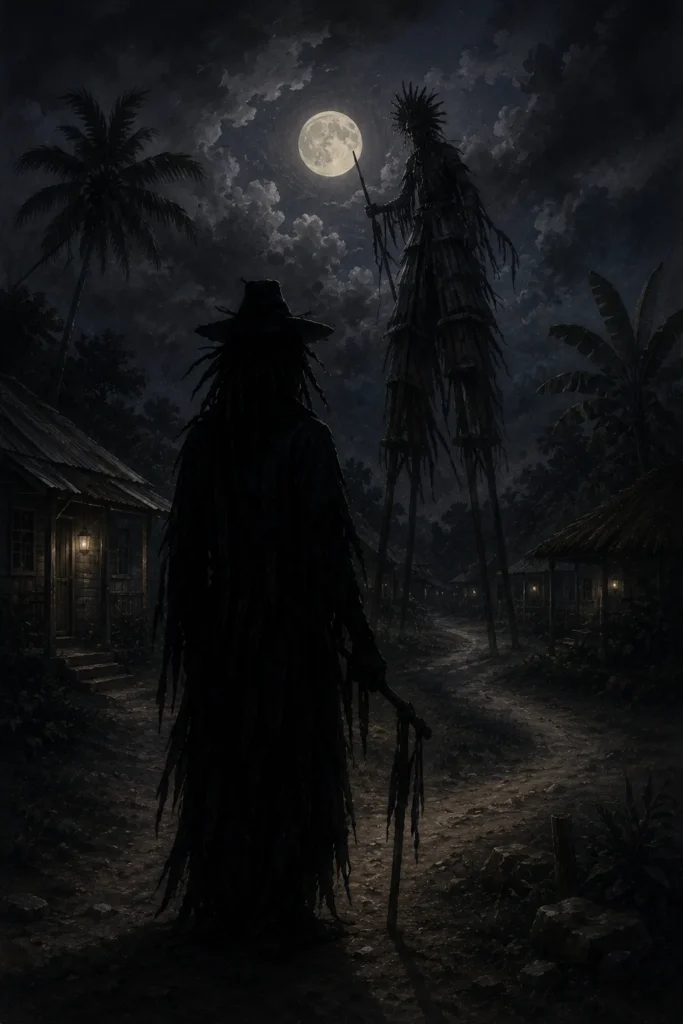
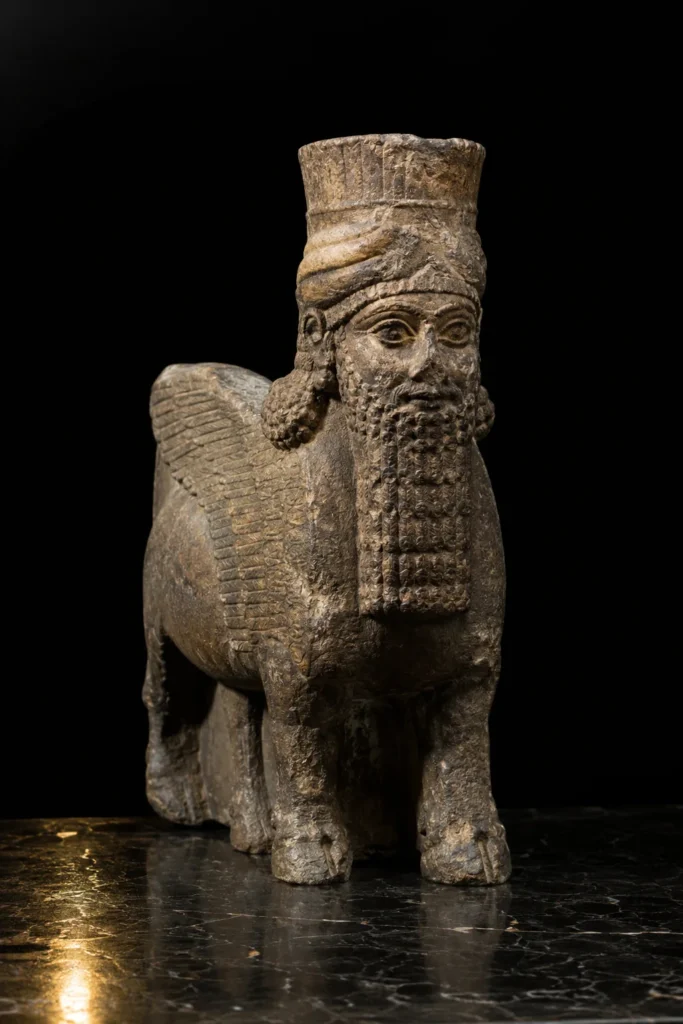
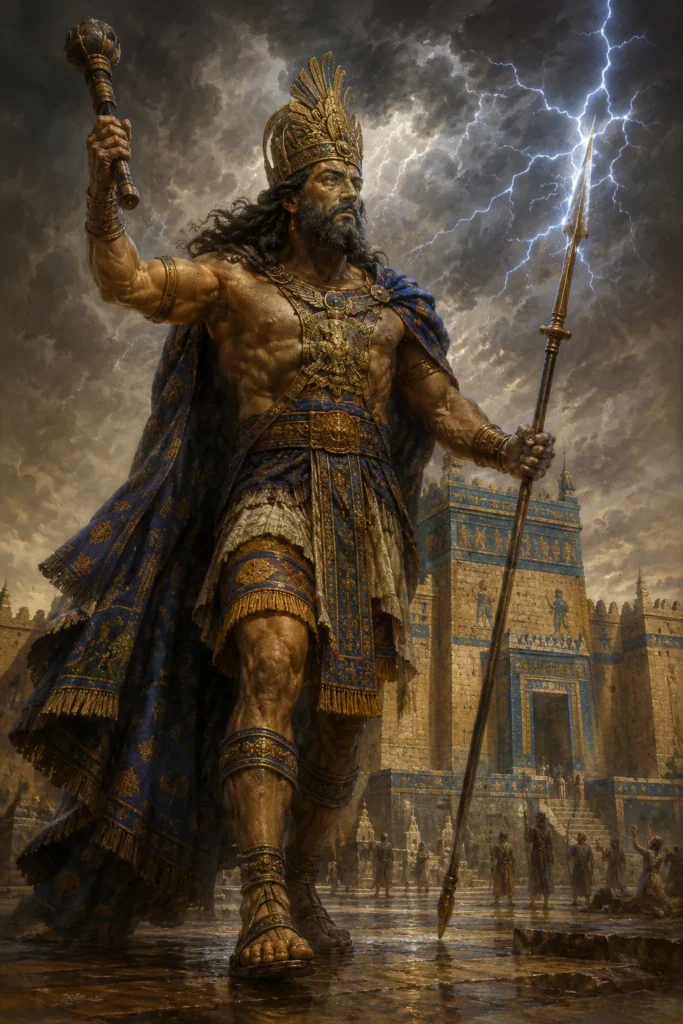
Thunderbird, thunder bird and cosmic storm being of the Native American tradition
By Ralf Ittermann · last reviewed on
Thunderbird (Lakota Wakinyan, Anishinabe Binesi, Northwest Coast T’iista’as in various languages) is the thunder bird and cosmic storm being found in almost all Native American traditions. It is among the most widely distributed religious beings in the religions of the American continent.
The Thunderbird is a storm being of the Native American tradition.
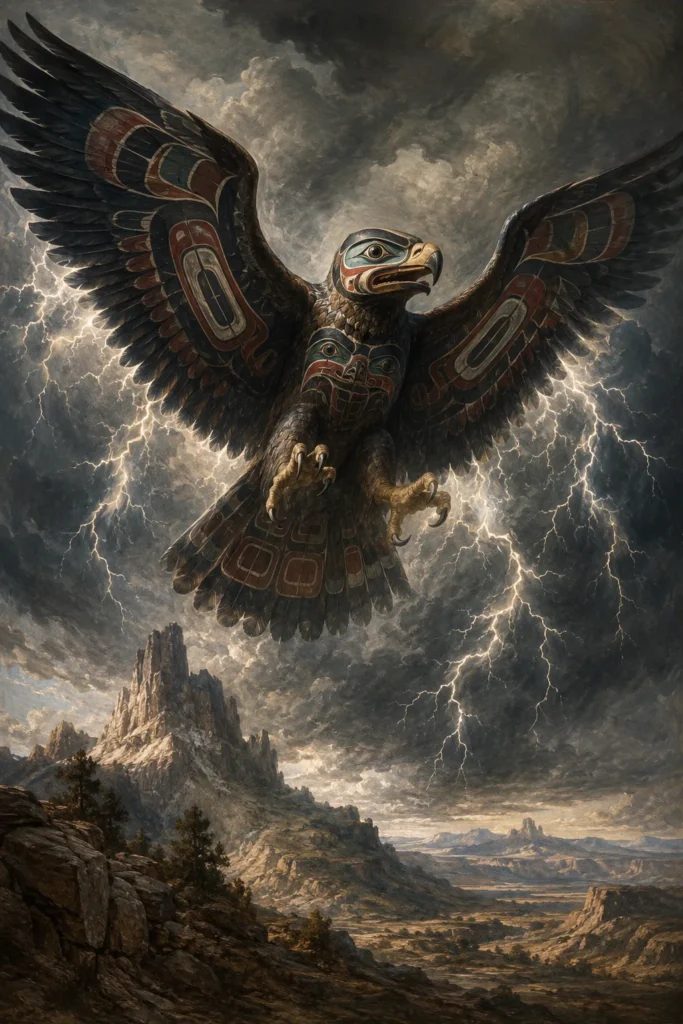
Profile: Thunderbird
Thunderbird: the most important aspects at a glance. The following fields summarise origin, effect, appearance, function, protection and parallels.
The Thunderbird is a thunder bird and storm being found in nearly all North American Native traditions. Names include Wakinyan among the Lakota, Binesi or Animikii among the Anishinaabe and T’iista’as among the Tsimshian.
A lightning strike is regarded as a direct expression of its power. Whoever is struck by lightning and survives is regarded as called by the Thunderbird. Among the Lakota, whoever receives a vision of the Wakinyan must live as a Heyoka, as a sacred fool who does things in reverse.
The Thunderbird is described as a giant bird whose wingspan is said to reach several dozen metres. Among the Plains peoples it appears as an eagle-like bird of prey with grasping talons and a powerful beak, on the Northwest Coast as a richly decorated bird with a long beak.
Its wingbeat produces the thunder, its eyes flash the lightning, its flight brings the rain. In the fight against the water serpent, the Underwater Panther or the Horned Serpent, it compels them with its thunder to release water to the earth as rain.
Against thunderstorms the dwelling was smudged with buffalo sage or sweetgrass at the first thunder, sharp metallic objects were hidden, and the Thunderbird was invoked with respectful prayer formulas. Eagle feathers at the bed and small representations of turquoise or bone were regarded as amulets.
Structurally comparable are the Greek Zeus, the Germanic Thor, the Hindu Indra, the Baltic Perkunas and the Mesoamerican Tlaloc. As bird figures Garuda, Simurgh and Karura are named, as well as the Yakut Suor and the Chinese Lei Gong.
Classification within Native American Religions
The Thunderbird is one of the few beings found across almost all indigenous American language families of North America. Its range covers the Great Plains (Lakota, Cheyenne, Crow, Arapaho), the Great Lakes region (Anishinabe, Cree, Innu), the Northwest Coast (Tlingit, Tsimshian, Kwakwaka’wakw, Nuu-chah-nulth), the Southwest (Pueblo, Navajo), and the American Southeast (Cherokee, Choctaw, Creek).
This pan-American distribution is unusual from a religious-ethnological standpoint and suggests either a shared ancestral tradition or a history of intensive inter-tribal contact.
From a religious-studies perspective, the Thunderbird belongs to the broad class of thunder beings, which play an important role in almost every agricultural or hunter-gatherer culture.
Structurally comparable beings include the Greek thunder of Zeus, the Germanic Thor, the Hindu Indra, the Baltic Perkunas, the Mesoamerican Tlaloc, and in non-anthropomorphic zoomorphic form the Andean-Amazonian thunder-being complex (see Illapa and Yacumama).
The specific character of the Thunderbird tradition, compared to anthropomorphic thunder gods, is its zoomorphic giant-bird form. The Thunderbird is thunder and bird in one; its wingbeats produce thunder, its eyes flash lightning, its flight brings rain.
This zoomorphic embodiment of weather is a religiously and philosophically distinctive contribution of the Native American tradition to global religious history.
Name and Regional Diversity
Depending on the language, the Thunderbird is known as: Wakinyan among the Lakota (from wak = sacred and kinyan = to fly, thus the sacred flyer); Binesi or Animikii among the Anishinabe; Hino among the Iroquois; Tlathl’aakwa among the Tlingit; Kwunusela among the Kwakwaka’wakw; T’iista’as among the Tsimshian; Heyoka-Wakinyan among the Lakota in the specific connection to the Heyoka sacred-clown complex.
Among the Pueblo peoples, a distinct Thunderbird tradition exists under the name Shiwanna, a term also used for the rain-bringing cloud-being Kachina (see Kachina). The Pueblo Shiwanna can be understood in part as predecessors or close relatives of the great pan-American Thunderbird tradition.
In standard English, the term Thunderbird has established itself as a collective designation for all these various indigenous beings. This generalization is problematic from a religious-ethnological standpoint, because it obscures the specific cultural distinctiveness of each individual tradition. Nevertheless, it has become established in academic discourse as a practical umbrella term.
Description and Iconography
The Thunderbird is described in all traditions as a giant bird whose wingspan is said to reach several tens of meters (in some accounts even several kilometers).
Its appearance varies regionally: among the Plains peoples it is usually described as an eagle-like bird of prey with talons and a powerful beak; among the Northwest Coast peoples as an equally richly ornamented, decoratively designed bird with a long beak; among the Anishinabe as a smaller but densely feathered storm bird.
On the totem poles of the Northwest Coast peoples (Haida, Tlingit, Tsimshian), the Thunderbird is one of the most important motifs.
It is depicted there as a stylized flat bird with outstretched wings, a sharp beak, and rich ornamentation. The Tlingit totem poles often show a Thunderbird at the top, symbolizing the full power of the upper sky.
In Lakota and Plains iconography, the Thunderbird appears on painted warrior shields, on drums, and on sweat lodge weavings. The typical Plains Thunderbird depiction shows a stylized bird with two W-shaped lines representing the wings and the lightning, as well as an eye symbol that symbolizes the generation of lightning.
Numerous Thunderbird depictions reaching back over millennia are found on preserved rock petroglyphs of the Plains region and in the southwestern Anasazi area.
A special component of Northwest Coast Thunderbird iconography is the fusion with the whale motif. In numerous Tlingit and Kwakwaka’wakw accounts, the Thunderbird is a whale hunter: it swoops down from the sky onto large whales, seizes them with its talons, and carries them back to the mountain heights.
This whale-hunting tradition reflects the ecological reality of the Pacific Northwest Coast, where the sighting of a large whale was a significant economic and religious-ritual event. On numerous totem poles of the Northwest Coast peoples, the Thunderbird-with-whale constellation is depicted as a central heraldic motif.
Mythological Narratives
The mythological tradition surrounding the Thunderbird is extensive. A central class of narratives describes its eternal battle against the Underwater Panther or Horned Serpent, a chthonic being often described as a water serpent living in the depths of lakes and rivers.
This cosmic struggle between the upper thunder-bird power and the lower water-serpent power is the theological-mythological personification of the weather cycle: the Thunderbird compels the water serpent with its thunder to release water to the earth (as rain), while the water serpent in turn attempts to keep the water in the depths.
This thunder-water-serpent confrontation is found in structurally similar forms among the Lakota, Anishinabe, Iroquois, and Pueblo peoples. It was described by the religious ethnologist Åke Hultkrantz in Belief and Worship in Native North America (1981) as a pan-American cosmological constellation, suggesting a shared ancestral tradition or a very early inter-tribal contact history.
A second class of narratives describes the Thunderbird as teacher of the Heyoka sacred clowns among the Lakota. Anyone who has received a Wakinyan vision is compelled to become a Heyoka, a sacred clown who experiences the world in reverse and behaves in reverse (wearing summer clothing in winter, laughing at grief, crying at celebrations).
This Heyoka tradition is one of the most distinctive religious-ritual structures of Lakota religion and is described in detail by Black Elk and Lame Deer in several autobiographical works.
A third important class of narratives describes the encounter of individual warriors with the Thunderbird.
A well-known Lakota account tells of a warrior who, during a vision quest in the Black Hills, is received by a Wakinyan; the Wakinyan carries him on its wings into the upper sky and shows him the cosmic structure of the world.
Upon his return, the warrior has become a great healer who knows the Wakinyan songs and can perform healings in the sweat lodges.
Such calling narratives are central to the Lakota vision quest tradition and form the theological foundation of the Wakinyan specialist role. Black Elk described his own Wakinyan vision, which made him a lifelong Heyoka.
Cult and Ritual Practice
The ritual veneration of the Thunderbird varies in its intensity across different traditions. Among the Lakota, Wakinyan is one of the most important wakan beings and is regularly invoked in the great rites (Sun Dance, Vision Quest).
Among the Northwest Coast peoples, the Thunderbird has its own masked dances and is a central heraldic animal of several clans (particularly the Tlingit Wolf Clan and the Haida Eagle Clan).
Among the Anishinabe of the Great Lakes region, the most important Thunderbird veneration takes place in the annual spring rites of the Mide society. When the first Thunderbird thunder is heard in spring, it is taken as a sign that the winter season is definitively ending and summer is beginning again.
The Anishinabe Mide rites to welcome the Thunderbirds include elaborate drumming sessions, tobacco offerings, and the preparation of the first spring plantings with invocations of the Thunderbirds.
Among the Pueblo peoples, the Thunderbird as Shiwanna is integrated into the Kachina dances. The Shiwanna Kachina appear in the summer dances, when the need for rain is greatest, and are invoked with special songs that imitate the voice of thunder. Frank Cushing systematically described the Shiwanna tradition in his Zuni studies.
A special ritual component is the Thunderbird drumming tradition. In the larger Plains gatherings, a dedicated Wakinyan drum set is used, specifically connected to the thunder-bird power.
The drum is a large double-hand drum with a stretched buffalo-hide surface whose thunderous sound imitates the Thunderbird’s thunder and thereby draws its presence into the ritual. This drumming tradition has been passed down through generations and ranks among the most impressive musical-ritual phenomena of Native American religions.
Protective Practice and Apotropaic Effect
In most traditions, the Thunderbird is both a feared being and one invoked for protection. A lightning strike is consistently regarded as a direct expression of Thunderbird power; anyone struck by lightning who survives is considered to have been called by the thunder bird itself and must undergo the corresponding ritual processing of that calling.
Concrete protective practices against thunderstorms include smudging the dwelling with buffalo sage or sweetgrass at the first sound of thunder, concealing all sharp metallic objects (which are considered to attract lightning), avoiding standing at a window or under a solitary tree, and addressing the Thunderbird with respectful prayer formulas rather than expressions of fear.
Apotropaic objects against the thunder bird itself, for instance when a family saw the danger of being struck by lightning, included eagle feathers (especially those of the golden eagle, which stands in close iconographic connection to the Thunderbird), hung as a small amulet at the bedside.
Wearing small Thunderbird representations made of turquoise or bone was also a widespread practice. These practices have been repeatedly described in ethnographic works on the Plains peoples (DeMallie, Walker, Brown).
A remarkable constellation is the connection to the Heyoka sacred-clown complex of the Lakota. Anyone who has received a Wakinyan vision must live as a Heyoka, meaning they must do things in reverse in everyday life: walk backward, appear in summer clothing in winter, laugh when others cry, cry when others laugh.
This paradoxical behavior is not regarded as madness but as a religious-ritual manifestation of the thunder-bird power, which challenges the ordinary understanding of the world. William Powers described the Heyoka-Wakinyan tradition systematically in Sacred Language (1986) and identified its theological significance as counter-intuitive holiness.
Parallels in Other Cultures
The thunder-bird tradition is strikingly widespread from a religious-studies perspective.
Structurally comparable beings include: the Hindu Garuda tradition (a bird deity that does not primarily have a thunder function, but is structurally similarly zoomorphic), the ancient Persian Simurgh, the Greek and ancient Arab Phoenix tradition (in its connection to the sun and heat), and the Southeast Asian Karura.
From a religious-ethnological standpoint, particularly noteworthy is the structural similarity between the indigenous American Thunderbird tradition and the Central Asian and Siberian thunder-bird tradition (in particular the Yakut Suor thunder bird and the Chinese mythological Lei Gong).
This similarity has led to the cautious hypothesis that the North American Thunderbird traditions may be historically connected to the Asian thunder-bird traditions, likely via the early Bering Strait migration of the indigenous American peoples.
Within the Native American traditions, the thunder-water-serpent confrontation, Thunderbird versus Horned Serpent, is a pan-American cosmological constellation. It is found structurally also in the Aztec-Mexican Quetzalcoatl tradition (Quetzalcoatl as water serpent) and in some South American water-serpent traditions (see Yacumama).
This pan-American cosmology of the thunder bird and water serpent is one of the most remarkable religious-mythological structural constants of the American continent.
An additional noteworthy parallel is found in the ancient Slavic-Baltic thunder-bird tradition. In Latvian-Lithuanian mythology, there is the Perkons thunder god, who occasionally appears in a bird form; ancient Russian accounts feature the Stratim giant bird connected to storms.
This structural convergence between American, Asian, and northeastern European thunder-bird traditions is of religious-ethnological interest and raises the question of possible historical connections via northern maritime migration routes or the early Bering Strait migration.
Modern Reception and Research
The Thunderbird remains vibrantly alive in the modern Native American tradition.
Among the Lakota, Wakinyan is a central reference in Sun Dance and Vision Quest rites; among the Northwest Coast peoples, it is the heraldic animal of important clans and a part of the modern indigenous art tradition (particularly in the works of Haida sculptors Bill Reid and Robert Davidson).
Among the Anishinabe, it is part of Mide religious practice and contemporary indigenous spirituality.
In academic research, Åke Hultkrantz, James Walker, Joseph Epes Brown, the Tlingit anthropologist Sergei Kan, and the Anishinabe writer Gerald Vizenor (The Trickster of Liberty, 1988) have systematically described the Thunderbird tradition.
The contemporary indigenous writer Louise Erdrich has used the Thunderbird in several of her novels as a symbolic figure of indigenous resilience and enduring cultural connection.
From a religious-studies perspective, the Thunderbird is an important example of a pan-American religious-mythological figure whose structural consistency across different language families and cultural regions raises the longstanding question of shared ancestral traditions among Native Americans.
The specific zoomorphic embodiment of thunder, a bird rather than an anthropomorphic god, is a genuinely indigenous American theological construction and belongs to the distinctive contributions of pan-American religious history. The iWell Guard treatment of the Thunderbird tradition describes these findings from a religious-historical perspective, without any claims of effect or spiritual recommendations.
An important recent line of research connects the Thunderbird tradition to contemporary climate discourses. As North American precipitation patterns change due to climate change, with more frequent extreme weather events, tornadoes, and storms, the Thunderbird theology in indigenous communities serves as a cultural resonance chamber in which these changes are negotiated religiously.
Indigenous writers and activists such as Winona LaDuke and Robin Wall Kimmerer (Braiding Sweetgrass, 2013) have brought the Thunderbird tradition forward as a symbolic reference point for indigenous climate reflection.
Literature and Sources
The following selection lists key works on Native American religion and Thunderbird research.
The Thunder Bird in the Narratives of the Plains: Wakinyan and the Unktehi
Among the Lakota and related Sioux groups, the thunder bird is known as Wakinyan, a term derived from kinyan (“to fly”) and an element connected to the sacred or mysterious.
The Wakinyan stand at the center of a cosmological opposition worked out in numerous orally transmitted narratives: they are the irreconcilable enemies of the Unktehi, horned water monsters that inhabit lakes, rivers, and underground waters.
The thunder over the Plains is interpreted in these narratives as an expression of an ongoing battle between the powers of the sky and those of the depths.
The ethnographic records that James R. Walker compiled between 1896 and 1914 on the Pine Ridge Reservation give these ideas comparatively dense shape. Walker’s informants, including the holy man George Sword, described the Wakinyan as beings located in the west, whose home lies on a mountain and who nest in a nest of dry wood.
Their gaze produces lightning, their wingbeats produce thunder. However, when reading Walker, it should be noted that he partially systematized his material and attempted to bring it into an ordered theology that does not always correspond to the original polyphony of the tradition.
In the narratives, the thunder bird often appears ambivalent. It is a purifying force that removes decay and refuse from the land, yet at the same time dangerous and unpredictable.
Anyone struck by lightning or visited by the Wakinyan in a dream is, in some traditions, obligated to become a heyoka, a ritual contrarian who does everything in reverse.
This connection between the thunder bird and the Heyoka role shows that the being was understood not only as a natural power but as the source of a distinctive social and religious calling. Related ideas are found among the Native American cultures of the Great Lakes as well as among tribes of the Northwest Coast.
Thunder Bird and Whale: The Iconography of the Northwest Coast
While the thunder-bird concepts of the Plains are strongly shaped by myth and narrative, the being appears on the Pacific Northwest Coast primarily in the visual arts and ceremonial systems.
Among the Nuu-chah-nulth, Kwakwaka’wakw, and neighboring groups, the thunder bird is an important heraldic animal appearing on totem poles, house fronts, masks, and ceremonial objects. Characteristic is the depiction with swept-back wings, a powerful hooked beak, and often two upright feathered ears or horns.
A recurring pictorial theme is the thunder bird lifting a whale from the sea. This scene refers to a narrative cycle in which the thunder bird appears as a hunter that carries off the whale as prey.
In some Nuu-chah-nulth traditions, this motif is linked to the memory of real catastrophes: researchers such as Ruth Ludwin have connected accounts of the battle between the thunder bird and the whale to historical earthquakes and tsunamis along the Cascadia Subduction Zone, particularly the great earthquake of 1700. This interpretation remains a hypothesis, but it shows how closely mythic images can be interwoven with the geophysical experience of a region.
In ceremonial dances, the thunder bird appears as a masked figure, often with moving parts that set the beak or wings in motion. Such transformation masks could open during the performance to reveal a second face, making the being’s capacity for transformation visible.
The mask was the hereditary property of certain families and could only be worn by those entitled to do so. Thus on the Northwest Coast, the thunder bird was not solely a cosmic power but also an element of social order, making visible rank, lineage, and property rights.
Sources and Research History: How the Thunder Bird Was Transmitted
Knowledge of the thunder bird rests almost entirely on oral tradition, which was first set down in writing late and mostly by non-indigenous observers.
The most important source collections were produced within the framework of North American ethnology between approximately 1880 and 1930. Franz Boas and his collaborators, including George Hunt, collected extensive text corpora on the Northwest Coast; on the Plains, alongside Walker, recorders such as Frances Densmore were also active, documenting songs as well.
This source situation is methodologically delicate. The records were produced during a phase of massive cultural suppression: ceremonies such as the Potlatch were at times legally prohibited in Canada, and religious practices of the reservation population were impeded in the United States.
Informants therefore spoke under pressure and sometimes with reservations. In addition, translators and collectors brought their own ideas; the term “thunder bird” itself is an English coinage that groups very different indigenous concepts under one collective name.
More recent research has therefore abandoned the aspiration to reconstruct a unified “thunder bird myth.” Instead, it is emphasized that these are a family of related but distinct concepts, ranging from the Algonquian language groups of the Great Lakes through the Sioux peoples of the Plains to the Salish and Wakashan speakers of the coast.
Where older works speak of “the thunder bird,” it would be more precise to speak of thunder-bird-like beings. A further line of research examines archaeological references, such as bird representations on objects of the Mississippian culture, but the continuity between prehistoric iconography and the historically documented concepts cannot be established with certainty.
Literature (Selection)
- Åke Hultkrantz: Belief and Worship in Native North America (1981)
- James Walker: Lakota Belief and Ritual (1980)
- Joseph Epes Brown: The Sacred Pipe (1953)
- Sergei Kan: Symbolic Immortality (1989)
- Gerald Vizenor: The Trickster of Liberty (1988)
- John Bierhorst: The Mythology of North America (1985)
In many Native American traditions, the Thunderbird is regarded as a cosmic storm bird whose wingbeats trigger thunder and whose gaze triggers lightning, and which embodies the battle against the water monsters of the deep.
Related key terms: Thunderbird Wakinyan Animikii Hino Shiwanna Heyoka Underwater Panther Horned Serpent.
iWell Guard and Protective Traditions
iWell Guard draws on the cultural-historical tradition of wearable protective objects, in the tradition of Native American and many other cultures worldwide. 41 levels, real gold, platinum, silver, crafted in Germany. 30-day return policy.
Individual experiences may vary. Not a medical device. No healing promises.