Kachina (Hopi katsina, Zuni koko, known under their own names in other Pueblo languages) designates a class of spirit helpers of the Pueblo peoples of the southwestern United States. The Kachina tradition encompasses around 400 distinct individual beings, each with their own tasks, iconographies, and ritual functions.
Kachina are central to the Pueblo religion as ancestral spirits and rain-bringers, appearing as spirit helpers of the living.
Within the Pueblo religion, Kachina is regarded as a central Hopi spirit being that embodies the connection between humans, ancestors, and cosmic powers.
The Kachina form a central class within the Pueblo religion. They are venerated especially among the Hopi (Arizona) and Zuni (New Mexico) within a highly developed ritual-practical tradition; the other Pueblo peoples (Acoma, Laguna, Tewa Pueblos) have their own, partly different spirit being classes.
From a religious-studies perspective, the Kachina belong to the broad class of spirit helpers, beings that mediate between the highest creative principles (see Spider Grandmother) and human beings. Structurally comparable are the Japanese kami, the Tibetan-Buddhist yidam, Catholic saints, and the Afro-Brazilian Orixas.
The Kachina are not deities in the strictly monotheistic sense, but rather numinous mediating beings that become truly present in ritual-practical settings when the masked dances take place.
The theological crux of the Kachina tradition is the doctrine of manifestation: when a Hopi man puts on the Kachina mask and dances in that ritual-practical context, he is not acting as a Kachina, but the Kachina itself becomes present in him.
This presence-theology has been systematically described by Hopi theologian Emory Sekaquaptewa and Hopi researcher Barbara Tedlock in their works.
An important theological distinction is the strict gender separation of the Kachina tradition: male Hopi initiation includes knowledge of the Kachina secrets (that the masks are worn by men); female Hopi initiation covers other, equally secret complexes (in particular the connection to Spider Grandmother and to the women’s secret societies).
This gender-differentiated religion was particularly difficult for the Spanish mission to grasp, because it had no comparable structure in the Catholic tradition.
The Spanish missionaries of the 17th century partly interpreted the Pueblo religion as demon worship and stumbled into the great Pueblo Revolt of 1680, which was partly triggered by the Spanish persecution of the Kachina religion.
The Hopi term katsina literally means respectful spiritual presence or sacred encounter. Its linguistic history is not definitively explained; a probable etymology connects it to the root ka- (sacred) and tsina (place, presence).
The popular English spelling Kachina, which became current in the 19th century through the spread of Kachina dolls (small wooden figure representations of the Kachina) in American Anglo-Saxon collector circles, is a simplified form of the correct Hopi spelling katsina.
The Hopi Tribal Council has repeatedly called for a return to the correct spelling since the 1980s; in academic discourse, katsina is now the standard spelling.
Among the Zuni, the corresponding class of beings is called koko or kokko; the Zuni masquerade tradition is structurally related to the Hopi tradition, but independently developed in its details.
In the Keresan Pueblos, the masquerade beings are called shiwanna, which literally means cloud beings and highlights the specific rain-bringing function of this class of beings.
The Hopi tradition recognizes between 250 and 400 different Kachina, depending on how they are counted. They are divided into several main classes.
The Chief Kachina are the most important principal figures, including Eototo (Chief of the Kachinas, a kind of supreme Kachina), Aholi (his companion), Sotuknang (Creator Kachina) and Massaw (Earth-and-Death Kachina, who received the Hopi upon their entry into the Fourth World).
A second class is the Mong Kachina, dignified, ancient companion beings who appear in the main ceremonies as instructors and teachers. A third class is the Wuya Kachina, clan-specific Kachina venerated only by a particular Hopi clan.
A fourth class is the Whipper Kachina, the punishing spirit beings (Hu, Wuwuyom, Tungwup), who use yucca whips to correct inattentive or disrespectful Hopi children.
A fifth class is the Clown Kachina, the comic and satirical spirit beings (in particular the Koshare and the Koyemshi), who appear during the intermission periods of the main ceremonies and correct the community’s social behavior through satirical acts.
These clowns have an important pedagogical and social function and have received intensive attention in the ethnological literature.
An important class of Kachina that does not fit into the main classification is the Mudhead Kachina (Koyemshi). They are the clown beings with characteristic round-headed clay masks and strikingly asymmetrical costumes.
In Hopi theology, the Mudheads represent the cosmological First World of Hopi creation and bear cosmological responsibility for the survival of the world. They are simultaneously comic and serious, a paradox that constitutes their theological significance. Frank Cushing described the Mudhead tradition extensively in his Zuni studies, highlighting their paradoxical dignity in comedy.
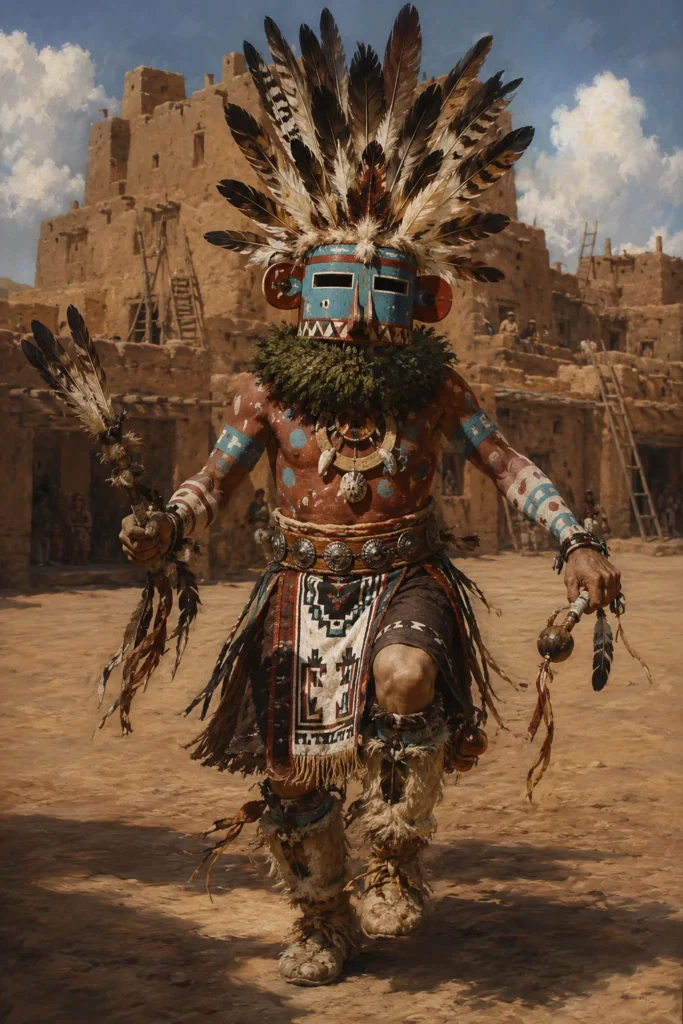
In ritual-practical presence, the Kachina are recognizable by their characteristic masks and regalia. Each Kachina has its own highly specific mask, formed from wood, leather, or cloth, with incorporated feathers, hair, shell ornaments, and colored paintings.
The mask is not for concealment but for the manifestation of spirit presence: whoever puts on the Kachina mask becomes the Kachina.
In addition to the mask, a complete costume of traditional dress, leather adornments, jewelry, and ritual tools belongs to each Kachina.
The Hopi costume tradition is highly standardized: each Kachina has its specific attire, passed down through generations. The mask and costume are not, in the Hopi sense, clothing, but material manifestations of the spirit being’s identity.
The Tihu, the Kachina dolls, small carved wooden figures that accurately reproduce the appearance of the individual Kachina, were traditionally given to Hopi girls as religious-pedagogical learning material. They served to help identify and recognize the individual Kachina with their specific characteristics.
Since the 19th century, Tihu dolls have become a popular collector’s item on the American art market, leading to commercial production that partly takes place outside traditional religious contexts.
Since the 1990s, the Hopi Tribal Council has established strict rules about which Tihu dolls may be sold and which, as religious-ritual objects, are not available for sale.
In Hopi theology, the Kachina have a specific cosmological function: they live in the Fourth World, the world in which the Hopi currently exist, only from February to July; for the rest of the year they dwell in the sacred mountains, in particular in the San Francisco Peaks near Flagstaff, Arizona, where the sacred Nuvatukyaovi summit (Snow-Covered Highest Place) is located.
In February the Kachinas return to the Hopi villages; this is the Soyalangwuul ceremony at the winter solstice, which marks the beginning of their return.
Over the following six months, various ritual dances take place in the Hopi villages on the Mesas (Walpi, Sichomovi, Hano, Shongopovi, Bacavi, Hotevilla, Oraibi, Mishongnovi), each dedicated to a specific function: bringing rain, securing the harvest, warding off illness, and children’s initiation.
The highlight of the Kachina year is the Niman Kachina, the Home Dance ceremony in July, in which the Kachinas leave the Hopi villages and return to the mountains.
This ceremony is accompanied by an elaborate gift-giving: the arriving Kachinas distribute Tihu dolls, fresh ears of corn, watermelons, and small gifts to Hopi children and women before departing for good.
The Niman ceremony is accessible to non-Hopi only in the rarest of cases; the Hopi Tribal Council has greatly restricted access since the 1990s to protect cultural authenticity.
Another important Kachina event is the Powamuya ceremony in February, also called the Bean Dance. It marks the mid-winter high feast and comprises a sixteen-day ritual sequence with numerous Kachina appearances.
In the kivas (underground ceremonial chambers), Hopi men sprout symbolic bean seeds during this ceremony under conditions that simulate summer warmth; the growing bean plants are then brought out of the kivas on the last day in a processional manner and distributed to Hopi children as a forerunner of the actual summer.
This symbolic summer simulation was systematically described by Jesse Walter Fewkes in his classic Hopi studies.

The Kachinas have a broad protective function in the Hopi tradition. They protect the villages from harmful spirits, ensure agricultural production (in particular through rain-bringing), and mediate between the Hopi ancestors and the living.
Concrete protective practices include placing Tihu dolls above the door lintel or in children’s cribs, hanging small wooden replicas of specific Kachina masks in living spaces, and the ritual invocation of particular Kachina in specific emergencies (for example Eototo in times of drought, Massaw at a death in the family, Hu in cases of children’s misbehavior).
A particularly important protective practice is the puberty initiation of Hopi children. At around eight years of age, children are first initiated into deeper knowledge of the Kachina tradition.
In this initiation, which involves a ritual yucca-whipping hierarchy in which the Whipper Kachina symbolically guide children through social learning, the children learn that the Kachina masquerade is worn by human men, and that at the same time the spirit presence is real.
This paradoxical communication, masculinity and spirit presence at once, is the core secret of the Hopi religion and is highlighted in ethnological discussion as an example of highly sophisticated religious-philosophical theology.
A specific protective practice is the Tihu burial. When a Tihu doll has been used as a religious-ritual object and is no longer actively needed, it is not thrown away or sold, but rather laid to rest in a small, dedicated burial ceremony beneath a rock or in a mountain crevice.
This practice reflects the theological understanding that the Tihu doll itself contains a small numinous presence that must be treated with respect. Comparable burial practices for ritual objects are widespread in many Pueblo traditions and differ fundamentally from the secular treatment of religiously charged objects in Western-secular culture.
The Kachina masquerade tradition has received much attention in comparative religious studies. Structurally comparable are the Japanese Noh and Kagura mask theatres, the African initiation mask traditions (especially in West and Central Africa), the Maya and Aztec mask tradition, and the Tibetan-Buddhist Cham dance tradition.
In all these cases, a specific theological construction is at work: the mask is not concealment but manifestation; the mask wearer is not an actor but is themselves the manifested being. This manifestation theology is philosophically complex and is described in comparative study as an incarnational ritual phenomenon.
Within Native American traditions, the Kachina tradition shows close parallels to the Northwest Coast masked-dance tradition (Kwakwaka’wakw, Tlingit, Tsimshian) and to the Pueblo-kindred Yei-bi-chai tradition of the Navajo.
The Pueblo Kachina and the Navajo Yei are not identical in terms of religious ethnology, but are structurally related; the Navajo most likely adopted their Yei tradition from Pueblo contacts of the 16th and 17th centuries and developed it further.
A further relevant parallel is the ancient Greek Eleusinian Mysteries tradition, in which masked appearances and the embodiment of the goddess Demeter/Persephone by initiated mystai were also a central theological element.
The structural convergences between the Hopi Kachina rites and the Eleusinian Mysteries have been repeatedly noted in comparative religious studies since Walter Burkert, though without suggesting any historical connection: these are convergent developments under similar sociocultural conditions of an agrarian, calendar-based religiosity.
The Kachina tradition is today one of the most vibrant and unbroken religious traditions of the Native American peoples. The Hopi religion on the Hopi Mesas and the Zuni religion in the Zuni Pueblo are practiced in a form that the Spanish mission (16th and 17th centuries) and the subsequent American colonization influenced only marginally.
In academic research, Jesse Walter Fewkes, Frank Cushing, Elsie Clews Parsons, Alfonso Ortiz, Hopi theologian Emory Sekaquaptewa, and contemporary Hopi researcher Wendy Rose have systematically described the Kachina tradition.
The classic Kachina list by Harold Colton (Hopi Kachina Dolls, 1959) remains an important identification reference, though it has been criticized by the Hopi as not entirely accurate.
From a religious-studies perspective, the Kachina tradition is a paradigmatic example of a highly complex indigenous religion with a differentiated pantheon, sophisticated theology, and continuous ritual-practical presence.
The fact that a tradition with around 400 different spirit beings has been transmitted over centuries without a written culture, exclusively through oral tradition and ritual-practical presence, ranks among the most notable findings of religious ethnology.
The iWell Guard reference to the Pueblo tradition describes these findings from a religious-historical perspective, without making any claims of efficacy or spiritual recommendations.
An important more recent field of research is the question of Tihu doll authenticity. As Tihu dolls developed into a valuable collector’s item from the late 19th century onward, a growing industry of non-Hopi-produced Tihu imitations has emerged, sold in tourist shops in Arizona and New Mexico.
In 1992, the Hopi Tribal Council established the Hopi Cultural Preservation Office, which among other tasks is charged with addressing the improper reproduction of Tihu dolls and protecting the cultural authenticity of Hopi art. These efforts are embedded in the broader discussion of indigenous cultural rights and the intellectual property of indigenous communities.
The following selection lists key works on Pueblo religion and Kachina research.
Among the Hopi and Zuni of the American Southwest, the beings known as katsina, usually spelled Kachina in English-language literature, are bound to a fixed annual cycle.
According to received understanding, the katsina spend part of the year among the people and the remainder at a distant place, which among the Hopi is associated with the San Francisco Peaks. Their arrival and departure structure the ceremonial year.
During the time of their presence, katsina appear at public ceremonies, embodied by men of the community who perform in appropriate regalia and mask.
These appearances are not conceived as mere representation; according to Hopi understanding, the performer is connected in a special way to the being during the ceremony. The katsina are associated with rain, fertility, and the well-being of the community, which carries existential significance in the arid highlands of the Southwest.
The ethnographic documentation is extensive, but viewed critically by the Hopi community. Jesse Walter Fewkes produced numerous descriptions and illustrations around 1900, and later researchers also documented the complex.
The Hopi tribal government has repeatedly objected to the publication of images and details of the ceremonies and considers a large part of this knowledge not intended for the public. A responsible account respects this position and confines itself to the generally known framework, without elaborating on ritual details.
Closely associated with the katsina are the carved figures known in Hopi as tihu. They represent individual katsina and were traditionally given primarily to children, especially girls. Their function was to familiarize recipients with the large number of different beings; they are therefore less toys than teaching aids within religious education.
Over the course of the 20th century, these figures gave rise to a significant art market. Collectors of the early 20th century were already acquiring tihu, and from the middle decades onward an increasing number of figures were carved expressly for sale.
These market pieces often differ in material, level of detail, and pose from the older figures intended for use within the community. Research records a tension between the religious origin of the figures and their status as collectibles.
The Hopi community itself distinguishes between figures connected to the ceremonies and those produced for sale. The former are considered non-tradeable. There have in the past been disputes over auctions in which objects were offered that the Hopi regard as sacred and not for sale, including other ritual objects.
These conflicts touch on fundamental questions of cultural property protection and the treatment of indigenous religious heritage.
For the portrayal of the katsina, the point is significant because it shows that the beings are tangible not only in narrative and ceremony, but also in a material heritage whose status remains contested to this day.
The Kachina of the Pueblo religion connect the spheres of the living and the ancestors in a distinctive way: they are regarded as spirit figures of the deceased who return to the villages as clouds, rain-bringers, and helpers.
In the ceremonies of the Hopi and Zuni they manifest through masked dancers, while carved Tihu figures make their nature tangible.
Related key terms: Kachina Katsina Koko Hopi Zuni Pueblo Soyalangwuul Niman Tihu Eototo.
iWell Guard draws on the cultural-historical tradition of wearable protective objects, in the tradition of Native American and many other cultures worldwide. 41 layers, real gold, platinum, silver, made in Germany. 30-day return policy.
Individual experiences may vary. Not a medical device. No healing claims.
Against its influence, cross-cultural tradition names these protective means:
Compare in the Protection Compass →Recommended protective means
The simplest protective means in this collection: 41 layers of fine gold 999, platinum, silver and silicon, manufactured in Ruhla, Thuringia. It requires no activation, is bound to no person, and is effective within a radius of around 50 meters, even without being worn.
Related Beings

Satyrs: the wild nature spirits in the retinue of Dionysus. Hesiod's judgement, the satyr play, v...

The Hinn, the lower pre-djinn class of Arabian tradition. Origin, classification and the religiou...

The Shellycoat, a shell-hung water spirit of the Scottish Borders. Origin, the clattering garment...

Aleya, the Bengali marsh spirit-light of drowned fishermen. Origin, its dual nature and its class...

Canwyll Corff, the Welsh corpse candle. Origin, the wandering death light, the interpretation of ...

Striga, blood-sucking night bird of Roman tradition. Early form of the later vampire and witch fi...