Mula sem cabeça, cursed on the night from Thursday to Friday
By Ralf Ittermann · last reviewed on
Mula sem cabeça is a spirit of Brazilian tradition.
A woman, cursed into a fire-breathing mule without a head.
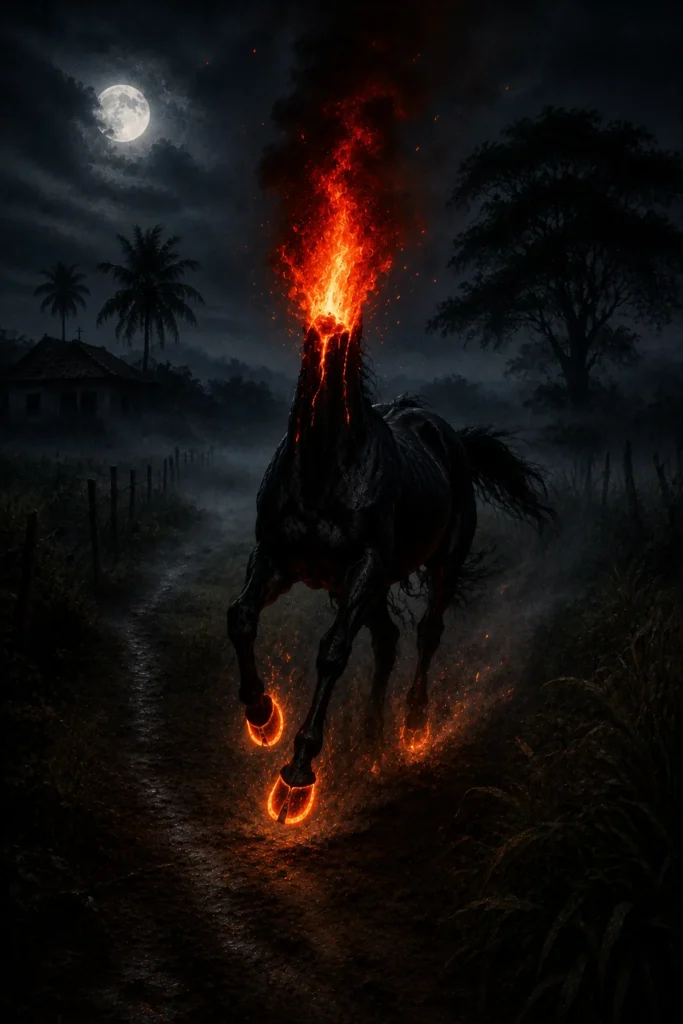
Mula sem cabeça, the headless mule woman, is a Brazilian curse figure. A woman who had a relationship with a priest transforms at night into a fire-breathing, headless mule that gallops and neighs loudly as it races through the countryside.
The legend has Iberian roots and was carried to Brazil during the colonial period, where it is especially widespread in rural areas, in the sugar cane regions of the northeast as well as in the interior of the southeast. It is above all on the night from Thursday to Friday that the transformation befalls travellers and rural populations.
Type: Brazilian curse figure, a woman transformed into a fire-breathing mule
Origin: Iberian folk legend, carried to Brazil in the colonial period
Texts: Canonical in Luís da Câmara Cascudo
Period: Widespread Brazilian folk legend, persisting to the present day
Appearance: Black or brown headless mule with a fire torch in place of the head
Context of tradition
Period of the Texts
A widespread Brazilian folk legend with Iberian roots, treated canonically in the work of Luís da Câmara Cascudo.
Area of Diffusion
Rural Brazil, especially the sugar cane regions of the northeast and the interior of the southeast.
Sources
Good: Luís da Câmara Cascudo treats the legend in his Dicionário do Folclore Brasileiro.
Name and variants
Portuguese: Mula sem cabeça literally means mule without a head. The curse figure is a woman cursed by God for her sin, often specifically for a concubinage or an illicit relationship with a priest.
Form and effect
Appearance
Headlessness and fire in place of the head stand for disfigurement and punishment. The mule, a sterile hybrid, underscores the unfruitful sin, and the transformation from Thursday to Friday links the curse to the church calendar and to Good Friday.
Effect
At night the woman transforms, and the fire-breathing mule gallops through the area with an ear-splitting neigh. It startles travellers and rural populations, remaining above all a figure of fright and curse.
Profile: Mula sem cabeça
The key aspects of the headless mule woman at a glance.
Brazilian folk legend with Iberian roots, recorded canonically by Luís da Câmara Cascudo.
Travellers and rural populations who encounter her at night on isolated paths.
Black or brown headless mule with a blazing fire torch in place of the head.
A figure of fright and, at the same time, a punishment: a warning against a love affair with a priest.
Hiding, shedding blood, or removing the iron bridle to break the curse.
The curse for loving the priest
Mula sem cabeça, Portuguese for mule without a head, denotes a woman cursed by God for her sin, often specifically for a concubinage or an illicit relationship with a priest. The punishment transforms her at night into the headless animal that gives her name.
The legend has Iberian roots and was carried to Brazil during the colonial period, where it took hold especially in rural areas. Luís da Câmara Cascudo treats it in his Dicionário do Folclore Brasileiro and also points to a possible influence of the Greek centaur figure.
School curriculum and folklore canon
The Mula sem cabeça is among the best-known Brazilian legends and is a fixed part of the folklore canon, of Folklore Day, and of school curricula, with countless retellings in comics, children’s media, and horror media.
In religious-studies terms, she is a curse for a sexual taboo, the relationship with a priest, and a church-moral cautionary tale with Iberian import and an anchoring in the Christian weekly calendar: the night from Thursday to Friday links the curse directly to the church calendar.
Hiding, blood, and the iron bridle
It is well documented that hiding offers protection: according to tradition, whoever lies face down on the ground and conceals their nails and teeth is not attacked. Shedding blood, for instance through a slight injury with a needle, breaks the curse, as does removing the iron bridle: only when the iron of the bridle falls does the transformation end. The priest himself can also lift the spell. A worn amulet also counts among the traditional protective signs against nocturnal cursed figures, and holy water works as a Christian sign against the cursed woman.
Headless riders between Brazil and Europe
As a headless frightening figure, the Mula sem cabeça corresponds to the internationally widespread motif of the headless rider and to the Irish Dullahan, a likewise headless, nocturnally riding frightening being. Câmara Cascudo also points to the Greek centaur as a possible influence on the motif. Tradition names further related figures such as the Venezuelan La Sayona, the Caribbean Lagahoo and the Chinese Wutou-gui.
Frequently asked questions about the Mula sem cabeça
When does the Mula sem cabeça transform?
At night, especially in the night from Thursday to Friday, since the transformation is tied to the church calendar.
How is the curse broken?
By shedding blood, for instance a slight injury with a needle, by removing the iron bridle, or by the priest himself.
Why does she transform into a mule specifically?
As punishment for the affair with a priest: the headless fire mule, an infertile hybrid, embodies the cursed woman and her sin, interpreted as infertility.
Further links
Further reading:
- La Sayona, Lagahoo – related American frightening figures
- Wutou-gui – related spirit of China
- Iron, amulet, holy water – traditional protective means
- Protection Compass – protective means at a glance
Literature (selection)
Further standard works in the bibliography.
As a headless she-mule, the Mula sem cabeça remains a Brazilian cursed figure bound to the night from Thursday to Friday, released only by blood, the iron bridle or the priest himself.