Pesta, the old woman with rake and broom
By Ralf Ittermann · last reviewed on
Pesta is a spirit of Norwegian tradition.
Rake or broom decide over life and death.
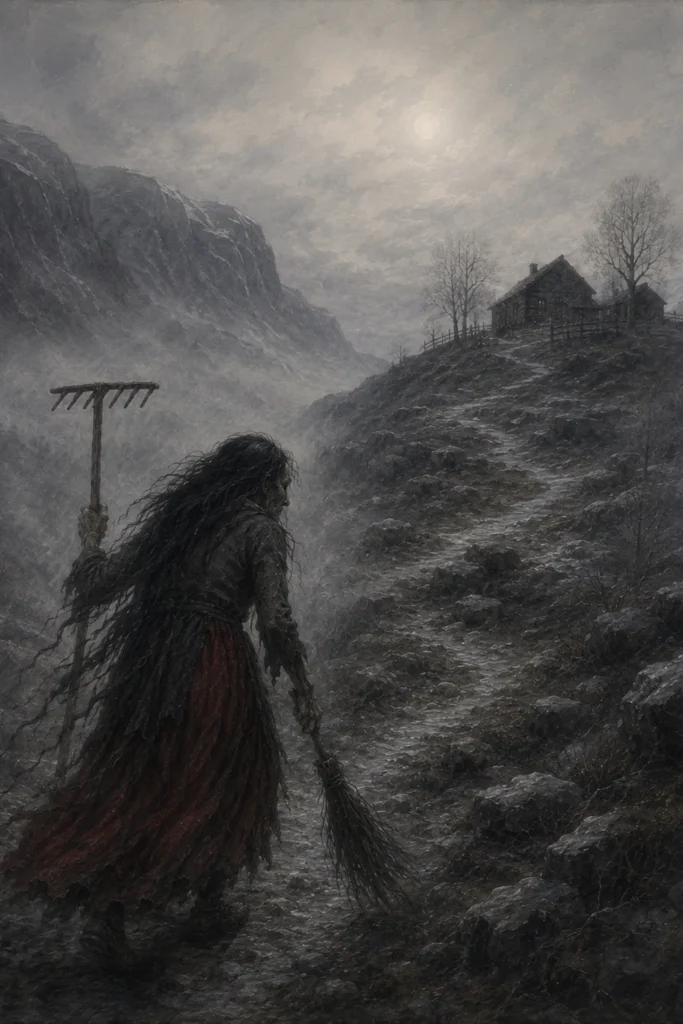
Pesta is the Norwegian embodiment of the plague, an ashen-pale old woman who moves from farm to farm, bringing the pestilence with her. With a rake and a broom she decides over life and death: the rake lets some escape between the tines, the broom sweeps everyone away.
Her figure is that of the Black Death, which raged in Norway from 1349 and recurred until 1654. The painter Theodor Kittelsen made the figure iconic with his 1900 work Svartedauen, which continues to shape the Norwegian memory of the plague to this day.
Type: Female personification of the plague
Origin: Norwegian folk legends of the Black Death
Texts: Legends and Theodor Kittelsen’s Svartedauen
Period: Legends from the plague era, artistic depiction around 1900
Appearance: small, old, ash-grey woman with rake and broom
Historical Background
Period of the Texts
Norwegian folk legends of the plague: the figure condenses the experience of the Black Death, which raged from 1349 and recurred until 1654, and was given artistic form by Kittelsen.
Area of Diffusion
Norway. Pesta travels across the land from farm to farm; her arrival at a farm means the pestilence.
Sources
Good: the traditional legends and Theodor Kittelsen’s pictorial work Svartedauen.
Name and variants
Language: The name Pesta is the female personification of the plague. In the legends she appears as a tangible figure of the Black Death, not as an abstract disease.
Form and effect
Appearance
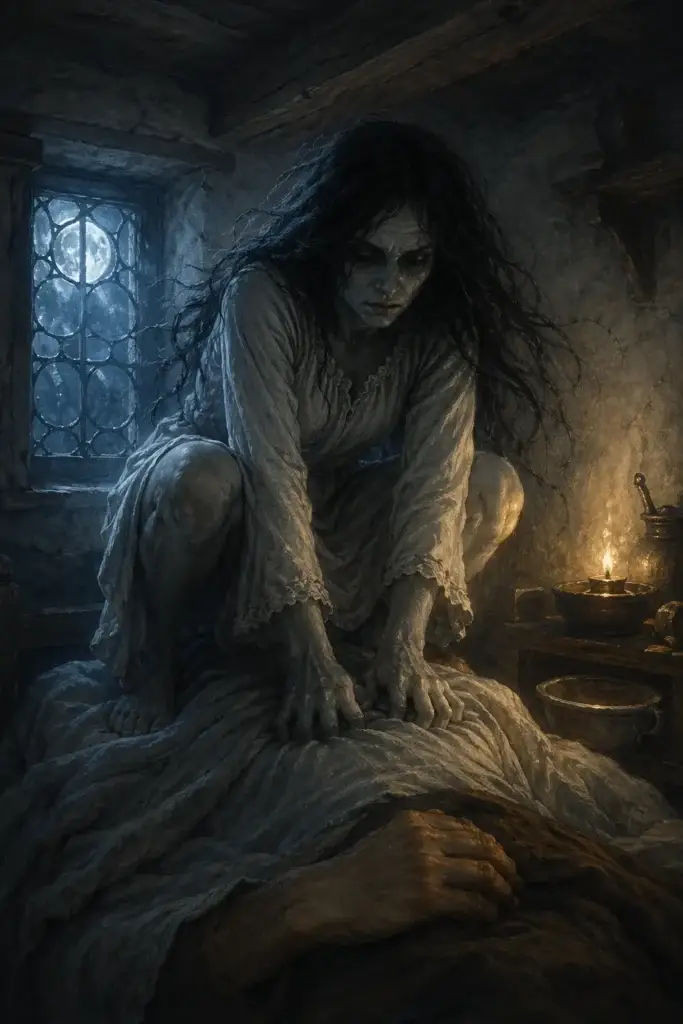
Pesta appears as a small, old, ash-grey, pale woman with black eyes, black hanging hair and a red or blue skirt. Her central signs are a rake and a broom.
Effect
The tool she uses decides the fate of a place: the rake means that she rakes through and some escape between the tines, so some survive; the broom means that she sweeps everything away and no one survives.
Profile: Pesta
The key aspects of the Norwegian plague figure at a glance.
Norwegian folk legend of the Black Death, artistically condensed in Theodor Kittelsen’s Svartedauen.
Entire farms and villages: Pesta brings widespread death, the extent of which is determined by her tool.
A small, ash-grey old woman with black hair and a red or blue skirt, holding the rake in one hand and the broom in the other.
Personification of mass death: the pestilence becomes an acting figure that decides over the partial or total loss of a place.
Negotiation and delay instead of destruction: in the legend of the ferryman, only the manner of death can be softened, not its arrival averted.
Unlike the corporeal Nachzehrer or the Gjenganger, Pesta is not a dead person returned from the grave, but an allegory of plague, closer to the Breton Ankou as a figure of death.
Rake and broom over life and death
Pesta travels from farm to farm, bringing plague. In the legend of Pesta and the Ferryman, she asks to be taken across a river; the ferryman recognises her too late and negotiates a quick, easy death, since his name is already in her book.
The image of the rake and the broom lies at the heart of her tradition: it renders the intangible act of dying graspable as a decision on whether a place is partly or wholly wiped out. In this way, the legend links helplessness before plague with the wish for an explanation.
Reception and classification
Pesta became iconic through Theodor Kittelsen’s Svartedauen of 1900; Kittelsen is regarded as a master of the macabre in Norwegian art. She remains a central image of Norwegian plague memory to this day and is present in museums such as the Nasjonalmuseet.
From a religious-studies perspective, Pesta is the personification and demonisation of a natural catastrophe as a female figure of terror. She links the fear of death with the need to personalise and make explicable the intangible mass dying, and stands close to the plague maiden and personified death, not to the revenant type.
Warding off the plague, not the figure
In the legends, Pesta can barely be warded off; the motif is negotiation and delay, not destruction, since she is a personification and not an exhumable corpse. The documented protective acts concern general defence against plague: holy water as a Christian sign, smoke cleansing against air held to be contagious, and the sound of consecrated bells, which during plague times was regarded as a protective sign against disaster.
Plague figures and personified death
Pesta is related to the Central European plague maiden and stands close to personified death and the reaper, though she carries a rake and broom instead of a scythe. She differs from the Breton Ankou, who gathers souls, in her collective aim: not individual death, but the dying of entire farms. She is clearly distinguished as an allegory from revenants such as the Nachzehrer and the Gjenganger.
Frequently asked questions about Pesta
Is Pesta a revenant?
No, she is the personification of plague, not a dead person returned from the grave.
What do the rake and the broom mean?
The rake means some survive; the broom means all die.
Where does her well-known image come from?
Chiefly from Theodor Kittelsen’s work Svartedauen of 1900.
Further links
Further reading:
- Germanic – beings of Germanic and Nordic tradition
- Nachzehrer, Gjenganger, Ankou – related figures of the dead and of death
- Holy water, smoke cleansing, bells – traditional protective means
- Protection Compass – protective means at a glance
Literature (selection)
Further standard works in the bibliography.
As Norway’s plague personification and plague maiden, Pesta turns the intangible mass dying into an acting figure: a rake or a broom in her hand decides whether a farm is partly spared or wholly wiped out.