iWell Guard

Holzfräulein, the little wood woman from Schönwerth's Upper Palatinate

The Holzfräulein is a spirit of German tradition.

The shy wood woman who helps, advises and herself seeks protection.

SpiritGermanic

Table of Contents

Wood Maiden, spirit of Germanic tradition
Holzfräulein

The Holzfräulein, also called Holzweibel, is the Upper Palatinate form of Germany’s small female forest spirits. Franz Xaver von Schönwerth recorded the tradition around 1857 from the words of the rural population.

The being is regarded as both helpful and in need of protection: it serves and advises people, helps with harvest and forest work, and asks for food in return. At the same time it is itself at risk, for on stormy nights the Holzfräulein is pursued by the Wild Hunt and seeks refuge with humans.

At a glance: Holzfräulein

Type: Small female forest spirit, Upper Palatinate form of the wood and moss women
Origin: Upper Palatinate folk tradition, recorded by Franz Xaver von Schönwerth
Texts: folkloric collections, chiefly Aus der Oberpfalz. Sitten und Sagen (1857-1859)
Period: records from the 19th century
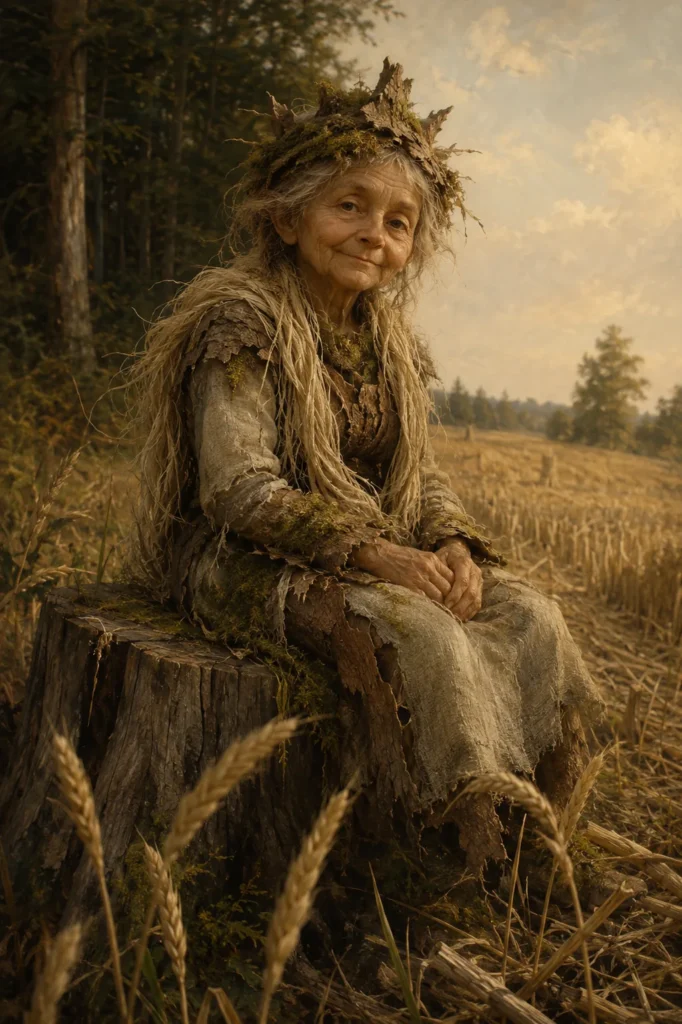
Appearance: small female figure in a dress of moss and bark, sometimes wrapped in flax

Origin and sources

Period of the Texts

The records date from the 19th century, chiefly from the years 1857 to 1859, when Schönwerth collected the stories of the northern Upper Palatinate.

Area of Diffusion

The Upper Palatinate is the core region; Holzweibel and related names are also attested in Upper Franconia, the Egerland, the Vogtland and the Bohemian Forest.

Sources

Folkloric collections, above all those of Franz Xaver von Schönwerth, whose work Jacob Grimm held in high regard; he saw in Schönwerth a fitting successor to his own work.

Name and variants

German: Holzfräulein, in the region also Holzweibel. Both names denote the Upper Palatinate representative of the small female forest spirits; in essence the figure belongs to the same group of beliefs as the moss women of Thuringia and Saxony. In some places the being was interpreted in Christian terms as a bewitched poor soul.

Appearance and behaviour

Appearance

The being is described as a small, dainty to aged female figure, poorly dressed in moss, bark and coarse cloth, at times wrapped in flax or with leaves in her hair. The flax and harvest motifs anchor the being in the farming women’s work of field and spinning room; symbolically it stands for the narrow border strip between forest and cultivated land.

Effect

Holzfräulein help with sheaf-binding and forest work, watch over children at the edge of the field and give advice on healing herbs and weather. As a reward they ask for food, gladly dumplings or porridge. Their thanks is held to carry a blessing; if offended they withdraw and take the blessing with them. The sources tell of no harmful power of their own. Their neediness reverses the usual relationship: it is not the human who pleads with the being, but the being that asks the human for food and shelter.

Profile: Holzfräulein

The key aspects of the little wood woman at a glance.

Cultural Context

Upper Palatinate form of Germany’s small female forest spirits, recorded around 1857 by Schönwerth from oral tradition.

Relates To

Woodcutters, harvest workers and farmwives: the Holzfräulein appears at the forest, the forest edge and the field boundary, most often at harvest, flax and baking time.

Depiction

A small, dainty to aged female figure in moss, bark and coarse cloth, at times wrapped entirely in flax or with leaves in her hair.

Sphere of Influence

Help with harvest and forest work, minding children, advice on healing herbs and weather; farms that treat it well prosper under its blessing.

Practice

Food offerings on a tree stump or field boundary, avoiding caraway in bread, and the three crosses in the stump of a felled tree as a sanctuary from the Wild Hunt.

Related beings

Closest are the Moss People of Central Germany; the wild people also include Schrat and Wild Man.

Schönwerth's collection and the Holzweibel landscape

The main source is Franz Xaver von Schönwerth, whose three-volume work Aus der Oberpfalz. Sitten und Sagen (1857-1859) is based on interviews with informants of the northern Upper Palatinate; Jacob Grimm held the collection in high regard. There the Holzfräulein appears as a small, poorly dressed being of the forest, in some places interpreted as a bewitched poor soul. The belief extends beyond the Upper Palatinate to Upper Franconia, the Egerland, the Vogtland and the Bohemian Forest.

A characteristic feature of the Upper Palatinate tradition is the close connection to farm work: Holzfräulein appear at harvest time, during flax work and on baking day. One tale recorded by Schönwerth tells how reapers found a Holzfräulein wholly wrapped in flax stalks on a tree stump and took it home with them. Like the moss women, the Holzfräulein are also pursued by the Wild Hunt or by wood-chasers and seek protection with humans.

Rediscovery of a forest spirit

Schönwerth’s work fell into long obscurity and only became known again once his papers were catalogued; the selection Prinz Roßzwifl (2010), edited by Erika Eichenseer, drew international attention in 2012 as the discovery of around 500 little-known fairy tales. Today the Schönwerth Society and storytelling trails such as the fairy-tale path in Sinzing keep the memory alive; the Holzfräulein has its own station there.

From a religious-studies perspective, the Holzfräulein is an instructive example of how a supra-regional legend type takes on regional character: in the Upper Palatinate the figure of the little wood woman is linked with harvest custom, flax work and belief in poor souls. Earlier scholarship around Mannhardt read the figure as a vegetation spirit; more recent folklore studies emphasise the source value of Schönwerth, who stayed close to the oral narratives, and interpret the legends as an expression of farming experiences of work and poverty. The pursuit by the Wild Hunt links the figure to the pan-European complex of the storm host and host of the dead.

Sanctuary and food offering: the protective customs

The customs correspond to the Moosleute tradition and are geared towards mutual understanding. Three crosses cut into the stump of a falling tree with an axe grant the Wood Maiden a sanctuary from her pursuers; food offerings on tree stumps or field edges secure her blessing. Caraway in bread was avoided so as not to drive her away, and stripping the bark of living trees was considered a sin against the forest folk. For the house itself, tradition prescribes quiet behaviour during the nights of the Wild Hunt and the blessing of the sign of the cross.

Wood women and wild folk compared

The Wood Maiden is closest to the Moosweibchen of central Germany, discussed on the page about the Moosleute, and belongs with them to the wild folk of Europe. Related traits appear in the Slavic Leshy as lord of the forest; the Alpine Salige Frau shares the helpfulness and the sudden withdrawal after an offence. Scottish-Irish tradition, too, with its old woman of the wilderness and its hidden hill folk, knows beings dependent on good neighbourliness with humans.

Frequently asked questions about the Wood Maiden

Is the Wood Maiden the same as the Moosweibchen?

Both belong to the same conceptual group of small female forest spirits. Holzfräulein is the term used in the Upper Palatinate and neighbouring regions, Moosweibchen the central German one. The motifs largely correspond, from the food offering to the three crosses to the pursuit by the Wild Hunt.

Is the Wood Maiden dangerous?

No, tradition knows of no attacking Wood Maiden. She helps, warns and asks for food; whoever offends her merely loses her blessing. In the legends, danger does not come from the being itself but from her pursuers, the Wild Hunt.

How do we know of the Wood Maidens?

The most important source is Franz Xaver von Schönwerth, who systematically recorded the Upper Palatinate tradition from the 1850s onwards. His estate was only fully catalogued in the 21st century, which made the collection known beyond Bavaria.

Further links

Recommended internal links:

Literature (selection)

A selection of key sources and studies:
  • Schönwerth, Franz Xaver von: Aus der Oberpfalz. Sitten und Sagen. 3 volumes, 1857-1859.
  • Grimm, Jacob: Deutsche Mythologie. 1835.
  • Mannhardt, Wilhelm: Wald- und Feldkulte. 2 volumes, 1875/1877.
  • Eichenseer, Erika (ed.): Prinz Roßzwifl und andere Märchen. Aus dem Nachlass von Franz Xaver von Schönwerth. 2010.

Further standard works in the bibliography.

Thus the name Holzweibel links the Upper Palatinate, Egerland and Vogtland into a shared narrative landscape, and to this day the region tells legend after legend of the Wood Maiden: the little helper at the field edge, who stands closer to humans than most beings of the forest.

Classification & Protection

ILEVEL
The Protection Compass assigns this being to influence level I, Minor influence.

No specific protective means is recorded in the tradition for this being.

Compare in the Protection Compass →

Recommended protective means

iWell Guard

The simplest protective means in this collection: 41 layers of fine gold 999, platinum, silver and silicon, manufactured in Ruhla, Thuringia. It requires no activation, is bound to no person, and is effective within a radius of around 50 meters, even without being worn.

All protective means at a glance →