iWell Guard

Rübezahl, the moody lord of the Schneekoppe

Rübezahl is a spirit of the tradition of the Giant Mountains.

The moody weather-maker who punishes mockery and rewards the poor.

SpiritGermanic

Table of Contents

Rübezahl, spirit of Germanic tradition
Rübezahl

Rübezahl is the mountain and forest spirit of the Giant Mountains and one of the best-documented legendary figures of Central Europe. In Czech he is called Krakonoš, in Polish Duch Gór or Liczyrzepa; the figure is shared narrative lore of Germans, Czechs and Poles.

His nature is moodiness: he punishes arrogance and mockery with weather and wrong paths, and rewards the poor and the sincere. He is attested since 1561, when his figure appeared on Martin Helwig’s map of Silesia.

At a Glance: Rübezahl

Type: Mountain and forest spirit, moody weather-maker and treasure guardian
Origin: Giant Mountains (Silesia and Bohemia, today the Polish-Czech border range)
Texts: First attestation 1561, legend collections from 1662, literary adaptations from 1783
Period: Early modern era to the present
Appearance: Shapeshifter, among others monk, miner, hunter, giant, animal

Historical Background

Period of the Texts

The first attestation dates from 1561, the first major collection followed between 1662 and 1665, and literary adaptations began in 1783 with Musäus; behind this lies an older oral layer.

Area of Diffusion

The Giant Mountains in Silesia and Bohemia, today the Polish-Czech border range; Rübezahl’s domain is the high plateaus and ridges, especially during sudden changes of weather.

Sources

Very good: early modern printed sources and extensive corpora of legends, from Helwig’s map through Praetorius to the collections of the 19th and 20th centuries.

Name and variants

German: Rübezahl, earliest attestation as Rubenczal. The linguistic origin of the name is unclear; interpretations from Rübe (turnip) and Zagel (tail) have been considered, among others. The legend itself explains the name as the mocking term Rübenzähler (turnip counter) from the tale of Princess Emma. Those who wish to honour the spirit say Lord of the Mountains or Lord Johannes; in Czech he is called Krakonoš, in Polish Duch Gór or Liczyrzepa.

Form and effect

Appearance

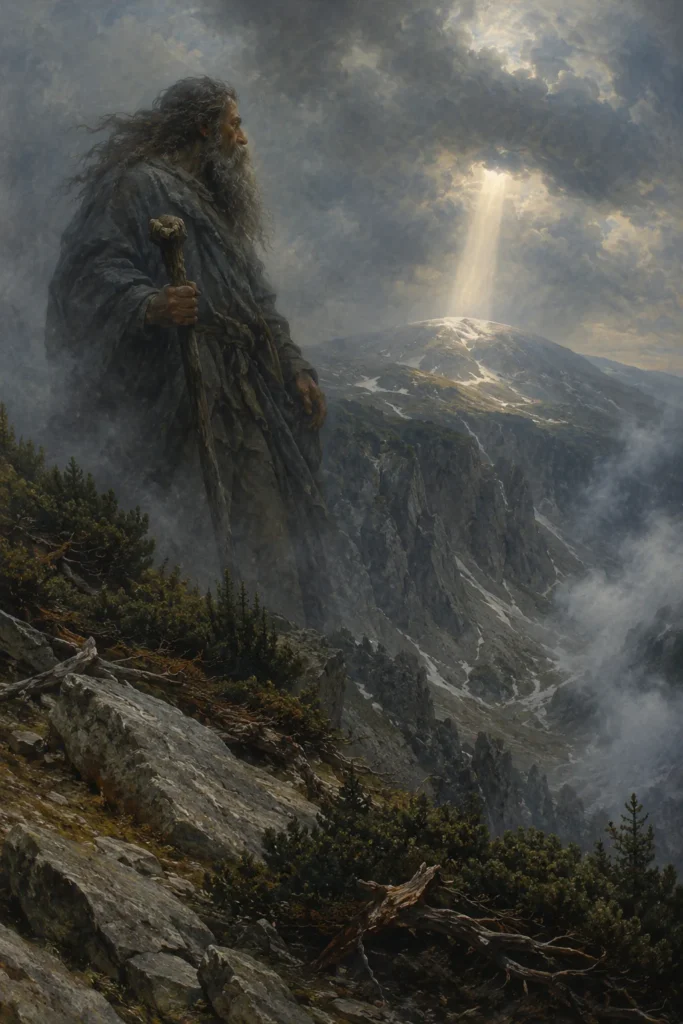
Rübezahl has no fixed form; change is his hallmark. The legends show him as a grey monk, as a miner with a mine lamp, as a hunter, as a distinguished gentleman, and also as a tree stump, raven or donkey; where he appears gigantic, he carries a staff and a flowing cloak. The pictorial tradition since the 19th century, shaped for instance by Moritz von Schwind, shows the bearded mountain giant with a knotted staff.

Effect

Rübezahl’s effect is a test through mood. Wanderers who mock him or shout his name derisively experience storms, hail or endless wrong paths; the arrogant, the miserly and dishonest traders are duped. He helps poor herb-women, lost children and honest craftsmen’s apprentices: he shows the way, cures with herbs from his garden, and gives unassuming leaves or turnips that turn into gold once home. In the classical tradition he is not malicious without cause.

Profile: Rübezahl

The key aspects of the mountain spirit at a glance.

Cultural Context

German-Czech-Polish common heritage of the Giant Mountains: told on both sides of the border as Krakonoš and Duch Gór, and become a shared figure of remembrance after 1945.

Relates To

Wanderers, herb gatherers, miners and the poor: those who set foot on the ridges are put to the test; how one treats a stranger decides between reward and punishment.

Depiction

A shapeshifter without a fixed form: grey monk, miner, hunter, distinguished gentleman, tree stump or animal; iconographically the bearded mountain giant with a knotted staff.

Sphere of Influence

The weather and paths of the high mountains: storm, hail, fog and wrong paths as punishment, guidance, herbal cures and gifts of gold as reward.

Practice

Observe the name taboo, walk the ridges quietly and respectfully. This protective practice complements prayers, guardian angels, protective stones, magical signs, salt, protective herbs, a protective circle and a talisman.

Parallels

The Slavic Leshy, the Japanese Tengu and the Nordic Troll share dominion over mountains, the leading astray of travellers and a giant form.

From the Helwig map to Musäus: a legend's career

The oldest attestation is cartographic: on Martin Helwig’s map of Silesia from 1561, the figure of Rubenczal appears in the mountains as a tailed demonic form. Behind this lies an older oral layer that research links to mining and herb gathering in the mountains: the spirit guards treasures and weather, as miners in many regions told. The scholar Johannes Praetorius produced the first major collection with the Daemonologia Rubinzalii Silesii (three parts, 1662 to 1665), around 241 stories from the narrative tradition of his time.

Johann Karl August Musäus made the material fit for literature, artfully elaborating five Rübezahl legends from 1783 onwards in the Volksmärchen der Deutschen, including the tale of Princess Emma: the spirit abducts her, she demands that he count the turnips in the field, and she escapes while he counts. The legend explains the name Rübenzähler (turnip counter) from this mockery, which the spirit regards as an insult. In the 19th and 20th centuries the figure travelled through legend collections, literary fairy tales and school textbooks, and after 1945 became a shared figure of remembrance for Germans, Czechs and Poles.

Reception and classification

Hardly any German legend has been reworked so often: after Musäus, among others by Carl Hauptmann (Rübezahlbuch, 1915) and Otfried Preußler (Mein Rübezahlbuch, 1993). In Czechia, the animated series Krkonošské pohádky made him popular as the kindly Krakonoš in the 1970s; in Poland he is a heraldic and tourism figure as Duch Gór. For Silesian expellees, he became after 1945 a figure of remembrance for a lost homeland; today the figure is increasingly told across borders and in a spirit of reconciliation.

In the history of religion, Rübezahl is a genius loci of the high mountains, uniting traits of the weather demon, the treasure guardian and the testing wanderer. Early modern demonology classified him among the devilish spirits, the Enlightenment turned him into a hero of literary fairy tales, and Romanticism made him a national figure; through him, the literary shaping of a folk belief can be traced layer by layer. The name taboo belongs to the classic motifs of religious awe before names of power, and the fact that a figure both punishes and blesses corresponds to the ambivalent basic type of the great nature spirits.

Name taboo and ridge etiquette

The most important traditional protective knowledge is the name taboo: in the mountains, the mocking name Rübezahl was not spoken aloud; instead, if at all, one spoke of the Lord of the Mountains or of Lord Johannes; even Praetorius reports that insults brought on storms. Guides and locals urged travellers to behave quietly and respectfully on the ridges. In addition, there are the behavioural rules of the legends: treat strangers in the mountains politely, for it might be the spirit; do not refuse help; do not disdainfully discard gifts received, since their value often only becomes apparent at home. An amulet defence or ecclesiastical banning practice against Rübezahl is not part of the core tradition; the protection lies in behaviour.

For those who cross the ridges, the protective practice additionally recommends prayers and invoking a guardian angel, protective stones and magical protective symbols, salt, protective herbs, a drawn protective circle when resting, and a worn talisman.

Moody mountain lords in comparison

The moody lord of a mountain range has equivalents worldwide. The Slavic Leshy leads forest wanderers astray just as Rübezahl does ridge walkers, the Japanese Tengu combines dominion over mountains, weather and the punishment of arrogance, and the Nordic Troll shares with the lord of the Giant Mountains a rocky domain, a giant form and remoteness from humans. The Andes too know a mountain lord in Apu Ausangate, and Tibet in the Nyen, powers that watch over mountain and land and receive the offerings of travellers.

Frequently asked questions about Rübezahl

Why must one not call Rübezahl by name?

In the legend, the name is regarded as a mocking name that recalls the trick of Princess Emma, who had him count turnips. Whoever calls it offends the spirit and risks storms and wrong paths. Respectful circumlocutions such as Lord of the Mountains were considered safe.

Is Rübezahl good or evil?

Neither: he is moody and just in his own way. The legends have him test people, often in disguise; he punishes arrogance and deceit, and rewards need and honesty. He becomes dangerous almost only to those who behave inconsiderately.

Where is Rübezahl at home?

In the Giant Mountains on today’s Polish-Czech border, especially around Sněžka and the ridge areas. Legendary places such as Rübezahl’s Herb Garden in the glacial cirques still bear his name today.

Further links

Recommended internal links:

Literature (selection)

A selection of key sources and studies:
  • Praetorius, Johannes: Daemonologia Rubinzalii Silesii. 3 parts, Leipzig 1662-1665.
  • Musäus, Johann Karl August: Volksmärchen der Deutschen. Gotha 1782-1786.
  • Peuckert, Will-Erich: Schlesische Sagen. Jena 1924.
  • Preußler, Otfried: Mein Rübezahlbuch. Stuttgart 1993.

Further standard works in the bibliography.

To this day the mountain spirit links the Giant Mountains, Sněžka and the ridge paths into a legendary landscape that Germans, Czechs and Poles tell together, and so Rübezahl wanders on from tale to tale, from early modern print all the way to children’s books.

Classification & Protection

VLEVEL
The Protection Compass assigns this being to influence level V, Profound influence.

Against its influence, cross-cultural tradition names these protective means:

Compare in the Protection Compass →

Recommended protective means

iWell Guard

The simplest protective means in this collection: 41 layers of fine gold 999, platinum, silver and silicon, manufactured in Ruhla, Thuringia. It requires no activation, is bound to no person, and is effective within a radius of around 50 meters, even without being worn.

All protective means at a glance →