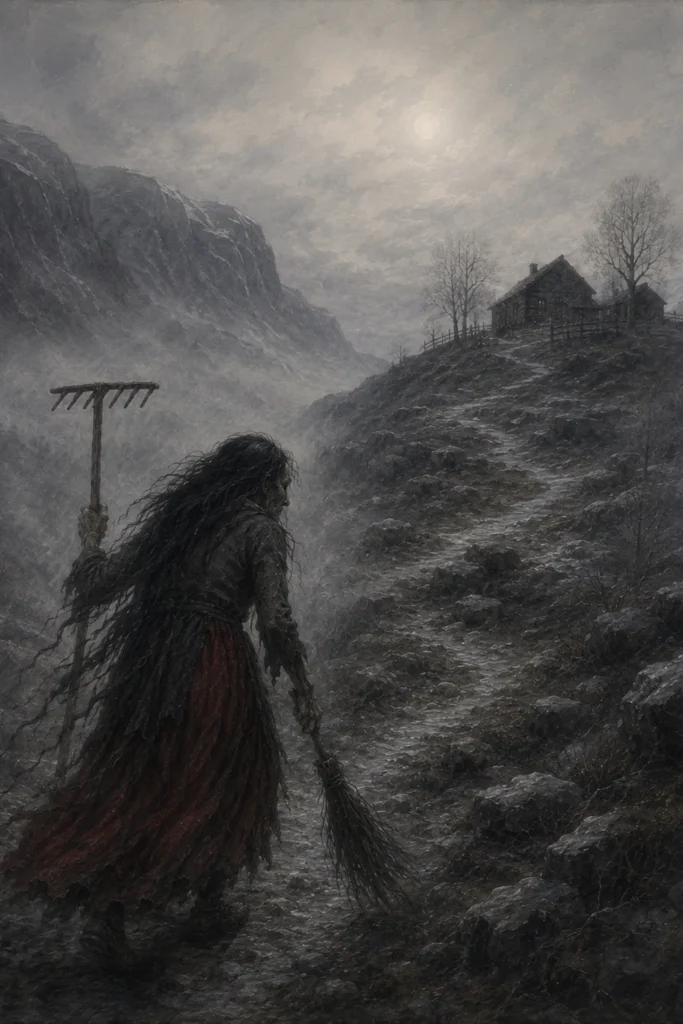
Bergsrå, mistress of mountain and mine
By Ralf Ittermann · last reviewed on
Bergsrå is a spirit of the Germanic tradition of Scandinavia.
She reveals ore and grants fortune, but punishes disregard.
Bergsrå, also called Bergrå or Bergsfrau, is a female mountain spirit, a rå: the guardian of the mountain or the mine in Sweden and Norway. To miners she may reveal ore and grant fortune, but she can also punish and seduce them.
Seen from the front, she appears as a beautiful woman; from behind, she is hollow or has a tail. Whoever disregards her is bergtagen, taken into the mountain and carried off; this belief is attested in mining folklore into the 19th century, especially in Bergslagen.
Type: Female mountain spirit, guardian of mountain and mine
Origin: Swedish and Norwegian mining folklore
Texts: Hofberg, Svenska folksägner; Lindow, Swedish Legends and Folktales
Period: Mining folklore into the 19th century
Appearance: a beautiful woman from the front, hollow or with a tail from behind

Source context
Period of the Texts
Belief in the Bergsrå is attested in Swedish and Norwegian mining folklore into the 19th century.
Area of Diffusion
Sweden and Norway, especially the mining regions of Bergslagen. The close association with the Falun copper mine is plausible on a regional level, but uncertain in detail.
Sources
The source material is good: Herman Hofberg’s 1882 collection of legends and John Lindow’s selection of Swedish legends are the main witnesses.
Name and variants
Swedish: berg means mountain, rå comes from Old Norse ráða, to rule or govern: the guardian or mistress of the mountain. The rår are place-bound protective spirits, such as the skogsrå of the forest, the sjörå of the water and the bergsrå of the mountain.
Appearance and the revealing motif
Appearance
Bergsrå is a beautiful woman from the front, hollow from behind with a trough-like back or with a fox-like tail. She shares this revealing motif with the skogsrå, the Huldra of the forest.
Effect
As mistress of the mountain and the mine, Bergsrå can reveal ore and grant fortune, but also punish. She seduces miners; whoever disregards her is bergtagen, taken into the mountain and carried off.
Profile: Bergsrå
The key aspects of the Scandinavian mountain spirit woman at a glance.
A place-bound protective spirit from the family of the rår, alongside the skogsrå and sjörå; attested in the mining folklore of Sweden and Norway.
Miners in the mines of Bergslagen: Bergsrå reveals ore and grants them fortune, but she can also seduce and punish them.
A beautiful woman from the front, hollow from behind with a trough-like back or with a fox-like tail, a classic revealing motif.
Rule over mountain and mine: revealing ore, granting fortune, punishing; disregard leads to bergtagen, being carried off into the mountain.
Respect, calm and order within the mountain, along with refraining from cursing; the code of conduct relies on appeasement rather than banishment.
The skogsrå and the Huldra of the forest, the sjörå of the water, as well as the Bergtroll and the Mountain King, at times used synonymously.
The mistress of the mountain within the family of the rår
The name explains the being: berg means mountain, rå comes from Old Norse ráða, to rule or govern, together thus the keeper or mistress of the mountain. The rår are place-bound protective spirits, each sphere has its own: the skogsrå in the forest, the sjörå in the water, the bergsrå in the mountain.
The belief is attested in Swedish and Norwegian mining folklore into the 19th century, especially in the mining districts of Bergslagen; the close link to the Falun copper mine is plausible on a regional level, but uncertain in detail. In the legends, Bergsrå appears to miners as a force to be reckoned with: she can point the way to the ore, but she can also seduce and bergtaga, take into the mountain.
National Romanticism and classification
Bergsrå is present in the Swedish tradition of legend collections and in the cultural history of mining, and became a motif of National Romantic art and literature.
From a religious-studies perspective, Bergsrå is ambivalent: benevolent towards respectful miners, dangerous through abduction in cases of disrespect. Two clarifications are important: Bergsrå is not automatically female, in parts of the tradition the mountain spirit is male as the Mountain King. And the feature of the hollow back genuinely belongs to the skogsrå and the Huldra, and was transferred to Bergsrå as a wandering motif.
Respect instead of banishment: the code of conduct in the mountain
Protection from Bergsrå lies in respect, calm and order in the mountain, as well as refraining from cursing. Concrete objects of defence are less well attested than this general code of conduct, which relies on appeasement rather than banishment. Steel and iron are attested as a general Nordic means of defence against vättar and trolls, but are not specifically confirmed for Bergsrå.
Skogsrå, Huldra and Mountain King
Bergsrå stands alongside the skogsrå and the Huldra of the forest as well as the sjörå of the water, the sisters of the rå family. Within the mountain itself, she overlaps with the Bergtroll and the Mountain King, with whom the term is sometimes used synonymously; in German mining, the Bergmönch appears as a male counterpart to the mistress of the mine.
Frequently asked questions about Bergsrå
What is a Bergsrå?
A female mountain spirit, the keeper of the mountain or the mine in Scandinavia.
What does she look like?
A beautiful woman from the front, hollow or with a tail from behind.
Is Bergsrå always female?
No. In parts of the tradition the mountain spirit is male as the Mountain King.
Further links
Literature (selection)
Further standard works in the bibliography.
Hardly any Swedish mountain spirit is as ambivalent as the Bergsrå: keeper of the mine to some, seductress and punishing mistress to all who forget respect within the mountain.