Undine, the water woman without a soul
By Ralf Ittermann · last reviewed on
Undine is a spirit of the learned tradition of Europe.
Born without a soul, given a soul through faithfulness by the water. According to Paracelsus, Undine is classed as an elemental spirit of water.
Undine is the water spirit of the learned tradition: Paracelsus assigned her to the element of water, human-like yet without a soul.
A water woman gains a soul through marriage; if the man forsakes her for a new marriage, his life is forfeit. Widely known since 1811 through Fouqué.
Type: elemental spirit of water without a soul
Origin: Paracelsus, 16th century
Texts: Liber de nymphis (1566), Fouqué (1811)
Period: 16th century to the present
Appearance: human-like water woman without any identifying mark

Source context
Period of the Texts
16th century to 1811, from Paracelsus to Fouqué.
Area of Diffusion
Learned tradition of Europe, centred on the German-speaking region.
Sources
Purely written: natural-philosophical with Paracelsus, literary with Fouqué.
Name and variants
Language: Undine comes from the Latin unda, meaning wave, coined by Paracelsus for a distinct creature of water.
Form without a mark
Appearance
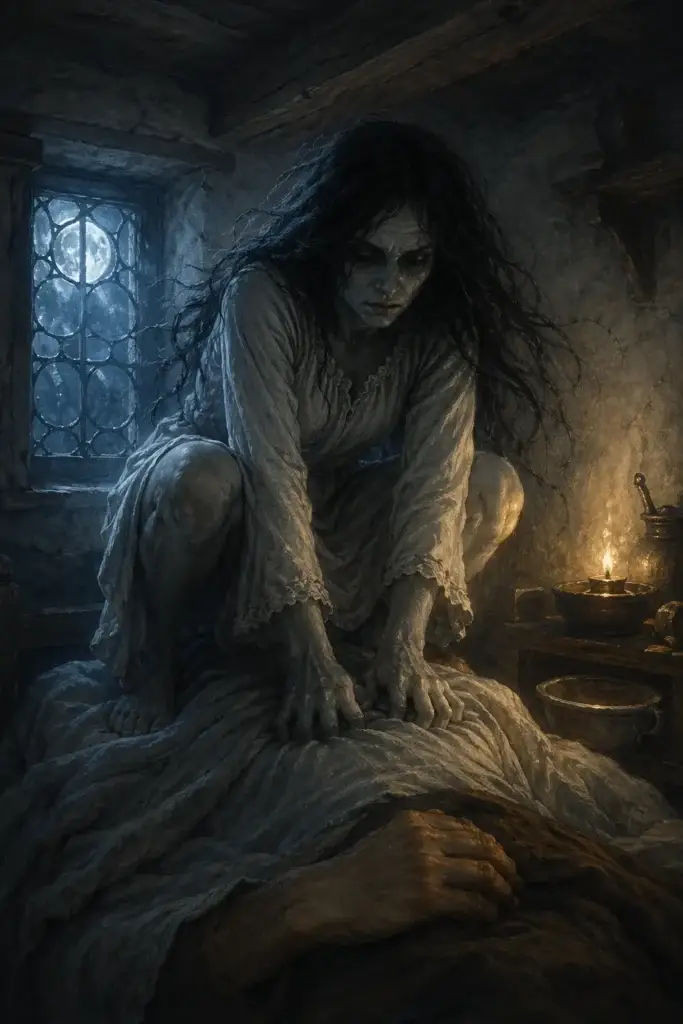
Unlike a mermaid or Melusine, she bears no mark, no serpent body; Paracelsus stresses her human likeness. Fouqué gave her a dual nature: moody before marriage, quiet after.
Effect
An Undine does not haunt; she becomes dangerous only if the pact is broken.
Profile: Undine
The key aspects of the water woman at a glance.
Natural-philosophical system of Paracelsus, completed by Fouqué in 1811.
People who enter into marriage with a water woman and uphold its conditions.
Human-like woman without a mark or tail, moody before marriage, quiet afterwards.
Gaining a soul through faithfulness, enforcement of the water’s law upon breach of word.
Keep your word, never scorn your companion by the water, never enter a new marriage.
Unlike a mermaid, Melusine or the Loreley, she has no identifying mark and no song.
From Paracelsus to Fouqué's kiss of tears
Undine owes her name to the Latin unda; Paracelsus coined it around 1537/38 in the Liber de nymphis, first printed only in 1566, as a soulless elemental being that gains a soul through marriage. If the man forsakes her for a new bride, his life is forfeit.
Fouqué translated this in 1811: the knight Huldbrand marries Undine, betrays her, and dies at the wedding through her kiss of tears.
Afterlife between opera and medicine
Few subjects have been reworked so often: Hoffmann set it to music as an opera in 1816, Henze as a ballet in 1958, Giraudoux and Bachmann rendered it in literary form, and Petzold’s film (2020) relocated it to Berlin; medicine later named Undine syndrome after it.
From a religious-studies perspective, she shows how learned systematics ordered folk belief, a case of the disrupted fairy marriage.
No banishing formula, only a promise
No warding customs against Undines have been recorded; the figure originates in the study, not in haunting belief. The sources demand only faithfulness: never insult her by the water, no new marriage, keep your word.
Where Undine material seeped into folk belief, the usual means helped: holy water, salt, an amulet.
Mermaid, Loreley, Melusine: related yet distinct
The mermaid is her closest relative, but bears identifying marks that Undine lacks. The Loreley shares the tradition, but her motif is song, not the doctrine of the soul. Melusine shares the fairy marriage: with her it is the forbidden glance on Saturday, with Undine it is scorn spoken by the water.
Frequently asked questions about Undine
Is Undine a legendary being or a literary invention?
Both: the name and system come from Paracelsus, the figure was created by Fouqué in 1811. You are more likely to find folk belief with the mermaid.
What is meant by the curse of Undine?
The expression goes back to Giraudoux, denoting the punishment for the faithless husband.
Literature (selection)
Further standard works in the bibliography.
Anyone searching today for Undine water spirit or Undine Paracelsus finds the same figure: an elemental spirit without a soul, given a soul only through faithfulness, lost through a broken word.