Loreley, the legend a poet invented in 1801
By Ralf Ittermann · last reviewed on
Loreley is a spirit from the German literary legend of Rhine Romanticism.
A poet’s legend that made a rock famous in 1801. Loreley is regarded as a Nixie and legendary figure tied to a rock on the Rhine.
The Loreley is the most famous water woman of the Rhine and a special case: her legend does not stem from old folk belief but was invented by Brentano in 1801, made world-famous by Heine. The rock of the same name, with its echo and shipping channel, provided the material and the stage.
Type: literary water woman, invented legend
Origin: Middle Rhine near St. Goarshausen
Texts: Brentano 1801, Heine 1824, Silcher 1837
Period: female figure since 1801
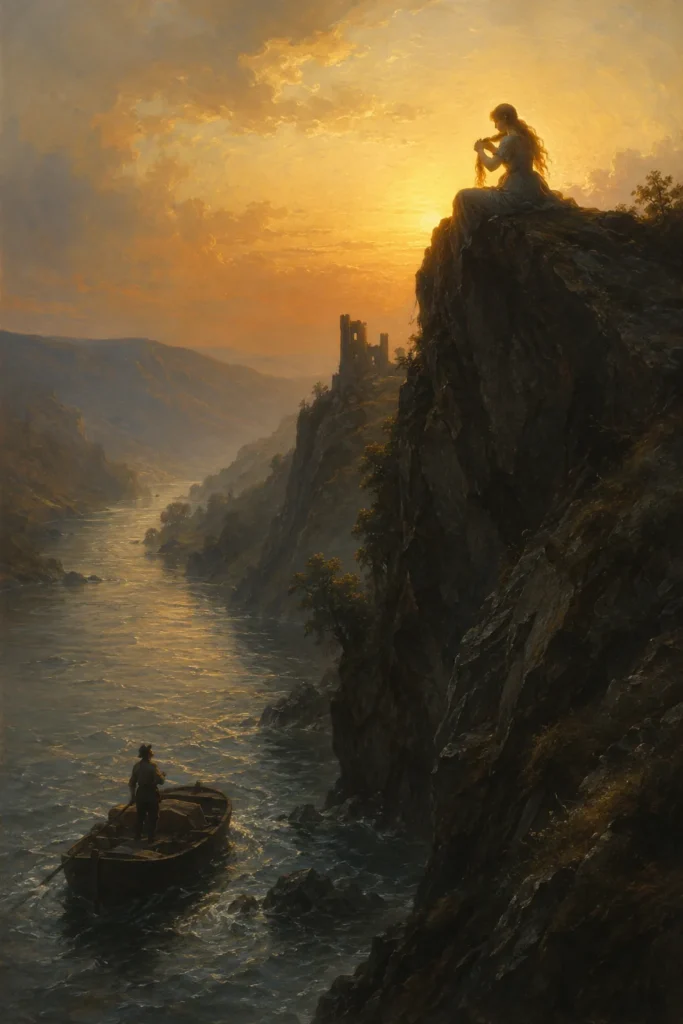
Appearance: beautiful woman on the rock, golden hair and comb
Textual history
Period of the Texts
The name of the rock is documented since the Middle Ages, but the female figure was only created in 1801 by Brentano, shaped further by Heine in 1824 and Silcher in 1837.
Area of Diffusion
The setting is the Middle Rhine near St. Goarshausen, where the rock forms the real stage of the poetry.
Sources
Rich in literature, thin in folklore: an invented legend without an older female figure at the rock.
Name and variants
Rhenish: Ley, Celtic, denotes the slate rock; the first part is presumably Middle High German luren, to lurk. The interpretation is not certain.
Appearance
Appearance
Heine’s stanzas fixed the image: golden hair, a golden comb, singing of wondrous melody.
Effect
Distraction, not attack: the boatman looks at the singer instead of the cliffs.
Profile: Loreley
The key aspects of the rock legend at a glance.
A literary legend of the Rhine Romantic movement, not handed down from old folk belief.
Rhine boatmen at the dangerous narrows by the rock.
A beautiful woman on the rock, golden hair and comb, singing.
Distraction through song: the gaze lifts from the fairway to the singer.
No warding custom against the figure; in reality, pilots, signal stations and Saint Goar helped.
How a rock acquired its female form in 1801
The rock has been called Lurlaberch since the Middle Ages; Ley, Celtic, refers to the rock itself. This tradition knew no female figure: she is Brentano’s creation of 1801. Heine gave her form in 1824, Silcher the folk song in 1837.
From poem to World Heritage rock
After Brentano, Eichendorff and others took up the subject before Heine gave it its canonical form; the rock today belongs to the Upper Middle Rhine Valley World Heritage Site. There are no sources for ancient roots of the female figure.
Saint Goar instead of a banishing spell
There are no warding customs against the Loreley herself, since the figure originates in poetry. Historically attested: Saint Goar, prayer, bell signals; also holy water, amulet and salt.
The singing seductress in comparison
Frequently asked questions about the Loreley
Is the Loreley a genuine folk legend?
In the strict sense, no: Brentano invented the female figure around 1800, and only later did it come to be regarded as folk tradition.
What does the name mean?
Ley denotes the slate rock, probably related to Middle High German luren, to lurk.
Literature (selection)
Further standard works in the bibliography.
Known as the Loreley legend, the story remains inseparable from the Loreley rock: a literary legend of 1801 that first made the place famous, not the other way round.