Hödekin, the little hat of the Hildesheim bishop's court
By Ralf Ittermann · last reviewed on
Hödekin is a spirit of Germanic tradition.
Helpful at the bishop’s court, deadly when insulted.
Hödekin, also called Hütchen, is a household spirit from the environs of the Bishopric of Hildesheim who wears a felt hat, hence the name. He is helpful and warns of danger, but vengeful when insulted; the kitchen-boy legend is well known.
The Lower Saxon legend is set around the time of Bishop Bernward, around 1000. It was recorded early on by Johann Weyer in 1563; the Brothers Grimm included the material as Hütchen in the Deutsche Sagen.
Type: household spirit of the bishop’s court, helpful and vengeful at once
Origin: Hildesheim, Lower Saxony, set around 1000
Texts: Weyer 1563, Praetorius, Francisci, Grimm’s Deutsche Sagen number 74
Period: Weyer 1563, Grimm 1816
Appearance: small man with a conspicuous felt hat
Context of tradition
Period of the Texts
The legend is set around the time of Bishop Bernward, around 1000; it was recorded in 1563 by Johann Weyer, and the Brothers Grimm included it in 1816.
Area of Diffusion
Hildesheim in Lower Saxony, more precisely the bishopric and the bishop’s court; the legend is also linked to the County of Winzenburg.
Sources
Well documented: Johann Weyer 1563, later Johannes Praetorius and Erasmus Francisci, as well as the Deutsche Sagen of the Brothers Grimm, number 74.
Name and variants
Low German: Hödekin is a diminutive of Hütchen, little hat. The name refers to his defining feature, the felt hat; the hat is the name-giving trait, not mere decoration.
Appearance
Appearance
Hödekin is a small man with a conspicuous hat, often present only as a voice or an action; shape-shifting is less pronounced for him than for Hinzelmann.
Effect
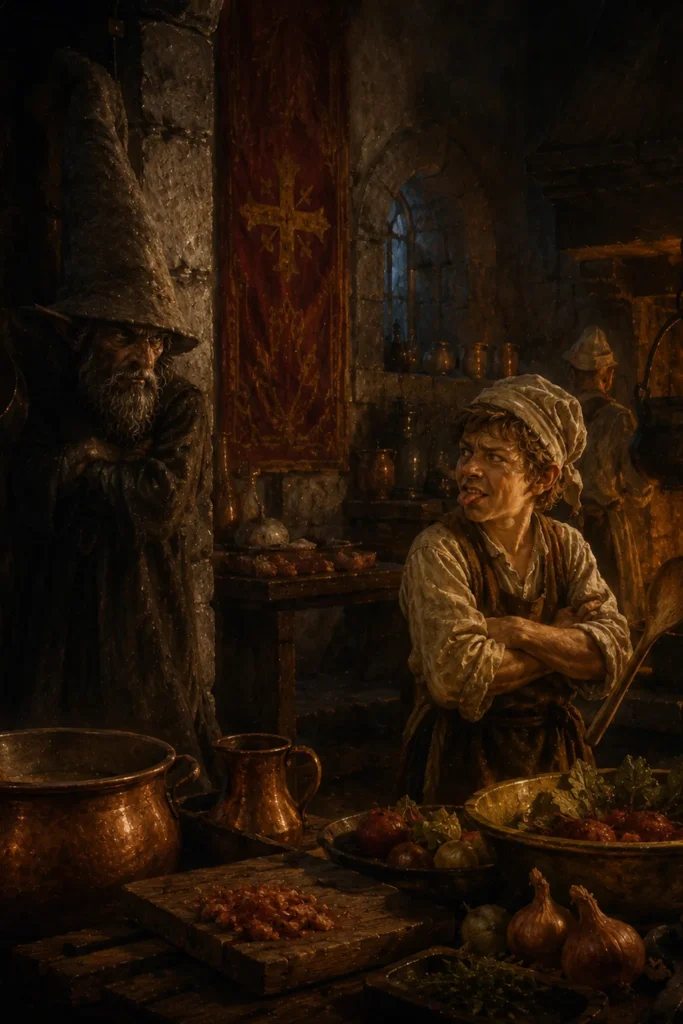
Hödekin is ambivalent: helpful, warning and even politically advisory, since he is said to have served the bishop and warned him of dangers, but vengeful when insulted. Central is the kitchen-boy legend: a kitchen boy repeatedly mocks and douses him; Hödekin kills him and puts the pieces into the cooking pots, and when the cook rebukes him, he poisons the food and causes the cook’s death.
Profile: Hödekin
The key aspects of the Hildesheim household spirit at a glance.
Lower Saxon bishopric legend, set around 1000, recorded early on by Weyer and canonised by the Grimms as Hütchen.
The bishopric and the bishop’s court of Hildesheim: he served the bishop as a warner and adviser, while the household staff found him touchy.
Small man with a conspicuous felt hat, often present only as a voice or an action, without the shape-shifting versatility of other household spirits.
Help, warnings and political advice for the bishop; but mockery and insult are met with deadly revenge, as the kitchen-boy legend shows.
The rule of respect and no insult: those who honour him gain a useful helper; mockery is life-threatening. A ritual banishment is not reliably documented.
Hinzelmann and Klabautermann within the household-spirit type, along with the Brownie, who becomes a Boggart when offended.
From the bishop's court to the Deutsche Sagen
Hödekin is a Low German diminutive of Hütchen, little hat; the name refers to his defining feature, the felt hat. The Lower Saxon legend is set around the time of Bishop Bernward, around 1000, and is linked to the County of Winzenburg.
It was recorded early on by Johann Weyer in 1563, later by Johannes Praetorius and Erasmus Francisci; the Brothers Grimm included the material as Hütchen in the Deutsche Sagen, number 74. Thus the household spirit of the bishop’s court moved from early modern demonology into the canon of German legend collections.
Reception and classification
Hödekin is a firm part of Hildesheim’s local folklore and is widely transmitted through Weyer, Grimm and Praetorius; he is regularly cited in literature on household spirits and demonology.
From a religious-studies perspective, Hödekin is deadly when insulted, but rather helpful when unprovoked. Important clarifications: the Grimm number is 74; the hat is the name-giving trait, not mere decoration; and he is occasionally confused with Hinzelmann, both being from Lower Saxony but with different locations and traditions.
Respect instead of a banishing spell
Central is the rule of respect and no insult: those who honour Hödekin and do not mock him gain a useful helper, while mockery is life-threatening. A dedicated ritual banishment is not reliably documented; the legend functions as a moral cautionary tale that regulates dealings with the household spirit rather than driving him away.
From Brownie to Boggart: related ambivalent figures
Hödekin belongs to the poltergeist and household-spirit type alongside Hinzelmann and Klabautermann, as well as the Scottish Brownie, who turns into a malicious Boggart when offended. The advisory role to the bishop recalls motifs of serving spirits.
Frequently asked questions about Hödekin
Who is Hödekin?
A household spirit from the environs of the Bishopric of Hildesheim, named after his felt hat.
What does the kitchen-boy legend say?
A kitchen boy repeatedly mocks him, whereupon Hödekin kills him and later causes the cook’s death as well.
Is he the same as Hinzelmann?
No. Both are from Lower Saxony, but with different locations and traditions.
Further links
Further reading:
- Germanic – all beings of Germanic tradition
- Hinzelmann, Heinzelmännchen, Klabautermann – related household spirits
- Amulet, Salt, Protective candle – traditional protective means
- Protection Compass – protective means at a glance
Literature (selection)
Further standard works in the bibliography.
As the goblin of Hildesheim and as Hütchen with the felt hat, Hödekin represents the darker side of house spirit belief: a helper and warner whose goodwill depends on a single rule, never to mock him.