Klabautermann, the Invisible Carpenter on Board
By Ralf Ittermann · last reviewed on
The Klabautermann is a spirit of the Germanic tradition.
He keeps the ship watertight; whoever sees him is lost. Invisible to the crew, the ship’s guardian spirit was said to keep the vessel watertight. As the Ship Goblin, the Klabautermann is associated with vessels sailing the North and Baltic Seas.
The Klabautermann is the ship kobold and protective spirit of sailors on the North Sea and Baltic Sea coasts. The ship is the sailors’ home; invisibly he keeps it in good repair and warns of danger, yet his visible appearance is regarded as a feared omen of death.
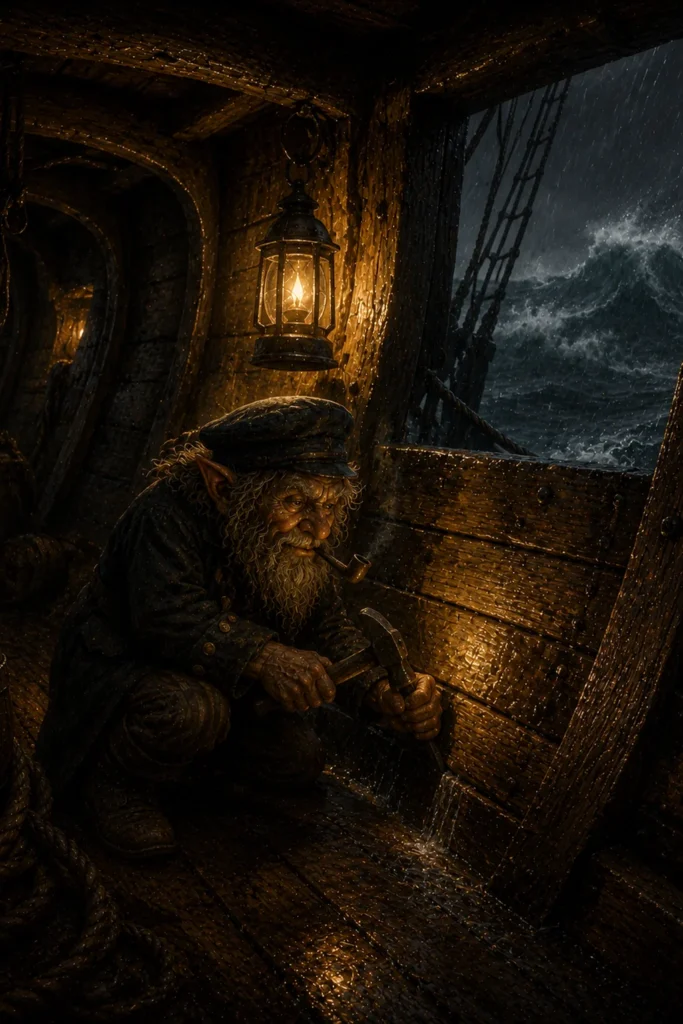
Orally the belief reaches back to the 1770s, written records begin around 1810. As a small sailor figure with a pipe and caulking hammer, the Klabautermann has been taken up repeatedly from Heinrich Heine to the present day.
Type: Ship kobold and protective spirit of sailors
Origin: North Sea and Baltic Sea coasts, the Netherlands, Flanders
Texts: Temme 1840, Müllenhoff, Buss
Period: oral tradition until the 1770s, written from 1810
Appearance: small sailor figure with a pipe and caulking hammer
Historical Classification
Period of the Texts
Orally the belief reaches back to the 1770s; written records begin around 1810, with the core sources being Temme 1840 and Müllenhoff.
Area of Diffusion
The North Sea and Baltic Sea coasts, the Netherlands and Flanders; in the Baltic region the Estonian counterpart is called kotermann.
Sources
Well documented: Temme’s Volkssagen von Pommern und Rügen of 1840, Müllenhoff, and Reinhard J. Buss’s study on the Klabautermann sagas.
Name and variants
German: The etymology is disputed: either from kalfatern, to caulk ship seams, favoured today, or from klabastern, to rumble and knock, fitting for the knocking spirit.
Description
Appearance
The Klabautermann is a small sailor figure, often with a pipe, a sailor’s cap and a red or grey jacket, and can appear as a ship’s carpenter; his tool is the caulking hammer. He is bound to the wood of the ship, for according to belief the soul of a stillborn or unbaptised child buried beneath a tree passes, via the timber, onto the ship.
Effect
As a protective spirit he invisibly plugs leaks, pumps water, stows ballast, hammers shut leaks and makes repairs at night; he warns by knocking and protects against illness, fire and pirates. If the crew is idle, he plays tricks. Crucially, however: he shows himself only when the ship is lost; his visible appearance was the most feared sign among sailors.
Profile: Klabautermann
The key aspects of the ship kobold at a glance.
Sailors’ belief from the North Sea and Baltic Sea coasts, reaching back orally to the 1770s and recorded in writing from around 1810.
The sailors on board: for them he keeps the ship in repair, warns by knocking and punishes idleness with tricks.
A small sailor figure with a pipe, a sailor’s cap and a red or grey jacket, appearing as a ship’s carpenter with a caulking hammer.
Plugging leaks, pumping water, stowing ballast, nightly repairs; protection against illness, fire and pirates, warning by knocking.
Respect for the ship and the spirit; Heine tells of a captain who offered him a place in the cabin and the best food and drink.
The maritime counterpart to the land kobold and to the Niß Puk; he assimilates traits of the Danish skibsnisse, and in the Baltic region his counterpart is the Estonian kotermann.
From the Klabautermann wood to the protective spirit on board
The etymology is disputed: either from kalfatern, to caulk ship seams, favoured today, or from klabastern, to rumble and knock, fitting for the knocking spirit. The belief is attested on the North Sea coast, in the Netherlands and in the Baltic region, where the Estonian counterpart is called kotermann; orally it reaches back to the 1770s, with written records beginning around 1810.
Notable is the Klabautermann-wood motif: according to belief, the soul of a stillborn or unbaptised child buried beneath a tree passes, via the timber, onto the ship. The core sources are Temme’s Volkssagen von Pommern und Rügen of 1840 and Müllenhoff.
From Heine to One Piece: the afterlife
Heinrich Heine’s Nordsee in the Reisebilder of 1826, along with poems by August Kopisch and Longfellow, passed on the Klabautermann. The Klabautermann fountain of 1912 now stands by the German Maritime Museum in Bremerhaven. In modern times he appears in One Piece, in music and in Pumuckl.
From a religious-studies perspective, the Klabautermann is normally harmless to helpful, yet his visible appearance is an omen of death, not through malice but through what his visibility announces. Important clarifications: he is not simply a helpful protective spirit, seeing him is deadly; the etymology remains unresolved; and whether the death-omen trait is old folk tradition or partly a romantic embellishment cannot be cleanly separated from the sources.
The best place in the cabin
Dealing with him requires respect for the ship and the spirit. Heinrich Heine tells of a captain who offered the Klabautermann a place in the cabin and the best food and drink. If he appears naked, one should not offer him clothing, as he resents being pitied, a widespread household-spirit motif.
The kobold who went to sea
Frequently asked questions about the Klabautermann
What is the Klabautermann?
The ship kobold and protective spirit of sailors on the North Sea and Baltic Sea.
Why do sailors fear seeing him?
Because he shows himself only when the ship is lost; his visible appearance is an omen of death.
Is the etymology resolved?
No. Discussed are kalfatern, to caulk seams, and klabastern, to rumble.
Further links
Further reading:
- Germanic – all beings of Germanic tradition
- Niß Puk, Nisse – the kobold relatives on land
- Amulet, Salt, Protective candle – traditional protective means
- Protection Compass – an overview of protective means
Literature (selection)
Further standard works in the bibliography.
As the ship kobold of the Baltic and protective spirit of the ship, the Klabautermann unites care and dread in a single figure: as long as he hammers invisibly, the ship is in good hands; once he shows himself, it is lost.