Nisse, the farm guardian with the red pointed cap
By Ralf Ittermann · last reviewed on
The Nisse is a spirit of Norwegian-Danish folk tradition.
Guardian of farm and livestock, who demands the julegrøt.
The Nisse is the Norwegian-Danish farm and barn spirit, the counterpart to the Swedish Tomte. Under the native names Gardvord, Tunkall or Tuftekall, he guards the farm, livestock and family, and does the barn work at night.
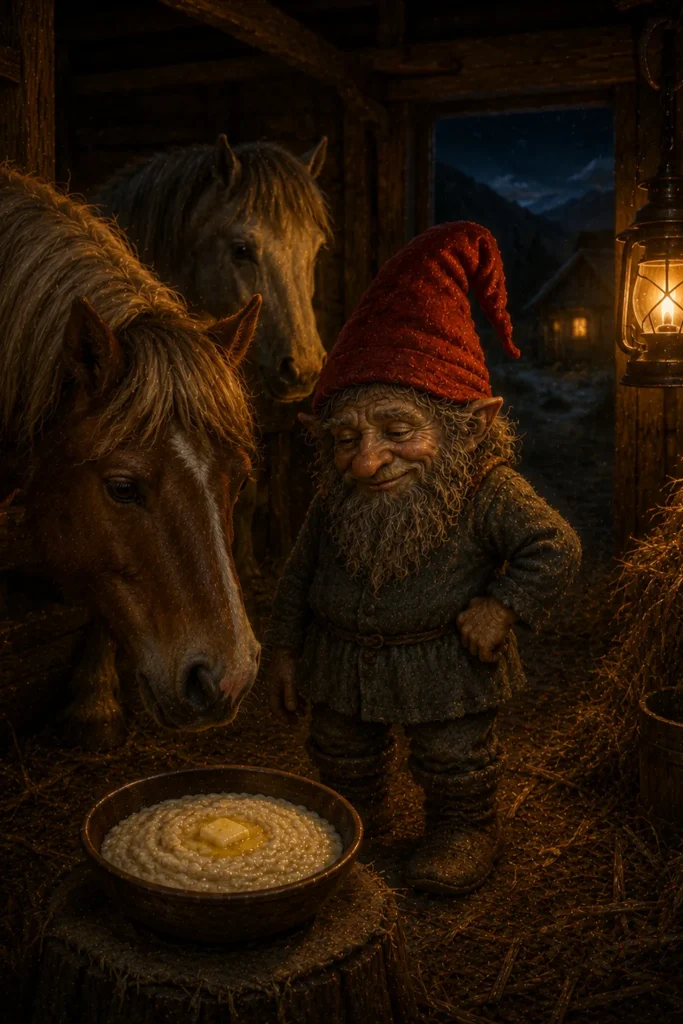
His reward is the julegrøt, the Christmas porridge with a dab of butter. Whoever respects him is granted the prosperity of the farm; whoever offends him must expect his revenge, from beatings to the killing of livestock.
Type: Farm and barn spirit
Origin: Norway and Denmark; the native names are old, the collective name Nisse came from Denmark
Texts: folk tradition recorded by Stokker and Kvideland, literary versions by Asbjørnsen and Andersen
Period: old folk belief, still alive today as the Julenisse
Appearance: child-sized grey wight with a red pointed cap
Origin and sources
Period of the Texts
The native names such as Gardvord and Tunkall are old. The collective name Nisse came from Denmark into Norwegian tradition; its dating is disputed, ranging between a 17th-century import and an older occurrence.
Area of Diffusion
Norway and Denmark: the Nisse belongs to the farms of both countries and is bound to farm, barn and family.
Sources
Well documented: the collections of Stokker and Kvideland, along with the literary transmission through Asbjørnsen and Hans Christian Andersen.
Name and variants
Nordic: The most widespread derivation, put forward among others by Jacob Grimm, sees Nisse as a pet form of Nils, the short form of Nikolaus. Older native names are tufte, gardvord (farm guardian) and tunkall (farm fellow). The collective name came from Denmark, likely as a flattering alias name; a derivation from a water spirit is doubtful.
Appearance and behaviour
Appearance
The Nisse is child-sized, dressed in grey and wears the red pointed cap. In Denmark he is often long-bearded, though according to Olrik and Ellekilde the beard is a later addition; originally he was beardless. He can transform into animals and, despite his small size, possesses immense strength.
Effect
The Nisse is guardian of farm, livestock and family. He does the barn work at night and secures the farm’s prosperity. At the same time, he watches over order: the stable hand had to feed the animals on time, or face beatings.
Profile: Nisse
The key aspects of the farm spirit at a glance.
Norwegian-Danish farm spirit with old native names such as Gardvord and Tunkall; the counterpart to the Swedish Tomte.
Farm, livestock and family: the Nisse guards the animals, does the stable work at night and secures the farm’s prosperity.
A grey being the size of a child, with a red pointed cap, originally beardless; the long beard of the Danish depictions is a later addition.
Protection and secret work for the farm; if slighted, revenge, ranging from beatings and killing livestock to leaving the farm along with its good fortune.
The Julegrøt on Christmas Eve and Thursday evenings, in Norway the sour cream porridge rømmegrøt, in Denmark the rice porridge risengrød, always with a dollop of butter.
Tomte, Tonttu and Brownie; his shipboard offshoot is the Klabautermann, the skibsnisse.
From Tunkall to Nisse
Behind the name commonly used today lie older native terms: tufte, gardvord, the farm guardian, and tunkall, the farm lad. The collective name Nisse came to the Norwegian tradition from Denmark, probably as a flattering pseudonym used so as not to call the spirit by its true name.
When this happened is disputed: proposals range from an import in the 17th century to an older occurrence. The most widespread derivation of the word itself, put forward among others by Jacob Grimm, sees it as a pet form of Nils, the short form of Nikolaus.
From farm spirit to Julenisse
The Nisse changed alongside the Swedish Jultomte into the Julenisse and became assimilated to Santa Claus; unlike him, however, he does not live at the North Pole and enters through the front door. He was passed down in literature by Asbjørnsen and Hans Christian Andersen.
From the perspective of religious studies, the Nisse, like the Tomte, is well-disposed but vengeful when slighted, with beatings, killing livestock, or leaving the farm along with its good fortune. Important clarifications: he is not Santa Claus, that is a later reinterpretation. The name is a late loan from Danish, the native names are older. And the derivation from a water spirit is doubtful.
The Julegrøt and the order of the farm
Well attested in sources is the Julegrøt: in Norway traditionally the sour cream porridge rømmegrøt, in Denmark the rice porridge risengrød, always with a dollop of butter, set out on Christmas Eve and Thursday evenings. The same butter story applies as with the Tomte, for the spirit examines the offering closely. A cautionary tale tells how a maid eats the Nisse’s own porridge and is nearly beaten to death for it: the offering to the farm spirit is no decoration, but an obligation.
Related farm spirits of Europe
Frequently asked questions about the Nisse
What is a Nisse?
The Norwegian-Danish farm and stable spirit, the counterpart to the Swedish Tomte. He guards the farm, livestock and family and does the stable work at night.
What does he demand as an offering?
The Julegrøt, in Norway the sour cream porridge rømmegrøt, always with butter on top.
Is the Nisse Santa Claus?
No. That is a later reinterpretation; the Nisse is a year-round farm spirit who neither lives at the North Pole nor comes down the chimney.
Further links
Further reading:
- Germanic – all beings of Germanic tradition
- Tomte, Tonttu – related farm spirits of the North
- Salt, Amulet, Protective candle – traditional protective means
- Protection Compass – an overview of protective means
Literature (selection)
Further standard works in the bibliography.
As the Norwegian farm and stable spirit of the farmsteads, the Nisse embodies the old alliance between house and spirit world: nightly labour and protection in exchange for a bowl of porridge with butter and the respect that is due.