Draugr, Spirit of the Germanic Tradition
By Ralf Ittermann · last reviewed on
The Norse revenant, guardian of burial mounds.
Draugr in Saga Sources
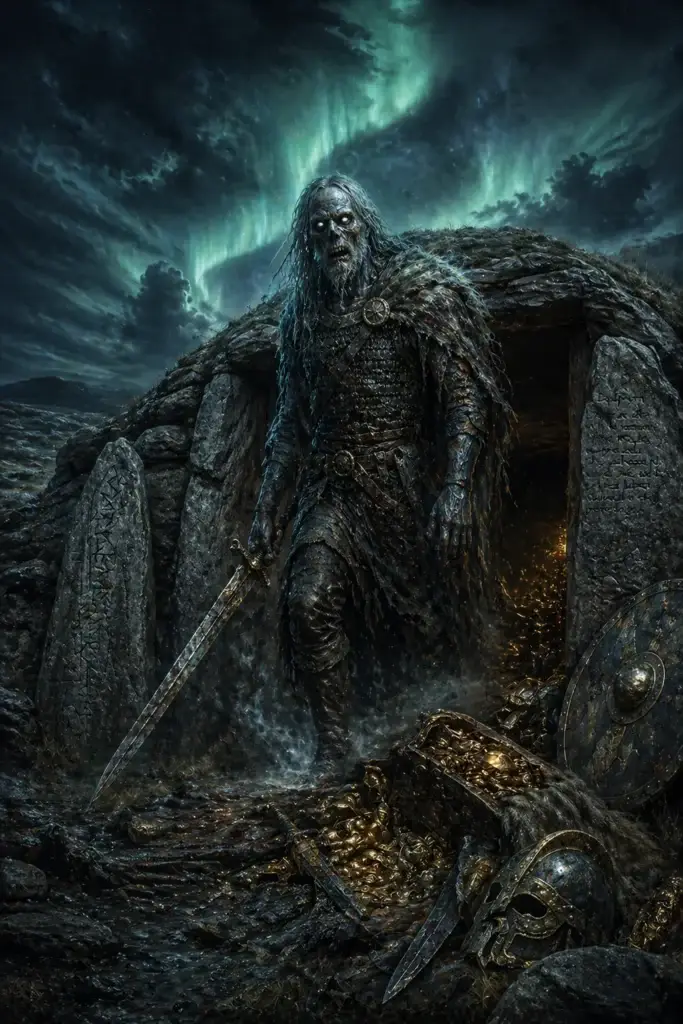
The Draugr (also aptrgǫngumaðr, “the one who walks again”) is the undead burial-mound figure of Old Norse saga literature. Primary sources include the Grettis saga (chs. 32-35: the Glamr episode), the Eyrbyggja saga (Þórólfr Bægifótr), and the Laxdæla saga. Characteristics: heavy body, blue or black skin, superhuman strength, residence in the burial mound.
Transformation occurs after death caused by greed, murderous intent, or unresolved guilt. Combated by decapitation with the being’s own weapon and burning in open ground.
Related figures: Haugbúar (mound-dwellers), Aptrgangr (revenant).
The Draugr is a spirit of the Germanic tradition.
The Draugr is the archetypal revenant of Old Norse tradition. A deceased person rises from the burial mound, not as a spirit, but as a physically present, supernaturally strong, often considerably enlarged dead being.
It guards its grave goods, strangles intruders, can kill the livestock of neighboring farms, and render entire regions uninhabitable. The Icelandic sagas contain the densest literary tradition.
Characteristic of the Draugr: physical presence and immense strength. It may be weaker during the day, but at night it tears open the burial mound and roams the land.
The sagas describe in detail the battles between living heroes and draugar, usually concluding with the rite of staking, decapitation, and burning. The Draugr is functionally related to the Edimmu, Lemures, and the Slavic Upyr, and stands at the beginning of a broad European revenant tradition.
The Eyrbyggja Saga and the Classic Draugr Episode
The Eyrbyggja Saga (written down probably in the thirteenth century, with events set in the tenth century) is one of the most detailed sources for Draugr appearances. The saga reports several revenants who rise from their burial mounds, visit their relatives, and cause unrest.
A prominent motif is the Draugr from the sea: a person who drowned and returns thereafter as an aquatic being, often heard or seen along the coast. The saga treats these appearances not as supernatural in the modern sense, but as a normal part of the order of existence.
The Eyrbyggja also documents countermeasures: reburial in a more sacred place, cremation of the corpse, or magical rituals. These measures imply that draugar are not simply ghosts but remain bound to their physical body and therefore require a corporeal intervention.
Overview: Draugr
Type: Norse revenant
Origin: Improperly buried or re-interred dead, usually with character traits such as greed or violence
Texts: Icelandic sagas, Edda, Norwegian folk legends
Period: Viking Age to the present (literary)
Countermeasures: Decapitation, staking, cremation, burial face-down
Classification
Literary peak in the Icelandic sagas of the 13th to 14th centuries (Grettis saga, Eyrbyggja saga, Laxdœla saga). Precursors in the Edda. Folk traditions continued in Norwegian-Icelandic folklore into the modern era. Successful revival in the modern fantasy genre (Skyrim, among others).
Core area: Iceland, Norway, Scandinavia in general. Parallel motifs in the Germanic and Anglo-Saxon tradition (the Beowulf triad with Grendel shows related structures).
Icelandic sagas (Grettis saga in detail, Laxdœla saga with the famous Hrapp), Edda passages, Norwegian legend collections (Asbjørnsen and Moe), modern folkloristic studies on Scandinavia.
Name
Old Norse: draugr (plural draugar); haugbúi, “burial-mound dweller”.
Related terms: aptrganga (“one who walks again”), dauðr (simply “death/dead”, context-dependent).
Norwegian modern: draug (often with a maritime reference in coastal folk legends).
The Icelandic tradition knows the landdraugr (in the burial mound) as the primary form. The coastal folk tradition developed a sea-draugr, a dead person haunting the sea, who appears to the fisherman at sea.
Characteristics
Appearance
Giant-like (often greatly enlarged after death), dark blue or grey-black, sometimes decomposed. The sagas describe Glamr (Grettis saga) as “so large that there was no measure for it”. Eyes glow in the night. Body intact, not spectral.
Behavior
Guards its treasure in the burial mound. Can venture out on certain nights, kill livestock, strangle people, and empty entire farmsteads. Those who survive a battle against it can win treasure and renown, but may also take away a curse that acts for a lifetime.
Sphere of Influence
The burial mound and its surroundings. In severe cases, an entire region rendered uninhabitable by the Draugr (Eyrbyggja saga, Thorolf Bægifótr). The sea-draugr appears at sea and in fishing huts.
Mythological Classification
The Draugr does not arise through divine action, but through a combination of the deceased’s character disposition and negligent burial. Those who were guilty, violent, or greedy in life are more likely to become a Draugr than those who were peaceful.
Grettis Saga and Glamr, the Strongest Draugr
The Grettis Saga (probably fourteenth century) describes the hero Grettir’s battle against the Draugr Glamr. Glamr had once been a shepherd but died under mysterious circumstances and returned from his mound.
He retains his physical size (superhuman), is weaker by day but invincible at night. Grettir must grapple physically with Glamr, a bodily confrontation that distinguishes the Draugr from immaterial ghosts. The battle ends with Grettir overpowering Glamr and opening his grave.
This episode has become prominent in Norse literary scholarship and serves as the archetype for Draugr confrontations. It also shows that draugar are conceptualized as disturbances in the cosmological order that must be resolved through supernatural or ritual force, and at the same time as malevolent or morally guilty.
Profile: Draugr
The most important aspects of the Draugr at a glance.
From a deceased person who awakens in the burial mound. Contributing factors: poor character, improper burial, violent death.
Grave robbers, inhabitants of neighboring farms, livestock. Heroes who seek to overcome the burial mound.
Physically present, grown to giant size, dark blue or black, glowing eyes. Not a phantom: the Draugr has weight.
Strangles people, kills livestock, renders regions uninhabitable. Can be subdued through wrestling or combat ritual; often leaves behind a curse.
Decapitation with the head placed between the feet, staking, cremation, burial face-down. In persistent cases, opening the burial mound and ritual destruction of the remains.
Protective Practice
Burial Rituals
To prevent a Draugr: burial face-down (“so the dead person facing downward cannot find the way out”), binding of the big toes, shroud secured with needles. Particularly difficult dead were carried out feet first and turned several times to confuse their sense of orientation.
Combat Rituals
The hero enters the burial mound, wrestles with the Draugr, cuts off its head, places the head between the legs, burns the body, and scatters the ashes or casts them into the sea. The sagas describe this in several famous scenes (Grettir vs. Glamr, Grettir vs. Kar the Old).
Amulets and Signs
Iron (sword, sickle), crosses after Christianization, runic amulets. In the Norse folk tradition: horseshoes on door and bed, burning lights in the night.
Parallels and Afterlife in Tradition
Older European Traditions
The Draugr shares structural features with Mesopotamia’s Edimmu, Rome’s Lemures, and Greek restless dead. In each case: deficient burial as the cause, ritual as the remedy.
Slavic Upyr and vampire: The Slavic Upyr and the Central European vampire share the physically present revenant character. Bram Stoker’s Dracula (1897) is a distant descendant. The distinction: the Draugr does not drink blood but strangles and beats its victims to death.
Modern reception: Draugr figures in fantasy and video games (Skyrim, God of War Ragnarok) preserve the physical presence and burial-mound association. Nordic noir and contemporary Icelandic literature take up the motif.
Icelandic Tradition and the Continuity of Belief
Iceland has played a special role in the history of Draugr tradition. As a relatively isolated society with a stable literary tradition (sagas, Eddas), the Draugr concept was preserved and refined over centuries.
Modern Icelandic folklorists such as Jon Arnason (nineteenth century) still documented Draugr sightings from their regions and concluded that the belief had never entirely disappeared but had transformed.
This continuous tradition allows a direct comparison between medieval literary sources and modern folk belief. Such lines of continuity are rare in European folkloristics and make Iceland a valuable archive for the study of Draugr tradition.
The Draugr in the Icelandic Sagas
The most detailed accounts of the Draugr are found not in mythological poetry but in the Icelandic sagas, the prose narratives of the thirteenth and fourteenth centuries that report on the lives of Iceland’s settlers.
These sagas contain numerous episodes in which the dead leave their burial mounds and haunt the living. The Draugr there is no pale phantom but a physically present, bodily being possessed of superhuman strength.
Two cases are particularly well known. In the Grettis saga, the hero Grettir battles the revenant Glamr, a shepherd who roams after his violent death and kills people and livestock.
Grettir defeats him in a long wrestling match, but the dying Glamr places a curse on him that thenceforth brings Grettir misfortune and fear of the dark. In the Eyrbyggja saga, an entire household of dead haunts the living until the survivors hold a formal legal proceeding against the revenants and thereby expel them.
These narratives are valuable for the history of religion because they show how concrete and everyday the concept of the restless dead was. The Draugr is bound to its burial mound and its former dwelling place, acts out of malice, envy, or possessiveness, and can only be subdued by resolute measures.
Scholars read the sagas not as factual reports but as literary processing of a genuinely held belief. The fact that these episodes are narrated in such detail, with fixed patterns, is taken as an indication that belief in revenants was firmly rooted in medieval Iceland.
Warding Off, Reburial, and Handling the Grave
The sagas report not only on the appearance of draugar but also, in remarkable detail, on the means of rendering them harmless.
These accounts offer insight into an entire practice of dealing with the dangerous dead. The most effective method was to overpower the Draugr definitively in its mound or in combat, and then to destroy its body.
Several sagas describe a fixed procedure: the revenant’s head was cut off and placed at the buttocks or between the thighs; the corpse was burned and the ashes taken to a remote location or scattered at sea.
Sometimes the dead was also taken from its mound and reburied in another, secluded place. These measures aimed to sever the dead person’s bond to its place and to break its capacity for movement.
Archaeology has produced findings that correspond to this tradition. In Scandinavian graves of the Viking Age, individual burials are found in which the corpse was weighed down with heavy stones, laid in an unusual position, or otherwise treated differently from the norm.
Scholars interpret such findings cautiously as a possible expression of concern about revenants, while also urging restraint, since the motives behind a burial can rarely be established with certainty from archaeological evidence alone. The connection between saga narrative and grave find remains an important but methodologically delicate field of Germanic religious history.
Haugbúi, Aptrgangr, and the Diversity of Revenant Belief
The Old Norse tradition does not know a single, clearly defined revenant type but rather a range of related terms and concepts. Alongside draugr, the most common terms are haugbúi, literally “mound-dweller”, and aptrgangr, “one who walks again”.
Scholars have long debated whether these words are to be kept strictly apart or whether they designate overlapping aspects of the same basic concept.
A widely held distinction sees in the haugbúi the place-bound dead who remain in the burial mound and usually become dangerous only when someone breaks in to steal the buried treasures.
The aptrgangr, by contrast, leaves the grave and seeks out the living in their homes. The term draugr is sometimes used as a superordinate category, sometimes for the particularly active and malicious revenants. These boundaries, however, are not consistently maintained in all sources.
The religious-studies assessment emphasizes that behind all these terms lies a common underlying assumption: death does not end existence entirely, and a dead person can under certain circumstances persist in a distinct, bodily form. What caused a dead person to become a revenant is not uniformly regulated in the sources.
The texts mention: a malicious character during life, a violent or unjust death, inadequate or faulty burial, and a strong attachment to possessions or place. This variety of triggers shows that revenant belief was not a closed doctrinal system but a bundle of related concepts weighted differently according to each narrative.
From the Medieval Revenant to Modern Reception
Belief in the Draugr did not disappear with the Middle Ages. In Icelandic and Scandinavian folk tradition more broadly, ideas about the restless dead continued into the modern era, if often changed and supplemented with new features.
In some later narratives, the Draugr is connected with the sea and appears as the spirit of the drowned, threatening the living at sea. This maritime variant is known especially from Norway and shows how the basic figure adapted to the lifeworld of coastal populations.
In the nineteenth century, the Draugr became known to a wider public through the recording of folk narratives and through growing interest in Old Norse literature. Writers and collectors took up the material, and the revenant found its way into the Romantic and late-Romantic poetry of Scandinavia.
In the present day, the Draugr is an established figure in popular culture. Video games, fantasy literature, and films employ the term, but often in a greatly simplified form or blended with other undead concepts.
The modern game-Draugr is usually a generic undead being that shares little with the precise, legally, spatially, and mortuary-bound figure of the sagas beyond the name.
From a religious-studies standpoint, this finding is typical: a clearly contoured medieval object of belief becomes a flexible motif in modern entertainment, losing its original social and legal context.
Those who wish to understand the historical Draugr must therefore rely on the sagas and the scholarship on the Germanic tradition, not on its modern media counterparts.
Research Literature
Further standard works in the literature index.
The protective practice described here represents a religious-studies classification of historical traditions. iWell Guard draws on this cultural-historical line of wearable protective objects and presents a contemporary form of it. Learn more about the iWell Guard