Haugbúi, the guardian in its own burial mound
By Ralf Ittermann · last reviewed on
Haugbúi is a spirit of Old Norse tradition.
A guardian who never leaves its mound and its treasure.
Haugbúi, also spelled haugbui, is the Old Norse dweller of the burial mound: a physical undead who never leaves its mound and guards it along with its treasure. Unlike the mobile, aggressive Draugr, it is strictly site-bound and attacks only those who intrude into its mound.
Those who avoid the mound have nothing to fear from the Haugbúi. It is attested chiefly in the Icelandic sagas, for instance as Kárr the Old in the Grettis saga, who remains like a guardian in his burial mound and rises only when disturbed.
Type: site-bound burial mound dweller, guarding mound and treasure
Origin: Iceland and Scandinavia, Old Norse saga literature
Texts: Icelandic sagas, well attested, for instance the Grettis saga
Period: Old Norse saga age
Appearance: physical undead within the mound, often resembling its appearance in life

Area of origin and sources
Period of the Texts
Old Norse saga age: the Haugbúi is a fixed figure of Icelandic saga literature and attested there several times.
Area of Diffusion
Iceland and Scandinavia. Its site of activity always remains its own burial mound.
Sources
Good: several Icelandic sagas, above all the Grettis saga, attest to the Haugbúi as a distinct figure alongside the mobile Draugr.
Name and variants
Old Norse: Haugbúi is composed of haugr, mound or burial mound, and búi, dweller, literally meaning mound-dweller. The word haugr is related to the English how for mound. In the sagas, the figure is often not called draugr but haugbúi or aptrganga, one who walks again.
Being and effect
Appearance
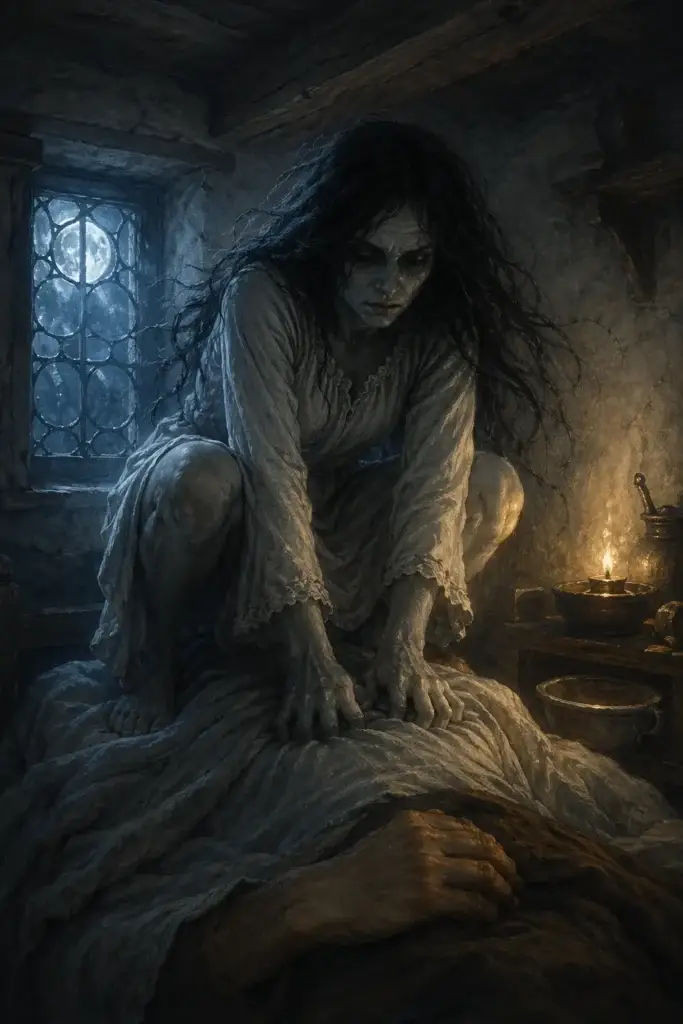
The Haugbúi appears as a massive, physical corpse in its mound, often still resembling its living form, and is inseparably bound to the burial treasure.
Effect
It symbolises the dead person’s continuing claim of ownership over the mound and its grave goods, placing it closer to a guardian spirit than to a raiding undead. Strictly bound to its place, it never leaves the mound and only attacks intruders and grave robbers who threaten its treasure; whoever avoids the mound has nothing to fear from it.
Profile: Haugbúi
The key aspects of the burial-mound dweller at a glance.
An established figure of Old Norse saga literature, attested in the Íslendingasögur alongside the mobile Draugr.
Intruders and grave robbers who enter its mound; those who stay away are left unmolested.
A massive, physical corpse in the burial mound, often still resembling its living form.
Guardian of mound and treasure: it defends its claim of ownership rather than going out to raid itself.
Respect the boundary and do not enter the mound; anyone who intrudes regardless must defeat the Haugbúi in single combat.
The place-bound counterpart to the mobile Draugr, related to the Gjenganger and the Wiedergänger.
Kárr the Old and the Guardians of the Sagas
The name Haugbúi is composed of haugr, mound or burial mound, and búi, dweller, literally meaning mound-dweller; the Old Norse haugr is related to the English how for mound. In the sagas, the figure often bears not the name draugr but haugbúi or aptrganga, one who walks again.
A central saga account is Kárr the Old in the Grettis saga: he remains like a guardian in his burial mound and rises only when disturbed. By comparison, the same saga also features the equally famous Glámr, a mobile revenant who leaves the place of his unrest, providing the exact counterpart to the place-bound Haugbúi.
From Kárr the Old to Tolkien's Barrow-Wights
The Haugbúi is an important source for the modern image of the Norse undead and is considered a model for J. R. R. Tolkien’s barrow-wights, as well as for treasure-guarding undead in fantasy and games.
From a religious-studies perspective, the Haugbúi is an expression of ancestor and burial-mound cults, in which the dead remain the owner of their mound. It reflects fear of the dead and ideas of ownership, standing as a guardian spirit between the restless revenant and the raiding undead.
Respecting the Boundary: Dealing with the Burial Mound
In the sagas, the Haugbúi is defeated in single combat within the mound; the typical destruction of Norse undead is decapitation, placing the head against the back of the corpse, followed by burning. The simplest way to avoid trouble, however, remains not entering the burial mound at all and not robbing the treasure, that is, respecting the boundary.
Where this boundary is crossed anyway, further precautions supplement dealing with the mound-dweller: iron was considered effective against the undead, a threshold protection was meant to prevent it from following the intruder to the exit, and rowan served as protective wood against the powers of the mound-dweller.
Haugbúi and Draugr: Comparing Two Norse Undead
The Haugbúi is the place-bound variant of the Draugr, which by contrast appears mobile and aggressive; both belong among the Norse revenants and are closely related to the Gjenganger, the Scandinavian linguistic counterpart for the physically returning dead. The Wiedergänger of Germanic tradition likewise belongs to this field of physically returning undead.
Frequently Asked Questions about the Haugbúi
What distinguishes the Haugbúi from the Draugr?
The Haugbúi never leaves its mound and only attacks intruders. The Draugr, by contrast, is mobile and aggressive and haunts the living even beyond its grave.
Is it always malicious?
No, it is often passive or even helpful, as long as its mound is left undisturbed and its treasure untouched.
What does it guard?
Its burial mound and the treasure within, which it regards as its continuing possession.
Further links
Further reading:
- Germanic – all beings of the Germanic tradition
- Gjenganger – the roaming, violent revenant of the same tradition
- Wiedergänger, Nachzehrer – related undead of the Germanic tradition
- Myling, Doppelsauger – further spirits of the dead in Norse-Germanic tradition
- Iron, Threshold Protection, Rowan – traditional protective means
Literature (selection)
Further standard works in the bibliography.
As an Old Norse undead, the Haugbúi remains above all one thing: the burial-mound dweller who does not give up its mound and its treasure even in death, becoming dangerous only to those who disregard its boundary.