Niß Puk, the Wight under the Thatched Roof
By Ralf Ittermann · last reviewed on
The Niß Puk is a spirit of the Germanic tradition.
Helps for sweet groats, punishes with haunting and ruin. This household Wight was known equally for quiet help and for mischief.
The Niß Puk, also called Nis Puk or Puk, is the house goblin of the North Frisian and Schleswig region, dwelling in house, stable or barn. When treated well, he helps with farm and stable work and demands groats; in another guise, he brings the owner goods belonging to others.
The North Frisian house goblin is well documented in Karl Müllenhoff’s collection of tales from 1845 and in the research of H. F. Feilberg. As a link between German and Scandinavian goblin tradition, he remains living regional folklore in the German-Danish border region to this day.
Type: House goblin of house, stable and barn
Origin: North Frisia, Schleswig, German-Danish border region
Texts: Müllenhoff 1845, Feilberg
Period: Schleswig-Holstein legends, Müllenhoff 1845
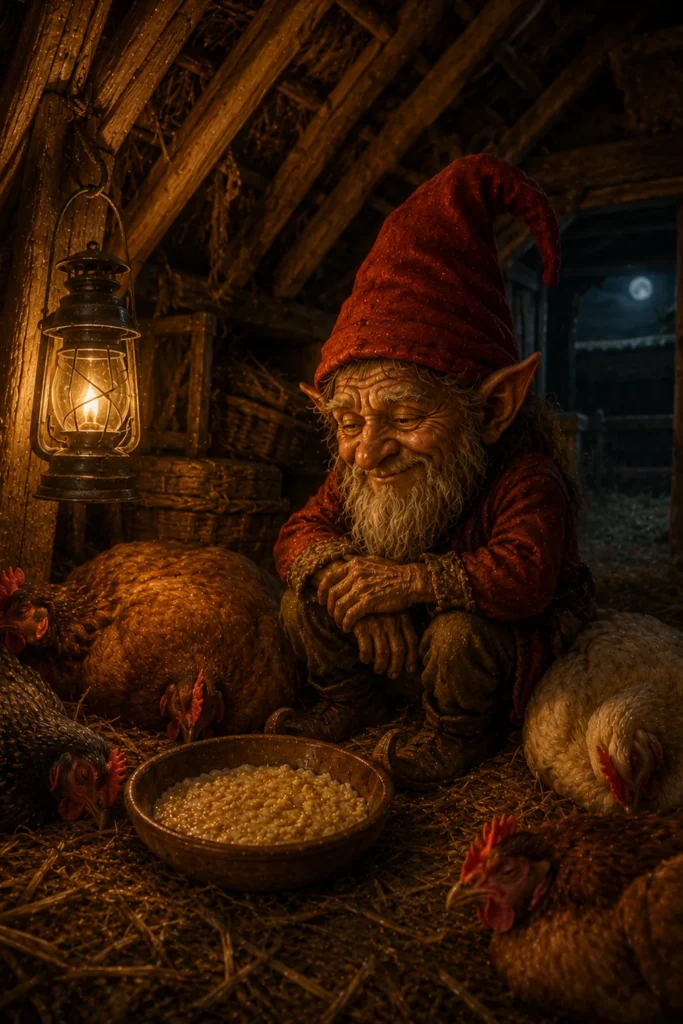
Appearance: small goblin with a red pointed cap
Source context
Period of the Texts
The written records belong to the Schleswig-Holstein legend tradition; the core source is Karl Müllenhoff’s collection of 1845.
Area of Diffusion
North Frisia, Schleswig and the German-Danish border region; the belief is widespread in the North Frisian, Low German and Danish-speaking areas.
Sources
Well documented: Müllenhoff’s Legends of the Duchies of Schleswig, Holstein and Lauenburg from 1845 and the research of Henning Frederik Feilberg.
Name and variants
North German-Danish: The name combines Niß, a short form of Nicholas as in Scandinavian nisse, and Puk, Old Danish puge from Old Norse puki, meaning goblin or little devil, linguistically related to English Puck.
Form and effect
Appearance
The Niß Puk is a small goblin, often wearing a red pointed cap, who dwells in house, stable or barn, gladly under a thatched roof; usually he stays hidden and is only noticeable through sounds and effects.
Effect
The Niß Puk has two faces: as a good house spirit he helps with farm and stable work, guards the chickens against the polecat and brings luck; in his other guise he approaches the Drak type, who brings the owner foreign, stolen goods and makes him rich, morally ambivalent.
Profile: Niß Puk
The key aspects of the Puk of the barn at a glance.
House goblin of the German-Danish border region, a link between German and Scandinavian goblin tradition.
House, stable and barn: he helps with farm and stable work, guards the chickens against the polecat and brings luck to the farm.
Small goblin with a red pointed cap, gladly dwelling under a thatched roof; usually hidden and recognisable only by sounds and effects.
Farm and stable help and household luck; as a bringer variant he brings the owner goods belonging to others and makes him rich, morally ambivalent.
The obligatory offering is a bowl of sweet groats with butter and milk at a fixed spot; refusal is punished with unrest and haunting up to the ruin of the farm.
Directly related to Nisse and Tomte, as well as Hinzelmann and Hödekin; linguistically related is the English Puck.
Between Nisse and Puck: a Name from Two Worlds
The name combines Niß, a short form of Nicholas as in Scandinavian nisse, and Puk, Old Danish puge from Old Norse puki, meaning goblin or little devil, linguistically related to English Puck. Even the name thus shows the dual origin of the being from German and Nordic tradition.
The belief is widespread in the North Frisian, Low German and Danish-speaking areas. It is well documented in Karl Müllenhoff’s Legends of the Duchies of Schleswig, Holstein and Lauenburg from 1845 and in the research of H. F. Feilberg, who comprehensively studied the history of the nisse figures.
Living Folklore and Classification
The Niß Puk is living regional folklore in the German-Danish border region, found in museums, children’s books and storytelling projects, and a link between German and Scandinavian goblin tradition.
From a religious-studies perspective, the Niß Puk is useful when treated well; his revenge consists of haunting and economic ruin, not killing. Important clarifications: Puk is etymologically related to Puck, yet the Niß Puk is a distinct North German-Danish form, not Shakespeare’s Puck; he is not purely benevolent, since the Drak variant brings goods belonging to others; and Niß means Nicholas, not water sprite.
The Groats Offering of Stapelholm
The food offering is obligatory: a bowl of sweet groats with butter and milk at a fixed spot. A documented legend pattern from Stapelholm states that whoever refuses him the groats or hunts him is punished with so much unrest and haunting that the farm becomes unusable and must be sold cheaply; the new owners, who feed him again, find peace. So the rule is to provide for and respect him, not to drive him away.
Related Goblins from Scandinavia to England
The Niß Puk is directly related to the Scandinavian Nisse and Tomte, the Hinzelmann and Hödekin; linguistically related is the English Puck. As a bringer variant he stands close to the Drak or dragon goblin.
Frequently Asked Questions about the Niß Puk
What is a Niß Puk?
The North Frisian-Schleswig house goblin who dwells in house, stable or barn.
What does he demand as an offering?
A bowl of sweet groats with butter at a fixed spot.
Is he the same as Shakespeare’s Puck?
No. Puk is etymologically related, but the Niß Puk is a distinct North German-Danish form.
Further links
Further reading:
- Germanic – all beings of Germanic tradition
- Nisse, Tomte – the Scandinavian relatives
- Hinzelmann, Klabautermann – further goblins of the north
- Salt, Amulet, Protective candle – traditional protective means
Literature (selection)
Further standard works in the bibliography.
As a North Frisian house goblin and Puk of the barn, the Niß Puk embodies the old contractual thinking of the farm: whoever sets out the groats has a helper under the thatched roof; whoever refuses loses the farm.