Bergtroll, the treasure-guarding giant in the rock
By Ralf Ittermann · last reviewed on
The Bergtroll is a spirit of Nordic-Germanic tradition.
He guards gold in the mountain, steals brides and turns to stone in the light.
The Bergtroll, also called Bergriese or Bergkönig, is the treasure-guarding mountain giant of Scandinavian folklore. He lives in mountains and rocks, guards gold and abducts humans, particularly brides; in sunlight he bursts or turns to stone.
He is only one expression of the broad collective term Troll, but the most giant-like and dangerous one: in many sagas he resides as a Bergakungen, a mountain king, with his own court inside the rock.
Type: Treasure-guarding mountain giant of troll folklore
Origin: Pan-Scandinavian tradition
Texts: Asbjørnsen and Moe, Norske folkeeventyr; Lindow, Trolls
Period: pan-Scandinavian troll folklore
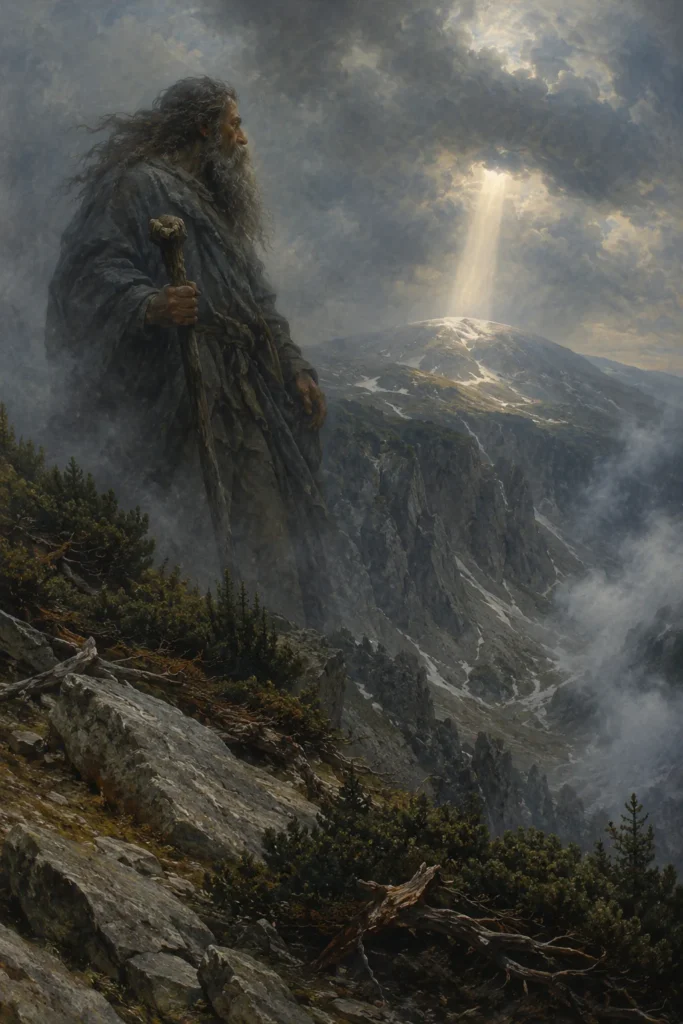
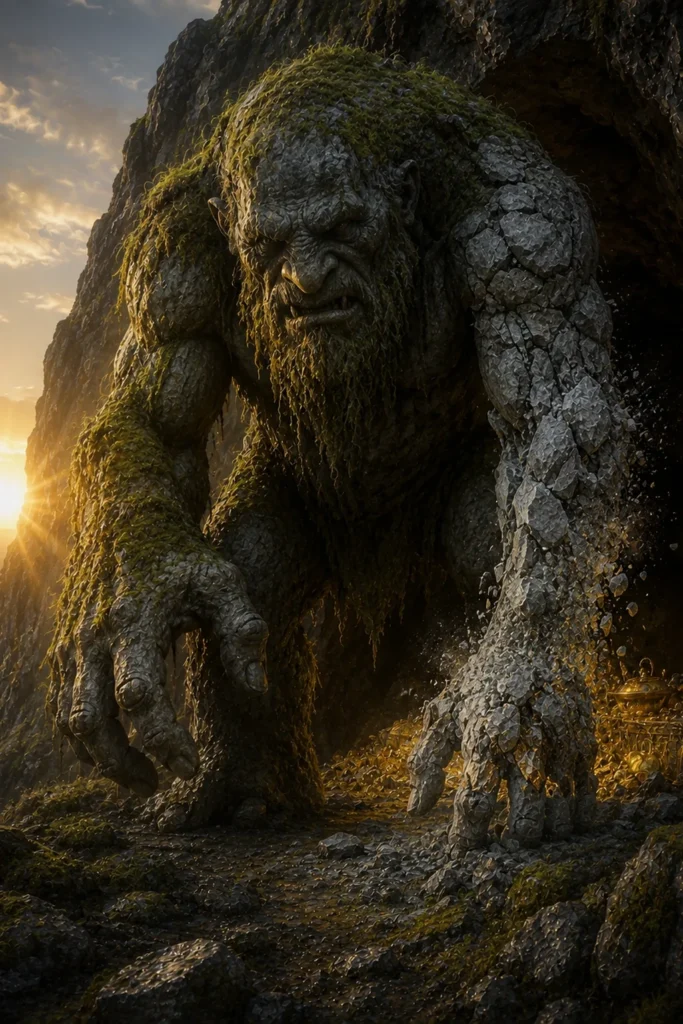
Appearance: large, hulking, rock-like giant, naturally moss-covered
Historical Background
Period of the Texts
The tradition of the Bergtroll is pan-Scandinavian; the classical evidence comes from the saga and fairy-tale collections, most notably Asbjørnsen and Moe.
Area of Diffusion
Norway and Sweden: there, in many sagas, the troll lives in the mountain or rock, often as a Bergakungen, a mountain king, with a court.
Sources
The state of the sources is good: the collection by Asbjørnsen and Moe, John Lindow’s troll study and Christiansen’s catalogue of migratory legends.
Name and variants
Scandinavian: The name combines berg with troll, rese, giant, or kung, king. In southern Scandinavia the Bergtroll is presumably a generalisation of haugtroll, mound troll, and bergtroll, the underground ones.
Appearance and powers
Appearance
The Bergtroll is large, hulking, ugly and giant-like, naturally moss-covered and rock-like, as though he were himself a piece of the mountain he inhabits.
Effect
The Bergtroll inhabits mountains and rocks, guards gold and treasures and abducts humans, particularly brides, in the motif of the stolen bride. He can ‘bergtage’ people, take them into the mountain; in many sagas the encounter with him ends fatally.
Profile: Bergtroll
The most important aspects of the Scandinavian mountain giant at a glance.
A giant-sized expression of troll belief, transmitted throughout Scandinavia; in many sagas as a mountain king with a court inside the rock.
Humans, particularly brides: the motif of the stolen bride is a fixed element of the Bergtroll sagas.
Large, hulking, ugly and giant-like, naturally moss-covered and rock-like; the petrified trolls are said to explain striking rock formations.
Mountains and rocks: guarding treasure, abduction of humans and ‘bergtagen’, the taking of people into the mountain.
Sunlight, in which trolls burst or turn to stone, along with church bells and ringing, steel and iron and Christian signs.
From Haugtroll to mountain king
The name of the Bergtroll combines berg with troll, rese, giant, or kung, king; in southern Scandinavia it is presumably a generalisation of haugtroll, mound troll, and bergtroll, the underground ones. The tradition is pan-Scandinavian.
In many sagas the troll lives in the mountain or rock, often as a Bergakungen, a mountain king, with his own court. There he guards gold and treasures, and from there he takes people: the motif of the stolen bride and ‘bergtagen’, the taking into the mountain, belong to the fixed repertoire of this world of sagas.
From Kittelsen to Trollhunter
The Bergtroll shaped the popular image of the troll, among other things through Theodor Kittelsen’s illustrations, Norwegian tourism and the 2010 film Trollhunter; the petrified trolls still serve today as a way of interpreting the landscape.
From a religious-studies perspective, the Bergtroll abducts humans and in many sagas proves fatal, warded off only by sunlight and Christian means. Three clarifications are important: Troll is a collective term, ranging from giant-sized mountain trolls to small underground beings, and the Bergtroll is only one expression of it. The cute souvenir trolls are a modern trivialisation. And petrification by the sun is predominantly a Norwegian feature.
Sun, bells and steel: the defence
Several means of defence against the Bergtroll are attested: sunlight, in which the trolls burst or turn to stone, which explains the troll-shaped rock formations of the landscape, as well as church bells and ringing, steel and iron and Christian signs. These defensive motifs are broadly attested in the Nordic saga tradition; the strongest ban is the day itself, for no Bergtroll survives the morning light.
Troll, Bergsrå and the jötnar
Within the Nordic world, the Bergtroll belongs to the broad collective term Troll, from which it is clearly distinguished as a giant-sized, rock-dwelling expression. It overlaps with the Bergsrå and the Bergakungen, the mountain king; related are the Icelandic and Norwegian jötnar, the giants, and generally the cave- and treasure-guardian motif.
Frequently asked questions about the Bergtroll
What is a Bergtroll?
A treasure-guarding mountain giant of Scandinavian folklore who abducts humans and lives in mountains and rocks.
Why do trolls turn to stone?
Because they burst or turn to stone in sunlight; this explains troll-shaped rock formations.
Is Troll the same as Bergtroll?
No. Troll is a collective term; the Bergtroll is only one giant-sized expression of it.
Further links
Literature (selection)
Further standard works in the bibliography.
As a Scandinavian mountain giant, the Bergtroll shaped the image of the troll into the present day; as mountain king of the trolls he sits enthroned in the rock above his treasures, until sunlight turns him to stone.