Lemures, Spirits of the Dead and the Household in Roman Belief
By Ralf Ittermann · last reviewed on
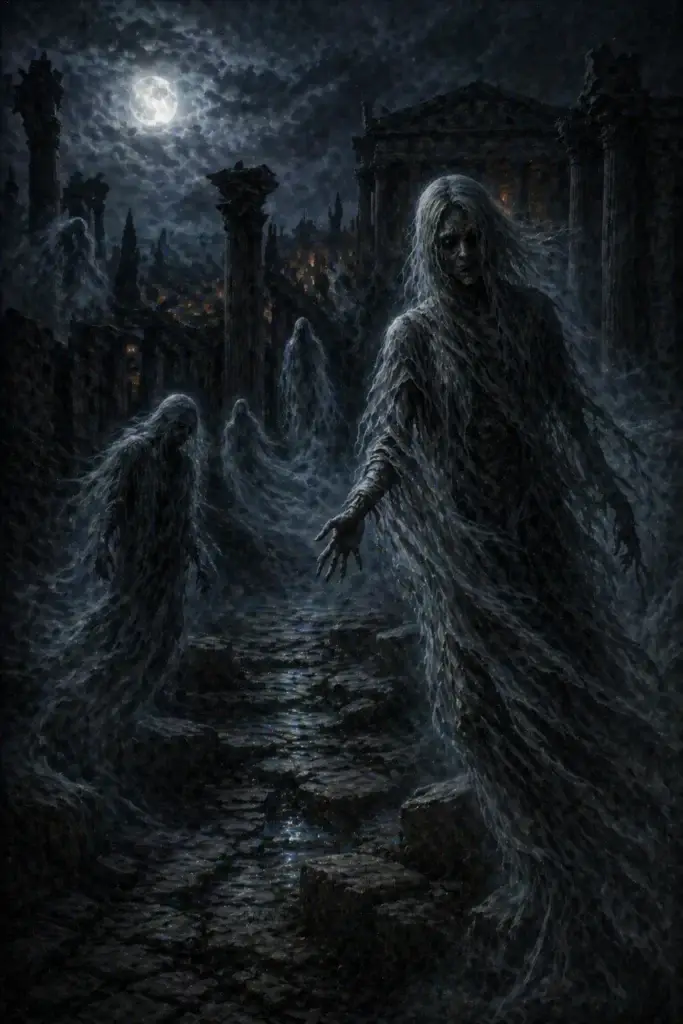
Lemures
The Lemures are the restless dead of the Roman tradition. Unlike the manes, who are honored in the regular ancestral cult, the Lemures are regarded as potentially dangerous: they return to the houses, disturb sleep and family, and demand to be appeased.
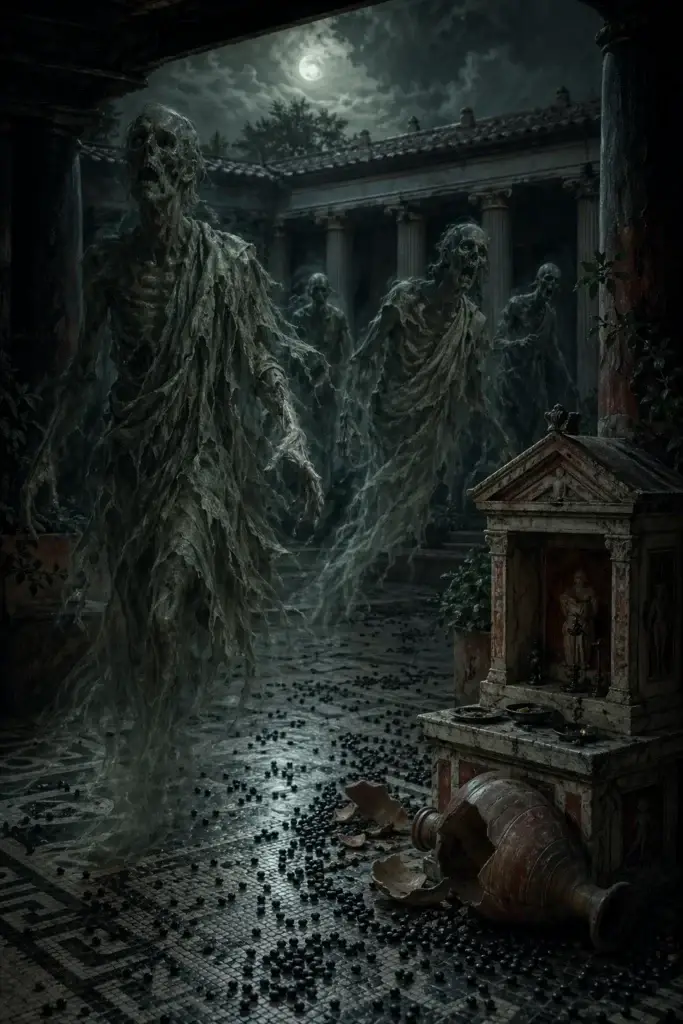
Every year in May, on the 9th, 11th and 13th, the festival of the Lemuria takes place, during which the head of the household drives the Lemures out of the house with a fixed rite.
The best-known literary description is given by Ovid in the fifth book of his Fasti. The ritual, throwing beans, reciting a formula, not looking back, is one of the most detailed ancient rituals we possess in written form. Its influence reaches into modern folkloric accounts.
At a Glance: Lemures
Type: Restless spirits of the dead
Origin: The deceased with incomplete burial or violent death
Texts: Ovid (Fasti V), Horace, Plautus, Persius
Period: Republic to late antiquity
Distribution: Italy, the Roman Empire
Defense: Lemuria rite (May), proper burial, Parentalia offering
Classification
The Lemures are already known in the early Republic. According to Ovid, the Lemuria festival dates back to its mythical founding by Romulus. Literary sources range from the 3rd century BC (Plautus) into late antiquity. Christian authors later adopt the word for demonic spirits in general.
The core lies in Italy, spreading throughout the Empire as Rome expanded. In the provinces, the notion merges with local spirit traditions. The festival of the Lemuria belongs to the fixed Roman calendar.
Central is Ovid’s Fasti V (419–492) with its detailed description of the Lemuria rite. Alongside this are mentions in Horace, Persius, Plautus, Augustine. Inscriptions relating to the Parentalia cult and burial law round out the picture.
Designation and Spellings
Latin: Lemures, mostly plural; the singular lemur is rare.
Distinguished from: manes (ancestral spirits, positive), larvae (malevolent spirits, often synonymous with Lemures), di inferi (gods of the underworld).
The etymology is unclear; Ovid speculatively derives the name from “Remus”. More likely is a root meaning “shadow” or “nocturnal figure”. The boundary with the Larvae is fluid; some authors use the terms synonymously, while others reserve Lemures for the more neutral category.
Description
Appearance
Shadowy, without a pictorial tradition of their own. The literature describes them as pale, soundless figures that appear in dreams or make themselves present through noises, knocking, rustling, murmuring.
Behavior
They return when their care for the dead has been neglected or when they have died violently. They disturb sleep, bring bad dreams, affect the health of family members, and make houses uncanny.
Sphere of Influence
The family home and the places of their death. In travelers’ tales occasionally also inns and unfamiliar places with a history of violent death.
Mythological Origin
According to Ovid, the Lemuria festival goes back to Romulus, who wished to bring rest to his murdered brother Remus. Historically it is probably older, deriving from a pre-urban Italic tradition of the cult of the dead.
Profile: Lemures
The most important aspects of the Lemures at a glance. The detailed account of name, description, defense and parallels can be found in the following sections.
From those who were improperly buried or who died violently. Not a created being, but a human deceased in the wrong position.
Above all the family itself, which has neglected the care of the dead. Also the inhabitants of houses with a violent history.
Shadowy, pale, soundless. No fixed iconographic program. The experience is mostly acoustic or in dreams, more rarely visual.
Sleep disturbances, bad dreams, unrest in the house, illness within the family. No sudden violence, but rather persistent suffering.
Lemuria rite in May: walking barefoot through the house at night, throwing black beans over the shoulder, calling out nine times “Manes exite paterni” (“Depart, spirits of the fathers”). The Lemures follow the beans out of the house.
Edimmu (Mesopotamia), Keres (Greece), hungry ghosts (East Asia), revenants (Germanic).
Protective Practice
Rituals of Defense
The annual Lemuria festival is the central rite of defense. The head of the household rises in the middle of the night, washes his hands, walks barefoot through the house and throws nine black beans over his shoulder without looking back.
He recites the formula “Manes exite paterni” nine times. The spirits follow the beans and leave the house.
Incantations
The formula of the Lemuria is short and fixed. Alongside it there are orally transmitted short formulas for cleansing the house and protecting sleep. Curse tablets (defixiones) directed against personal opponents may explicitly invoke Lemures.
Amulets and Protective Symbols
House altars with figures of the Lares, which at the same time represent the order of the household. Regular Parentalia offerings in February keep the ancestors gracious and thereby keep the restless ones away.
Lemures, Parallels in Other Cultures
Mesopotamia
The Edimmu is the close parallel: a restless spirit of the dead arising from neglected burial or violent death. In both traditions, defense is carried out by making up for the neglected ritual duty, in Mesopotamia particularly through the kispu rite.
Greece: The Keres and later terms for restless souls function similarly, without a comparably systematic festival like the Lemuria. The cult of the dead in Greece is organized in a more decentralized way.
European folk belief: Revenants, poltergeist motifs, household spirits. In all of these traditions the basic structure of the Lemures lives on: neglected care of the dead as the cause, ritual as the solution.
The Lemuria: Course of the Nocturnal House Rite
The most detailed account of the festival dedicated to the Lemures is given by Ovid in the Fasti (Book 5, verses 419 to 492). The Lemuria fell on the 9th, 11th and 13th of May, that is, on odd-numbered days, which were regarded as unfavorable in the Roman calendar.
On these nights, the restless dead, who had no proper burial or no descendants to tend their memory, were thought to roam through the house.
Ovid describes the rite as the task of the pater familias. At midnight he rose barefoot, made a sign with his thumb and closed fingers intended to ward off the shades, and washed his hands three times at a spring.
Then he took black beans into his mouth, turned away and threw them over his shoulder while saying nine times: haec ego mitto; his redimo meque meosque fabis, roughly: “These I cast; with these beans I redeem myself and mine.” The shades were supposed to gather up the beans behind him without his looking back.
Afterward he cleansed himself again with water, struck bronze vessels and called on the spirits nine times to leave the house: manes exite paterni. Only then was he allowed to turn around; the rite was regarded as completed and the house as cleansed.
Scholarship sees in the custom an apotropaic ritual whose individual elements, going barefoot, crossing the threshold, the noise of bronze and the number nine, are widely attested in ancient magic. In Rome beans were regarded as a food with a special connection to the dead; the Pythagoreans too avoided them.
Ovid’s account is the most important, but at the same time a late literary source that may embellish older practice. How widely the rite was actually practiced cannot be securely inferred from it alone.
Lemures, Manes and Larvae: Distinguishing the Classes of the Dead
The Roman world of ideas knew several terms for the dead and the spirits of the dead, which partly overlapped and are still discussed in scholarship today.
The di manes were the collectively venerated, generally benevolent ancestral spirits, to whom grave inscriptions were dedicated with the formula dis manibus. The festival of the Parentalia in February was devoted to them as a time of peaceful care for the dead.
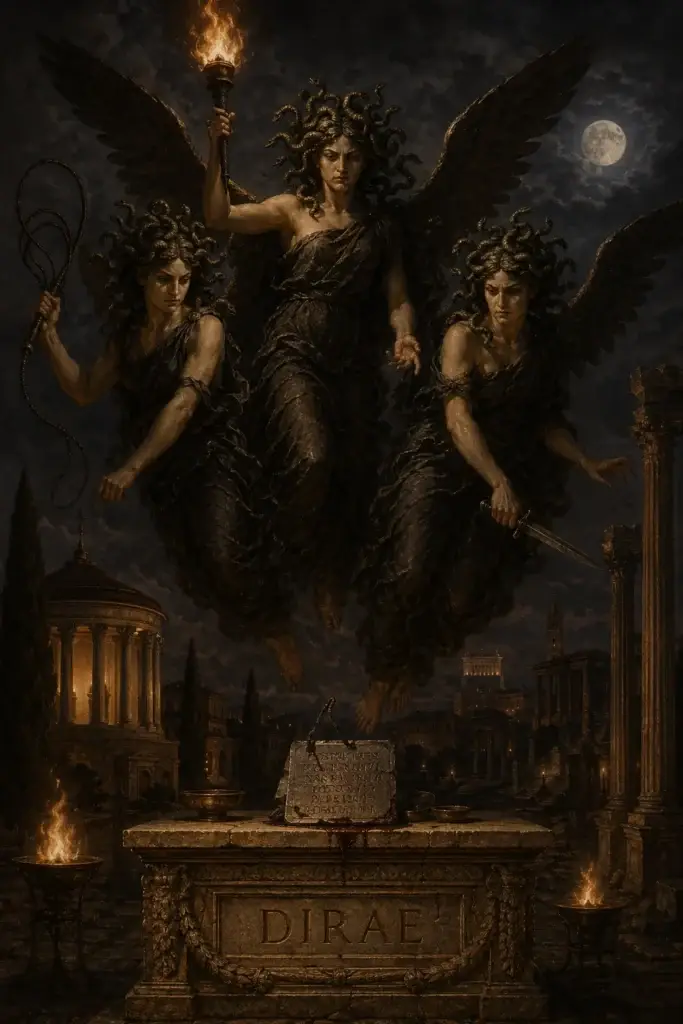
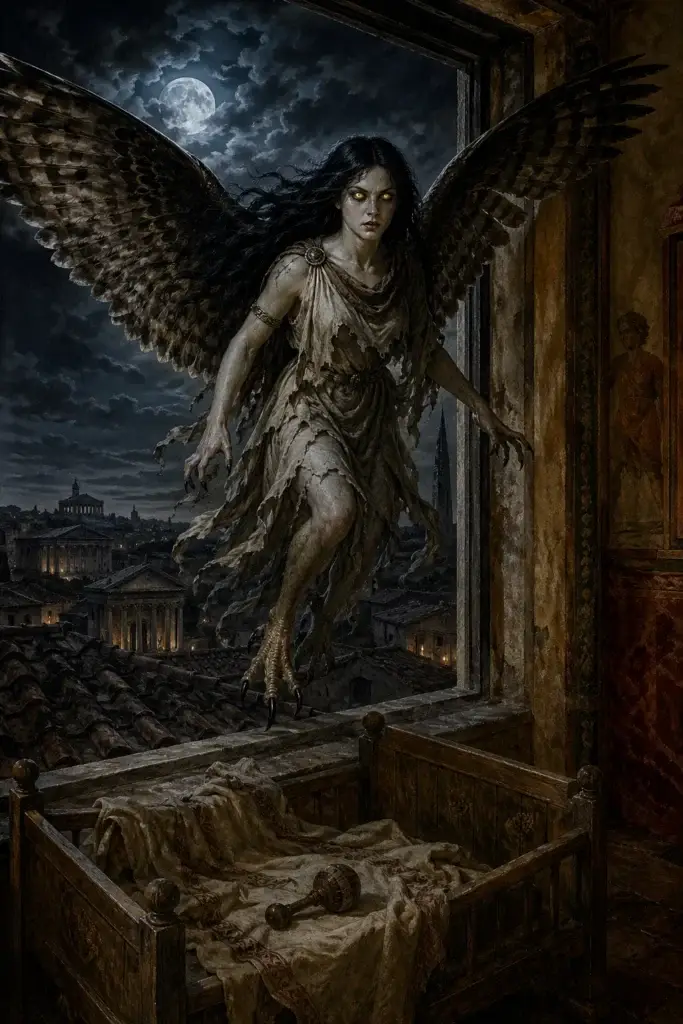
By contrast, according to a widespread interpretation, the lemures denoted the restless, potentially dangerous dead who had not come to rest. Ancient grammarians and later authors attempted to mark off a further class: the larvae as harmful, terrifying ghosts, occasionally equated with the Lemures.
In De civitate Dei (Book 9) Augustine reports a system he finds in the philosopher Apuleius: the soul of a deceased person is called lemur; if it turns out well-disposed toward the descendants, it becomes a lar familiaris; if it turns out punishing, a larva; and if it remains uncertain whether good or evil, one speaks of di manes.
This ordering is, however, a late, philosophically shaped construction and hardly reflects the lived conception of the earlier Republic. The sources are inconsistent, and even ancient authors were aware of the vagueness.
Modern scholars of religion such as Franz Cumont and later researchers of Roman death religion emphasize that the terms represent not so much fixed categories as flexible designations for different aspects of being dead.
If you are looking for more on the protective household spirits, you will find further pointers in the entry on the Lares; for the Egyptian parallel of a restless dead one, see the notions surrounding the ordered handling of the chaotic.
Etymology and Ancient Attempts at Interpretation
The origin of the word lemures is not secured. Already in antiquity explanations circulated that are folk-etymological rather than linguistically tenable.
In the Fasti Ovid derives the festival name Lemuria from a supposed older form Remuria and connects it with Remus, the brother slain by Romulus, whose restless spirit is said to have been appeased through a rite of atonement. This connection is a literary construction and is regarded by scholarship as unhistorical.
Linguistically, a connection with Greek words for nocturnal terror-figures is considered, but the etymology remains disputed. Some researchers suspect a pre-Latin, possibly non-Indo-European origin, which is not implausible given the special religious status of the term; a secure proof, however, is lacking.
More revealing than the word’s origin is the finding that lemures almost never appears in the singular and scarcely outside ritual or learned contexts. The word belongs to the sphere of the calendar and of household religion, not to mythological narrative.
There are no Lemures myths in the proper sense, no genealogies, no stories of individual named Lemures. This peculiarity clearly distinguishes them from the gods and heroes of the Greco-Roman pantheon and places them closer to ritual collective terms such as manes.
The modern zoological use of the name for the Madagascan lemurs goes back to Carl von Linné, who in 1758 named the nocturnal, ghostly-seeming animals after the Roman spirits of the dead.
This transfer of the name has nothing to do with ancient religion, but it shows how present the notion of the Lemures still was in the learned tradition of the early modern period.
Lemures in Latin Literature beyond Ovid
Outside Ovid’s festival description, the Lemures are only sporadically tangible in ancient literature, which underscores their marginal position in narrative myth. Horace mentions them in the Epistles (Book 2, Letter 2) in passing, in an enumeration of nocturnal terror: alongside dreams, magical horrors, Thessalian marvels and witches stand the nocturni lemures.
The passage shows that the word could serve in the educated usage of the early Principate as the epitome of ghostly haunting, without implying any precise cult.
In Persius and in later prose the term appears occasionally in the sense of “ghost” or “specter”.
The comic playwright Plautus titles his play about a haunted house Mostellaria, after mostellum, a little monster, yet the subject matter alone shows that the notion of the restless dead one haunting a house was firmly anchored in everyday Roman thinking.
The Christian authors of late antiquity took up the term in order to categorize or discredit pagan notions of spirits. Augustine uses it, as mentioned, within a demonological system.
Overall, a picture emerges in which the Lemures are present in literature more as an element of atmosphere and as a learned vocabulary item than as the object of elaborated narratives.
This source situation forces scholarship to reconstruct the religious significance of the Lemures almost exclusively from ritual and from the calendar. Comparable restless dead from other cultures are treated in the entries on related figures such as the Larvae and the Manes.
History of Research: From Spirit Belief to Religious Studies
The scholarly study of the Lemures is closely tied to the development of religious studies in the 19th and early 20th centuries.
In older research the Lemures were regarded as evidence of a supposedly primitive, pre-divine “spirit belief” out of which higher religion only later developed. This evolutionist view shaped, for instance, the work in the circle of Edward Burnett Tylor and his concept of animism.
For Roman religion in particular, the studies of Georg Wissowa were decisive; his handbook Religion und Kultus der Römer (1902, second edition 1912) placed the Lemuria within the fixed calendar of Roman state religion.
Wissowa and his successors emphasized the ritual, formulaic character and warned against deriving an elaborated doctrine of the afterlife from the Lemures.
Later researchers such as Kurt Latte in Römische Religionsgeschichte (1960) further refined the picture and located the festivals of the dead within household religion and the social function of ancestor care.
More recent research, for example in the circle of John Scheid’s work on Roman offering and festival practice, emphasizes less the question of “belief” than of ritual logic: what did the head of the household do, and what social and calendrical order did he thereby establish.
The question of the age and original distribution of the rite described by Ovid remains open to this day. Since Ovid is the only continuous source and works in a literary manner, it cannot be securely decided how much of it is lived practice and how much is learned reconstruction of the Augustan period.
The Lemuria in the Roman Festival Calendar and Its Social Function
The Lemuria were not an isolated custom, but part of a thoroughly structured festival calendar that divided the Roman relationship to the dead into two poles.
In February stood the Parentalia, a time of peaceful, nurturing attention to one’s own deceased, concluded by the Feralia. The Lemuria in May formed the counterpart: here it was not a matter of care, but of defense and separation.
The Roman calendar marked the three Lemuria days as nefasti, that is, as days on which public official business rested.
The sources also say that during the Lemuria the temples remained closed and no weddings took place; May was therefore considered an unfavorable month for marriage, a superstition that in part continued into modern times.
The social function of the festival can be grasped well. The rite was a matter for the household, not the state, and it was performed by the pater familias on behalf of the entire family community.
In this way the ritual confirmed each year the role of the head of the household as religious leader and at the same time drew a clear line between the living inhabitants of the house and the unintegrated dead.
Whoever was properly buried and remembered by descendants belonged to the manes and thus still to the family; whoever was not was symbolically driven out of the house as a lemur year after year.
The Lemuria thus performed a twofold work of ordering, a temporal one in the calendar and a social one in the relationship between the living and the dead. This connection of ritual and social structure is more central to understanding Roman household religion than any speculation about the appearance of the Lemures themselves.
Further Links
Further reading:
- Rome
- Larvae (close relatives)
- Edimmu (Mesopotamian parallel)
- Revenants and folk belief
Research Literature
Further standard works in the literature index.
The protective practice described here is a religious-studies classification of historical traditions. iWell Guard ties in with this cultural-historical line of wearable protective objects and represents a contemporary form of it. More about the iWell Guard →