Larvae, Spirit of the Roman Tradition
By Ralf Ittermann · last reviewed on
Larvae is a spirit of the Roman tradition.
Terrifying spirits of the dead, the mask of the evil death.
The Larvae are the malevolent variant of Roman spirits of the dead. Where the Lemures still stand in the shadows between dangerous and appeasable, the Larvae are consistently hostile.
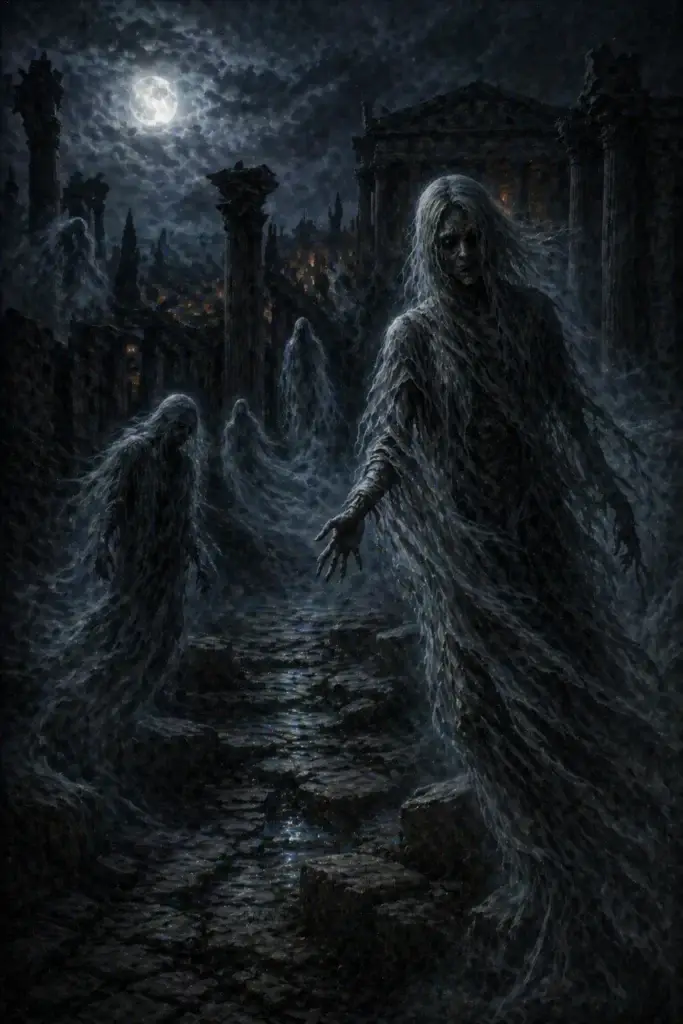
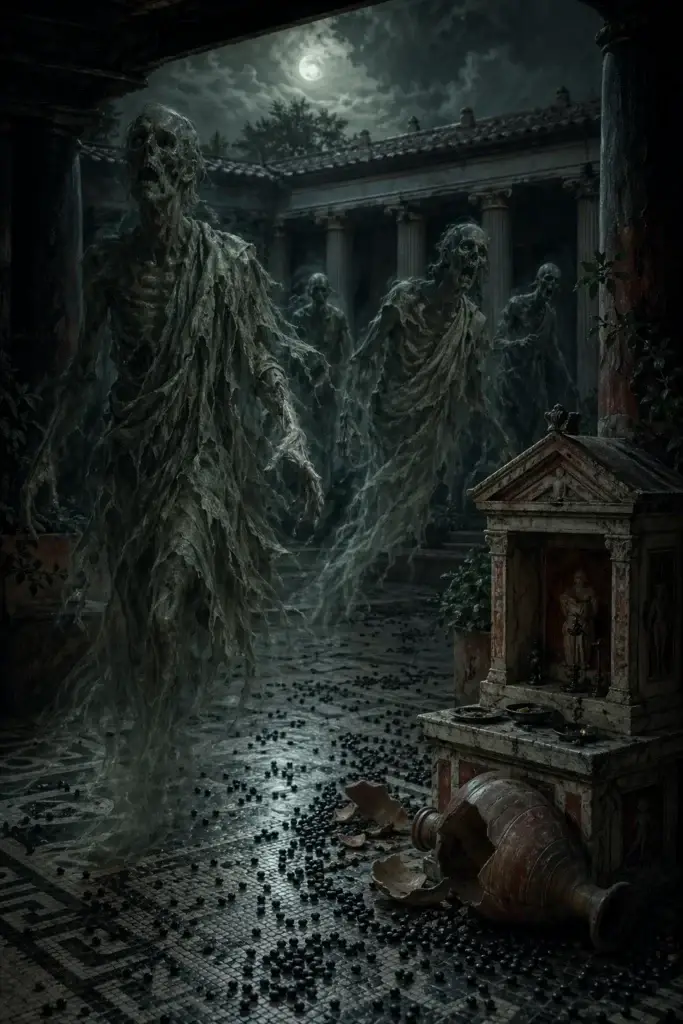
They appear as shadowy, terrifying figures and bring madness, illness, and haunting. The Latin word also means “mask,” a hint that they were imagined as grinning, hollow grimaces.
In literature they appear in Plautus, Seneca, and Apuleius. Later, Larvae and Lemures merged in common usage; Christian authors used larvae as a general term for malevolent spirits. In depictions of banquets, small Larvae figurines occasionally appear, little skeleton statuettes meant to recall the transience of life.
Quick Overview: Larvae
Type: Malevolent spirits of the dead
Origin: The guilty dead, murderers, the unburied, those who died violently
Texts: Plautus, Seneca, Apuleius, Augustine
Period: Republic to late antiquity
Distribution: Italy, the Roman Empire
Defense: Purification rites, completion of burial, apotropaia
Context
Attested early in Roman comedy (Plautus, 3rd/2nd century BC). Seneca’s tragedies and Apuleius’ Metamorphoses (2nd century AD) elaborate the notion. Augustine (4th/5th century AD) uses the term in a Christian reinterpretation as a synonym for “demon.”
The Italic cultural sphere and the Roman provinces. In late antiquity, increasingly understood as part of the growing Christian demonology.
Literary sources in comedy, tragedy, the novel, and patristics. Pictorially, the Larvae convivales figurines (skeleton statuettes at banquets), as preserved in Pompeii and Herculaneum among other places. Otherwise little fixed iconographically.
Name and variants
Latin: Larva (singular), Larvae (plural).
Meaning of the word: “mask,” hence also a term for the actor’s mask. The Larva is the grinning, hollow face of death itself.
Relation to the Lemures: close kinship, often synonymous.
The double meaning “mask / spirit of the dead” is characteristic. It reflects the Roman sense that the face of death is not the face of a person but a mask-like distortion.
The Larvae convivales figurines, small movable skeletons passed around at the banquet, draw on this connotation: they admonish the guest to enjoy life before the Larva comes.
Characteristics
Appearance
Terrifying, often skeletal figures; in descriptions with hollow eyes, grinning teeth, waxen skin. The Larva is less human than grimace, a mask being peeled away.
Behavior
More hostile than the Lemures. Larvae actively beset people, bring madness, nightmares, illness. They are associated with mental torment; the Roman expression larvatus (“possessed by a Larva”) means “insane.”
Sphere of action
The house of the perpetrator or the family, places of violent death, prisons, battlefields. Also banquets, where the memento mori motif is deliberately staged.
Mythological origin
No divine origin. Larvae arise from people whose death or life violated the regular ethical and ritual measure. They are the dark mirror of the Manes.
Apuleius and demonology in De deo Socratis
Apuleius wrote a systematic treatise on demons and spirits in De deo Socratis (ca. 170 AD). He treats Larvae as a subclass of demons, specifically as spirits of deceased people who were not received into the afterlife because they remained bound to earthly conflicts.
Apuleius differentiates: the good dead become Lares (guardian spirits), while the bad or imperfectly deceased become Larvae. This moral and functional dichotomy was later adopted by Christianity and transformed into the saved and the damned.
Apuleius’ systematic approach made the Larvae a conceptually stable phenomenon that could be analyzed and classified. His influence on medieval theological thinkers was great, especially on authors who sought to reconcile Christian and Platonic metaphysics.
Profile: Larvae
The most important aspects of the Larvae at a glance. You will find the detailed treatment of name, description, defense, and parallels in the following sections.
From malevolent dead, murderers, the unburied, victims of violent death. The dark mirror of the manes.
People burdened with guilt, perpetrators, families with an unreconciled death. Further: guests at banquets, where Larvae appear as a memento mori.
Skeletal, mask-like, hollow face. The Latin word also means “mask”; the Larva is the face of death being peeled away.
Madness, nightmares, illness, persistent harassment. More active and more hostile than the Lemures.
Completion of a delayed burial, purification rites, offerings to the di inferi. In late antiquity, Christian exorcism formulas against larvae.
Lemures (close kin), Edimmu, Keres, hungry ghosts, revenants.
Protective practice
Rituals of defense
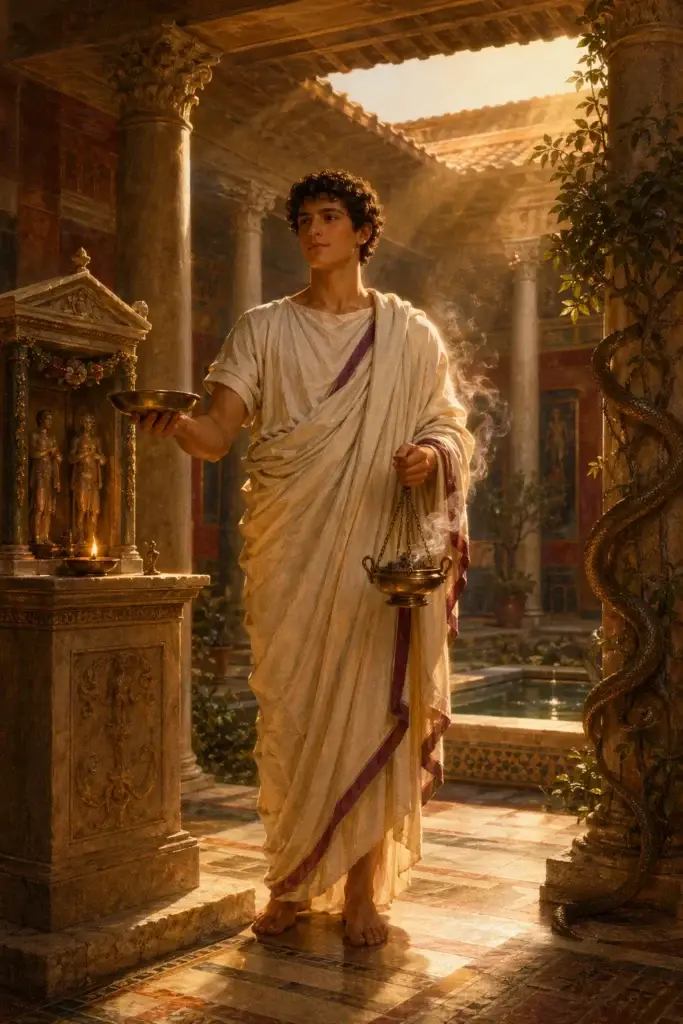
The Lemuria also covers the Larvae; the boundary between the two is fluid. No specific Larvae rites have come down to us; the general rites for the dead (burial, Parentalia, Lemuria) suffice as a countermeasure.
Invocations
No independent tradition of invocation. In defixiones, Larvae can be called upon to be sent against personal opponents. In patristics they are conjured as demons and driven out.
Amulets and protective symbols
General Roman apotropaia, the phallus fascinum, the bulla for children, eye amulets. The Larvae convivales figurines at banquets are not protection but a memento mori, a ritual encounter with the Larva in a safe setting.
Larvae, parallels in other cultures
Mesopotamia and Greece: Edimmu-like spirits of the dead; the Keres as battlefield figures; in both traditions the motif of the restless dead as a warning to the living.
Christian reception
Augustine uses larvae as a word for demons in a new sense. From there the term passes into medieval demonology and into the biological technical vocabulary (the insect larva, the “mask” before the adult form).
Popular belief and the modern era: The death mask, the skull on the memento mori, the Halloween mask, all derivations of the Larva motif. The basic pattern “mask as the face of death” remains stable.
Lemures and the Lemuria festival
The Romans distinguished between Larvae and Lemures, a dichotomy that is often confused in modern literature. Lemures are evil or dangerous dead, Larvae are regarded as even more hostile. The Lemuria festival (9, 11 and 13 May) was an important ritual to drive away the Lemures and protect households.
The father of the house performed a ritual, threw out black beans to ward off evil spirits, and whispered formulas of appeasement. This indicates that Roman society took the phenomenon seriously and developed means to counter it.
The etymological connection between Latin lemures and the modern English lemur (the animal) is a curiosity of natural history; Carl Linnaeus named the primates lemurs because he perceived their nocturnal and inconspicuous nature as similarly ghostly to the ancient spirits.
Larvae and Lemures: The harmful dead in Roman belief
The Roman imagination distinguished various classes of spirits of the dead. While the di manes denoted the deceased conceived of collectively and generally benevolently, larvae and lemures stood for the restless, harmful, or wandering dead. The sources often use both terms almost synonymously, yet a tendency can be discerned.
The lemures appear above all as nocturnal haunting spirits that beset the house. The larvae, by contrast, are more frequently described as malevolent, terrifying figures that can pursue the living, drive them to madness, or torment them.
The scholar Augustine of Hippo records in De civitate Dei an ancient classification according to which the good dead became lares, the evil became larvae, and the indeterminate became manes. This threefold division, however, is likely a late, ordering construction.
Plautus uses larva in his comedies as a term of abuse and as an expression for someone who appears possessed by an evil spirit or mad; the phrase larvatus denotes someone plagued by larvae.
This shows that in everyday awareness the Larvae were regarded above all as a cause of mental confusion and nocturnal terror. Scholarship emphasizes that there was no uniform Roman doctrine of spirits, but rather a fluid field of terms that was filled differently depending on author and epoch.
The Lemuria: The festival to ward off the restless dead
The most important testimony to the ritual handling of the harmful dead is the depiction of the Lemuria in the Fasti of the poet Ovid. This festival was observed on three days in May, the 9th, 11th, and 13th, and served to appease and expel the wandering spirits from the house.
Ovid describes the ritual precisely: the father of the house rose at midnight, went barefoot, and made a certain sign with his fingers so as not to encounter spirits.
He washed his hands in spring water, took black beans into his mouth, and threw them behind him without looking back, while speaking nine times: His ego mitto, his redimo meque meosque fabis, meaning, with these beans I redeem myself and mine.
Then he washed again, struck bronze vessels, and called upon the spirits nine times to leave the house.
The bean played a role several times in the Roman cult of the dead and was regarded as a plant connected with the deceased. Throwing without looking, the silence, and the repetition of the sacred number nine are classic features of a defensive ritual.
Scholarship sees in the Lemuria a rite of purification that freed the dwelling from the unburied or unatoned dead, in contrast to the more nurturing rites of the Parentalia in February.
Larva as mask: A second meaning of the word
The Latin word larva carries a remarkable double meaning. Besides the harmful spirit of the dead, it also denotes the mask, especially the frightening or grotesquely distorted mask.
This meaning is amply attested in Roman literature and is plausibly explained by the first: a frightening mask represents a dead person or a specter and can itself be called larva.
From the theatrical context the larva is known as a stage mask. Famous is an anecdote in Suetonius and others about banquet customs in which small movable skeleton figures, so-called larvae conviviales, were passed around to remind the guests of transience.
Petronius describes such a silver jointed figure at the banquet of Trimalchio in his Satyricon.
In terms of linguistic history, this second meaning has had far-reaching consequences. Through Medieval Latin, larva entered the scholarly terminology of the modern era. Carl Linnaeus adopted the term in the 18th century into zoology to denote the juvenile stage of insects, which conceals the later form as if behind a mask.
The modern word larva in its biological meaning thus goes back directly to the Roman spirit of the dead. The German word Larve in the sense of mask likewise preserves the old double meaning.
Further reading
Further standard works in the literature index.
The protective practice described here is a religious-studies classification of historical traditions. iWell Guard ties into this cultural-historical line of wearable protective objects and represents a contemporary form of it. More about the iWell Guard →