Azabache: the fist of black jet as a child's protection
By Ralf Ittermann · last reviewed on
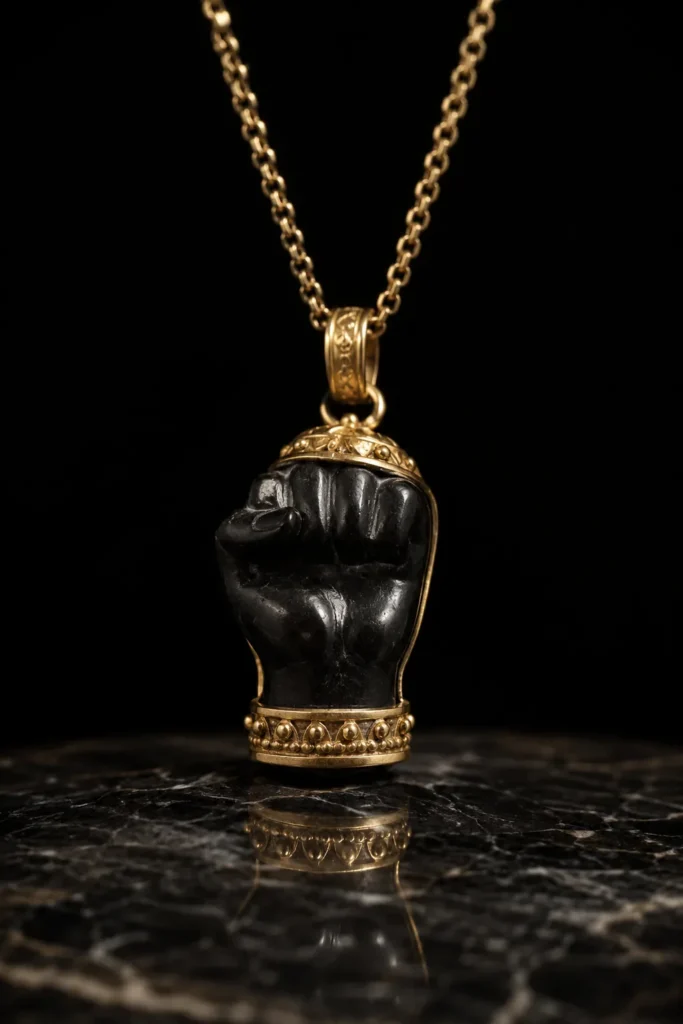
Azabache denotes a protective amulet made of black jet, a fossil material. In Spain and Latin America it is fastened to children in the shape of a small clenched fist, to keep them safe from the evil eye. Azabache is presented here as black jet worked into a fist, a shape that the tradition connects with a child’s protection.
Classification
The azabache is a protective amulet from the Spanish and Latin American world. The word denotes both the material jet and the amulet made from it. It belongs to the widespread protective symbols of these regions.
Jet is a deep-black, fossil material. It forms from old wood transformed under pressure and is related to coal. Because of its black colour and its good workability, it has long been used for jewellery and amulets.
The azabache is often made in the shape of a small clenched fist. This fist is an ancient protective gesture. There are, however, other forms as well, such as a simple black bead.
The azabache is used above all for children. It is fastened to the newborn and the small child, on a bracelet, on a necklace, or pinned to the clothing.
Its task is the warding off of the evil eye. In the folklore studies of the Spanish and Latin American world, the azabache is regarded as the familiar means of protection of early childhood.
This page presents the azabache from the perspective of protection. It describes the material jet, the fist form, the use for children, the operating principle and the distribution of the amulet.
The material jet
The material of the azabache is jet, a fossil material of deep-black colour. In Spanish this material itself is called azabache, and the amulet takes its name from it.
Jet forms from old wood that has been transformed under pressure over long periods. It is a particular, very dense form of fossil material and is related to coal.
The material is light, feels warm and lends itself well to working and polishing. When polished it takes on a deep, gleaming black lustre, which made it valued as a jewellery material.
Jet has long been used for jewellery and for amulets. Several regions of Europe had significant deposits, and the material was traded far and wide.
For the azabache, the black colour of the jet is essential. Black was regarded in the folklore studies of the Mediterranean region as a warding colour. A black amulet was meant to bind misfortune and turn it aside.
The azabache is thus a material amulet. Its protective meaning is closely bound up with the jet, with its deep-black colour and with the warding power ascribed to that colour.
The form of the clenched fist
The best-known form of the azabache is the small clenched fist. In Spanish this form is called higa.
The fist of the azabache often shows a particular hand position. The thumb is pushed through between the index finger and the middle finger, so that its tip projects. This is the gesture of the fig hand.
This gesture is known from the Italian mano fico. On the page about the mano fico, the fig hand is presented in detail as an ancient protective gesture of the Mediterranean region.
In the Spanish azabache this gesture is held fast in durable black jet. The amulet thereby unites the ancient protective gesture of the fig hand with the protective material jet.
Besides the fist there are further forms of the azabache. A simple black bead of jet is widespread. Other small signs were also made from the material.
The clenched fist, however, remains the characteristic form. It unites two protective ideas, the power of the fig-hand gesture and the warding power of the black material, into a single amulet.
Azabache as protection of children
The azabache is above all a means of protection for children. It is fastened to the newborn and the small child and belongs to the equipment of early childhood.
Often the child receives a bracelet with an azabache. The small black fist is tied to the infant’s wrist and accompanies it through the first months and years of life.
The azabache can also be pinned to the clothing or worn on a necklace. In every form the same purpose holds: the child is to be kept safe from the evil eye.
The newborn was regarded as especially at risk. A healthy, beautiful child aroused admiration, and admiration, according to the belief, could turn into a harmful gaze.
The azabache is often a gift. At birth or at baptism it is given to the child and thus links the protective idea with the expression of good wishes.
The azabache is thus closely bound up with the beginning of life. It is the familiar means of protection of early childhood and accompanies the child through the first period, regarded as vulnerable.
The evil eye and its warding off
The task of the azabache is the warding off of the evil eye. In the Spanish world this is known as mal de ojo, which literally means evil of the eye.
According to this notion, a gaze can cause harm. The evil eye is often connected with envy. Yet the admiring gaze too was regarded as dangerous, especially for children.
The belief in the evil eye is widespread throughout the Mediterranean region and is presented in detail on the page about the evil eye. With Spanish emigration it also reached Latin America.
The azabache counters this belief as a means of warding. Whoever provides the child with an azabache protects it, according to tradition, against the mal de ojo.
The amulet offers lasting protection. It does not need to be specially activated, but accompanies the child constantly, since it is fastened to the arm or the clothing.
The azabache is thus firmly embedded in the belief in the evil eye. It gives the widespread fear for the well-being of children a visible, lasting answer.
The operating principle of the azabache
The azabache follows a composite operating principle. Its protective power rests on several ideas that come together in the amulet.
The first idea is the material. Black jet was regarded as warding. Black was a colour meant to bind misfortune and turn it aside, rather than attract it.
The second idea is the form. The clenched fist with the projecting thumb is the fig hand, an ancient protective gesture. The amulet holds this powerful gesture fast in lasting form.
The third idea concerns distraction. A striking black amulet on the child draws the beholder’s gaze to itself. The gaze falls first on the azabache and not on the child.
Added to this is an old medicinal notion. Jet was credited, beyond the warding off of the evil eye, with a generally preserving power.
The azabache thus works through the interplay of material, form and distraction. It is a composite amulet, in which the power of the black jet and the power of the fig hand are united.
Azabache and related amulets
The azabache belongs to the family of protective amulets of the Mediterranean region. Within this family it holds a distinctive position through its material.
Through the fist form it is closely related to the Italian mano fico, the fig hand. Both reproduce the same gesture. The azabache differs above all through the black jet.
Through its task it stands alongside the cornicello, the mano cornuta and the cimaruta. All these amulets serve to ward off the evil eye in the western Mediterranean region.
Through its use for children, the azabache resembles the cimaruta, which likewise served above all the protection of children. Both belong to the equipment of early childhood.
Beyond the Mediterranean region, the azabache can be compared with the hamsa and with other child-protection amulets that accompany young life in many cultures.
The azabache is thus part of a rich body of protective amulets. What distinguishes it is the union of the fig-hand gesture with the particular, black material jet.
Distribution in Spain and Latin America
The azabache has its origin in the Spanish world and came from there to Latin America. In both regions it is alive to this day.
In Spain, jet had long been a valued material. Certain regions were known for working jet into jewellery and into amulets.
With Spanish emigration, the material, the amulet and the belief in the evil eye reached Latin America. There the azabache joined with the local customs.
In many countries of Latin America the azabache belongs to the equipment of the newborn. The bracelet with the small black fist is a familiar gift at birth and at baptism.
In some regions the azabache joined with further protective elements, such as red coral, small images of saints, or other signs that hung together on a bracelet.
The azabache is thus a means of protection that has travelled across the Atlantic. It shows how an amulet reaches new regions with the emigration of a population and lives on there.
Present-day reception
The azabache is present in the Spanish and Latin American world to this day. As a protective amulet of early childhood it belongs to the familiar customary tradition.
The bracelet with the small black fist is still fastened to newborns. It is a frequent gift at birth and at baptism and accompanies the child through the first years.
As jewellery, the azabache is also worn by adults. In this use it can be a sign of attachment to one’s origin and to tradition.
In Latin American communities worldwide the custom is carried on. The azabache travels with the families and preserves the connection to the region of origin.
For folklore studies, the azabache remains an instructive object. It shows how a material, a protective gesture and a belief in the evil eye come together in an amulet.
The azabache is thus a living example of a child-protection amulet. In it are united the black jet, the ancient gesture of the fig hand, and the wish, present to this day, to keep young life safe from the evil eye.
Literature (selection)
Related key terms: azabache jet black fist evil eye mal de ojo Spain Latin America child protection higa apotropaion.
iWell Guard and protective traditions
iWell Guard stands in the cultural-historical line of wearable protective objects, to which the azabache also belongs. A modern companion for people who live with protective symbols: made in Germany, 41 layers of solid gold, platinum and silver, with a 30-day right of return.
Personal experiences may vary. Not a medical device. No promise of healing.