iWell Guard

Iara, the singing mistress of the rivers

Iara is a spirit of Brazilian tradition.

Her singing on the riverbank lures men into the water.

SpiritBrazil

Table of Contents

Iara, spirit of Brazilian tradition
Iara

Iara is the water woman of the Brazilian rivers, a beautiful figure with long hair who sings on the riverbank and lures men into the water. Her name means mistress of the water in Tupí. Indigenous, European and African beliefs merge in her to form one of the best-known figures of Brazilian folklore.

Her roots reach back to the colonial chronicles of the 16th century, but she only acquired her now-familiar female form in the Romanticism of the 19th century, above all through the poem A Mãe d’Água by Antônio Gonçalves Dias, published in 1851. Iara is widespread throughout Brazil, with a particular focus in the northeast and in the Amazon region.

At a glance: Iara

Type: water woman who lures with her song
Origin: Tupí water-spirit tradition, reshaped by European and African motifs
Sources: colonial chronicle, romantic poetry, folkloristic systematisation
Period: roots in the 16th century, present-day form since the Romanticism of the 19th century
Appearance: beautiful water woman with long hair, sometimes with a fish tail

Textual history

Period of the Texts

The roots of Iara reach back to the colonial chronicles of the 16th century; her now-familiar female form only emerged in the Romanticism of the 19th century.

Area of Diffusion

Throughout Brazil, with a particular focus in the northeast and in the Amazon region.

Sources

Best grasped through three layers: the colonial chronicle of Gândavo, the romantic poetry of Gonçalves Dias, and the folkloristic systematisation of Câmara Cascudo.

Name and variants

Tupí: y means water, îara lord or mistress: Iara literally means mistress of the water, a name that could originally denote a water being in general, before it became the fixed designation for the beautiful river woman.

Appearance

Appearance

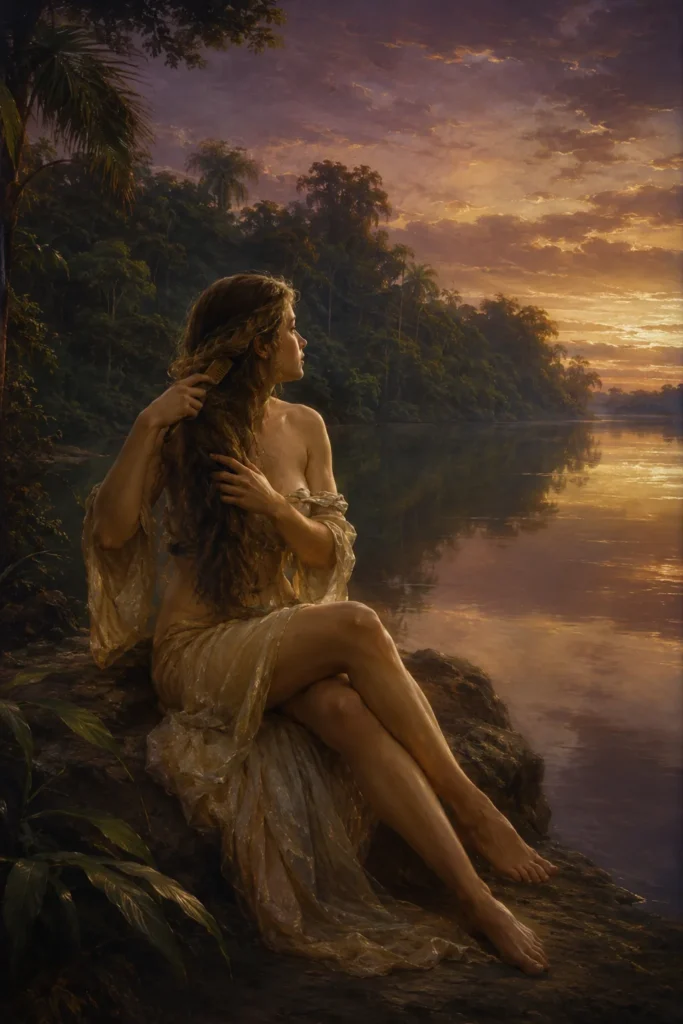
Iara appears with long, often golden hair, fair skin and an enchanting song, along with comb and mirror as attributes of the mermaid; sometimes she has a fish tail. She sits on the riverbank, combing her hair and singing.

Effect

Iara lures men with her song. Whoever follows it is pulled into the water and drowned, or taken forever into her underwater realm. Men who return are considered mentally disturbed or marked by an unquenchable longing. Her danger is directed almost exclusively at young fishermen and hunters who are alone by the water.

Profile: Iara

The key aspects of the water woman at a glance.

Cultural Context

Brazil’s syncretic water-woman tradition, drawing on Tupí roots, European mermaid iconography and African water deities.

Object of Influence

Young fishermen and hunters who are alone by the water at dangerous times of day.

Depiction

A beautiful woman with long, often golden hair, comb and mirror, sometimes with a fish tail, sitting and singing on the riverbank.

Sphere of Influence

A luring song that leads to drowning or to permanent abduction into the underwater realm.

Forms of Warding

Not following the song, avoiding eye contact, and staying away from the water at midday and at dusk.

Distinctions

Her forerunner is the male Ipupiara; related figures are the Brazilian Boto Encantado and the West African Mami Wata.

From the monster Ipupiara to the beautiful water woman

The name Iara derives from Old Tupí, from y, water, and îara, lord or lady, hence lady of the water. The original Tupí water figure, however, was the Ipupiara, a male, monstrous being. The Portuguese chronicler Pero de Magalhães Gândavo describes, in his História da Província de Santa Cruz of 1576, the killing of an Ipupiara with a dog-like head, human features and a fish tail.

The shift from male monster to beautiful woman took place over the colonial period through the merging of three traditions: the indigenous Ipupiara figure provided the framework of the water being, the European idea of the Sereia contributed beauty, a fish tail, comb and mirror, and African water deities reinforced the image of a powerful lady of the waters. The folklorist Luís da Câmara Cascudo argues that the Iara in her present form is essentially European in character. The figure was fixed in literature by Antônio Gonçalves Dias, who in 1851 published the poem A Mãe d’Água in his collection Últimos Cantos.

From colonial chronicle to national symbol

The Iara is a fixed part of the canon of Brazilian national folklore. Gonçalves Dias gave her literary standing, and Câmara Cascudo gave her folkloristic systematisation; she appears in schoolbooks, children’s literature, visual art, music and film, and is among the best-known figures of Brazilian folklore day.

From the perspective of religious studies, the Iara is a syncretistic figure in which indigenous, European and African water cults merge. It is important to note that she was not originally female: her forerunner figure, the Ipupiara, was a male, monstrous being, and only over the course of the colonial period into the Romantic era did the reinterpretation into a beautiful seductress take place. The Iara also serves as a moral tale warning against uncontrolled desire and explaining drowning accidents.

Avoidance as the most important protection

The central and best-attested form of protection is avoidant behaviour: not following the song, avoiding eye contact, and staying away from the water during the dangerous times of day, at midday and at dusk. Christian means of defence such as the sign of the cross, prayer and holy water appear in popular tales, but belong more to the Christian-influenced Boto tradition; for the Iara, behavioural avoidance remains the primary defence, while specific ritual means are less well attested.

Nonetheless, holy water is regarded as a protective means, a sign against the temptation of the water spirit in the Christian-influenced narrative tradition, along with a worn amulet for time spent on riverbanks, and salt as an old cleansing and protective means against the harmful side of water spirits.

Singing water women and their forerunners

The Iara belongs to the worldwide type of the singing water woman who lures men to their doom; her song places her alongside the Greek sirens and the Germanic Loreley. As a female figure who draws people into the water, she is close to the Slavic Rusalka and the Germanic Nix, without being interchangeable with them: her true forerunner figure is the male, monstrous Ipupiara of the same Tupí tradition, from whose form the beautiful Iara developed only over the centuries. Closely related, too, is the pink river dolphin Boto Encantado, with whom she shares Brazilian water folklore, while on the upper Amazon in Peru the Yacuruna form a structurally related people of water beings. The African water deity Mami Wata is among her other co-shaping influences.

Frequently asked questions about the Iara

Is the Iara an indigenous or a European figure?

Both elements shape her: the framework as a water being and the Tupí name are indigenous, while the present-day form of the beautiful, fair-skinned water woman is European in character. Câmara Cascudo emphasises the European share in her final form.

Was the Iara originally female?

No. The forerunner figure, the Ipupiara, was male and monstrous. The reinterpretation as female took place over the colonial period into the Romantic era.

Who does the Iara threaten?

Above all men who follow her song near the water. According to tradition, those who keep their distance and resist the lure are considered safe.

Further links

Recommended internal links:

Literature (selection)

A selection of key sources and studies:
  • Gonçalves Dias, Antônio: Últimos Cantos. Rio de Janeiro 1851 (contains A Mãe d’Água).
  • Câmara Cascudo, Luís da: Geografia dos Mitos Brasileiros. Rio de Janeiro 1947.
  • Câmara Cascudo, Luís da: Dicionário do Folclore Brasileiro. Rio de Janeiro 1954.
  • Magalhães Gândavo, Pero de: História da Província de Santa Cruz. Lisbon 1576.

Further standard works in the bibliography.

Iara Brazil: The name from Tupí means lady of the water, and as Mãe d Agua she still lures with her song today, even though her oldest form, the Ipupiara, was a monster and not a beautiful being.

Classification & Protection

IVLEVEL
The Protection Compass assigns this being to influence level IV, Severe influence.

Against its influence, cross-cultural tradition names these protective means:

Compare in the Protection Compass →

Recommended protective means

iWell Guard

The simplest protective means in this collection: 41 layers of fine gold 999, platinum, silver and silicon, manufactured in Ruhla, Thuringia. It requires no activation, is bound to no person, and is effective within a radius of around 50 meters, even without being worn.

All protective means at a glance →