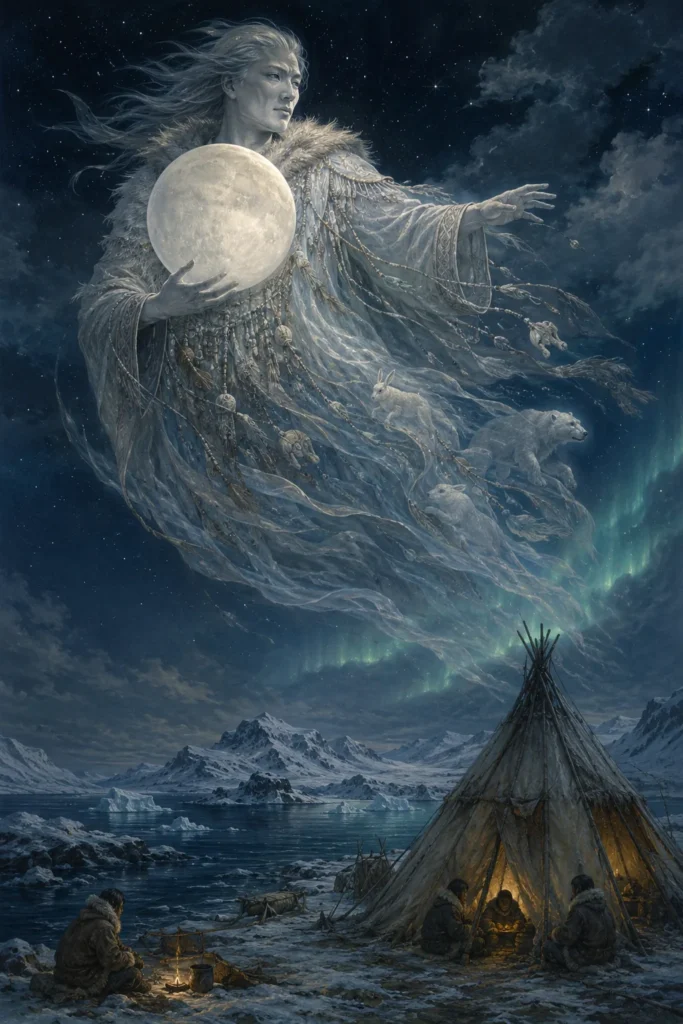
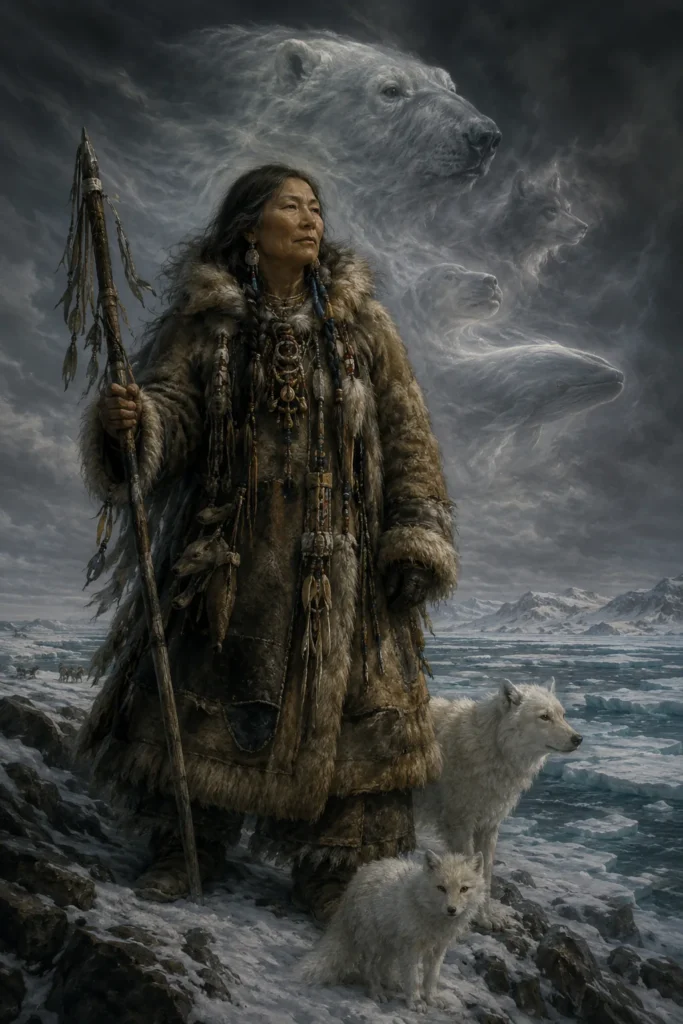
Tornarssuk: Great Protective Spirit of the Angakkuit and Lord of the Tornait
By Ralf Ittermann · last reviewed on
In the Greenlandic and Canadian Inuit context, Tornarssuk is the most powerful of the Tornait, the helping spirits through whom an Angakkuq exercises power.
In the early ethnographic sources he is described partly as a bear figure, partly as a formless protective lord. In religious-studies terms he is the central mediating figure between shaman and otherworld, and thus the operational key to Inuit shamanism.
Tornarssuk, the most powerful protective spirit of the Inuit shamans, serves the Angakkut as a central helper in trance practice.

Profile: Tornarssuk
Tornarssuk: the most important aspects at a glance. The following fields summarise origin, effect, appearance, function, protection and parallels.
Tornarssuk is regarded among the Greenlandic and Canadian Inuit as the most powerful of the Tornait, the helper spirits. His name derives from the stem torna for spirit, the suffix marks the great; he is literally called the great spirit or the supreme of the Tornait. The oldest accounts come from Hans Egede and his son Paul Egede from the 18th century.
Tornarssuk is individually bound to an angakkuq, a shaman, calls him, transmits power to him and introduces him to the system of helper spirits. In illness he recognises the underlying taboo violation or the harmful spirit. If a shaman angers his Tornait, he loses his power, can fall ill or be killed by them.
The descriptions vary greatly: Hans Egede calls him a formless, elusive entity, other sources know him in bear form, and from Iglulik a huge, white, dog-like or seal-like being is recorded. He shows himself to the shaman in the form that corresponds to the shaman’s biography of calling and regional tradition. Missionaries partly identified him with the Christian devil.
He acts as amplifier and companion of the shaman into the Otherworld and stands by him on the journey to Sedna. While Sedna controls the marine animals and Sila guarantees the order of the world, he is the intermediary relevant for action: he stands for what can be done.
Against hostile spirits Tornarssuk is called in order to organise resistance, and on the journey to Sedna the shaman is under his protection. The invocation took place through drum, song and breath-controlled trance, in a ritualised secret language called angakkuq taig, in which otherwise tabooed words were permitted.
Structurally Tornarssuk corresponds to the polezhniki of the Chukchi shamans, the kelet, the Nenets nguo and the Sámi saivo, in North America the manido of the Ojibwe and the uxan of the subarctic Athabaskans. Within the Inuit he is intertwined with the Tupilak and with Nanook, whose bear form partly merges with him.
Classification and brief profile
In the religious-studies sense, Tornarssuk belongs to the class of helping spirits through which a shaman carries out his tasks. Unlike Sedna, he is not a globally effective mistress of animals, but an instance individually bound to the shaman and collectively occupying the rank of a higher authority among the helping spirits.
This dual determination as an individual and collective spirit is typical, in the phenomenology of religion, of circumpolar shamanic hierarchies, and clearly distinguishes Tornarssuk from the economically dominant mistresses of animals.
The earliest accounts come from Greenland, where Hans Egede and his son Paul Egede in the eighteenth century describe him as a great Tornak, the highest among the spirits that serve an Angakkuq.
Knud Rasmussen, Birket-Smith, and later Daniel Merkur supplemented these statements for the Canadian Central Arctic and showed that Tornarssuk holds a prominent position in the Tornait hierarchy. This position should not be conceived as centralized, but as regionally variable.
This function makes Tornarssuk the key concept in any description of Inuit shamanism. Whoever understands the hierarchy of helping spirits understands how a shaman’s power is built up, transmitted, and, if necessary, withdrawn.
In religious-studies terms, this line of understanding is paradigmatic for the entire field of shamanism research and had considerable influence on the subsequent comparative ethnology of religion, particularly in the works of Mircea Eliade.
The historical-religious depth of the Tornarssuk conception has found its way into postcolonial religious studies. Inuit academics such as Aaju Peter and Rachel Qitsualik have pointed out in their contributions that an adequate account of Tornarssuk is possible only in close cooperation with the Inuit knowledge community.
The phenomenological treatment of this figure is therefore not complete, but in a methodologically reflective process of reconstitution.
More recent research approaches the foremost of the Tornait with an expanded methodological toolkit that brings together ethnographic care, linguistically critical examination of the tradition, and comparative classification.
That the Inuit knowledge community itself now takes part in this treatment is especially significant in the case of Tornarssuk: the early, partly colonially shaped descriptions by the missionaries Egede are thus corrected from within.
Name, etymology, and word family
The name Tornarssuk derives from the stem torna-, which in the Inuit languages denotes the spirit, the helping spirit, the numinous being. The suffix -rsuaq or -rssuaq marks the great and significant.
Tornarssuk is thus literally the great spirit or the foremost of the Tornait. This word formation is linguistically clear and informative in religious-studies terms, because it carries the position within the hierarchy directly in the name.
In the Greenlandic dialect of the West Greenlanders, the form Tornaarsuk or Toornaarsuk is common; in the Inuktitut tradition of Canada, additionally Tuurngarsuk. The variety of spellings reflects historical shifts in language and the transcription conventions of the respective researchers.
In modern Inuit orthography no uniform form has yet become established, which complicates scholarly discussion and is at the same time an example of the ongoing questions of standardization for indigenous languages.
The word family is large. Tornait (plural) denotes the helping spirits in general, tornaq (singular) a single helping spirit. Tornarsuit or similar forms denote collective terms for powerful spirits.
Tornarssuk stands at the apex of this semantic field and is linguistically clearly recognizable as an augmentative form, which in religious-historical terms points to a developed hierarchy and is typical, in the phenomenology of religion, of hierarchically structured spirit worlds.
Form and description
The descriptions of Tornarssuk vary greatly. Hans Egede describes him as a formless, elusive entity whom the shaman meets in trance. Other sources know him in bear form, which makes the connection to Nanook, the polar bear spirit, close.
In Iglulik sources there is mention of a huge, white, dog-like or seal-like being. This variation is not arbitrary but reflects the specific experiences of the respective shamans and the regional conditions.
In religious-studies terms, this variation is not an inconsistency but a sign of the transformative nature of helping spirits. Tornarssuk appears to the shaman in the form corresponding to the respective biography of vocation and regional tradition.
What remains is the function: accompaniment into the otherworld, protection from hostile spirits, mediation to Sedna and other figures. This functional constancy amid formal variation is, in the phenomenology of religion, a distinct phenomenon in its own right.
In sources overlaid with Christianity, especially from the late eighteenth and nineteenth centuries, Tornarssuk is at times identified with the Christian devil. In religious-studies terms, this missionary reinterpretation is to be read as an external attribution, not as an original intrinsic meaning.
It nevertheless left traces in Greenlandic self-representation well into the twentieth century and makes religious-studies source criticism demanding, because later indigenous self-statements are already shaped by missionary filters.
The calling of the Angakkuq by Tornarssuk
According to Inuit conception, a shaman was made not through study but through calling. This calling takes place through Tornait and in particular through Tornarssuk.
Often the future Angakkuq passes through a crisis experience in which a spirit appears to him and transmits its power. In religious-studies terms, this initiatory crisis is a typical pattern of circumpolar shamanic training and is documented in numerous cultures of Eurasia and North America.
In Becoming Half Hidden, Daniel Merkur described the typical sequence: initiatory crisis, sojourn in solitude, visions of dismemberment of the bones, and finally acceptance by Tornarssuk, who introduces the initiand into the system of helping spirits.
Only after this introduction can the Angakkuq win further Tornait for himself, yet Tornarssuk remains the hierarchically foremost. This structured sequence is well documented in religious-studies terms and attested in several regional variants.
This process of calling has been discussed in comparative shamanism research as a classic example of the circumpolar spirit marriage and spirit adoption, for instance by Eliade and later by Roberte Hamayon.
The structural stability of this pattern across thousands of kilometers is, in the phenomenology of religion, a finding in its own right and suggests a common root, though its precise historical transmission remains speculative.
An important differentiation concerns the gender dimension of the calling. While the Sedna theology has a markedly female connotation, a Tornarssuk spirit can call both male and female shamans.
Evidence for female Angakkuit who worked with Tornarssuk is found in the records from Iglulik and Netsilik, which refutes the thesis of an exclusively male shamanic function.
Shamanic practice with Tornarssuk
In concrete practice, Tornarssuk functions as an amplifier and companion. On the journey to Sedna, the shaman does not go alone but under the protection of Tornarssuk. In the case of hostile spirits, Tornarssuk is called upon to organize defense.
In illness diagnoses he identifies the underlying violation of taboo or the harming spirit. This variety of functions makes him the operational key figure of Inuit shamanism.
The invocation was traditionally carried out through drum, song, and breath-controlled trance. The shaman spoke in a ritualized secret language referred to as angakkuq taig. Words that were taboo in everyday life were permitted in this spirit language.
Tornarssuk answered partly through a voice from the background, partly through bodily signs on the shaman himself. In religious-studies terms, this double articulation is a typical feature of trance-induced communication in circumpolar religions.
Important is the reciprocity: Tornarssuk demands from the shaman loyalty, ethical integrity, and the observance of taboos. A shaman who angers his Tornait loses his power, may fall ill, or may even be killed by them.
Shamanic power is therefore not a possessed property but a relationship that must be continually maintained. This reciprocity structures the whole of Inuit religion and makes it a pronounced relational theology in which all power is relationally constituted.
Tornarssuk in relation to Sedna and Sila
Tornarssuk stands in a triangular relationship to Sedna and Sila. While Sedna controls the economic resource of the sea animals and Sila guarantees the cosmological-meteorological order, Tornarssuk is the mediator relevant to shamanic action.
He is not as all-encompassing as Sila, not as economically central as Sedna, but he is the operational entity without which no intervention in the other spheres would be possible. This functional triad is a distinct religious-studies model of the Central Arctic Inuit religion.
From this mediating function arises his prominent position in the literature on shamans. While Sedna and Sila describe theologically what is, Tornarssuk describes what can be done. In religious-studies terms, this pragmatic axis is a characteristic of shamanic religions worldwide and distinguishes them from purely contemplative religions that are meditative and introspective in orientation.
What remains important is the functional complementarity.
In religious-studies terms, the temptation is great to structure the relationships genealogically, yet the Inuit tradition itself knows no such system and resists the Western family logic of the divine world.
Christian reinterpretation and demonization
With the mission, beginning with Hans Egede in 1721 in West Greenland, a systematic reinterpretation of Tornarssuk set in. The missionaries identified him with the Christian devil and translated him accordingly in linguistic terms as well.
In the sermons of the Moravian and Danish missionaries, Tornarssuk became the embodiment of evil, against which Christian baptism offered protection. This reinterpretation was intentional and followed a strategy of discrediting indigenous religion.
In religious-studies terms, this is a textbook case of the demonization of indigenous helping spirits in contact with monotheistic mission.
The original function as a protective spirit was systematically reinterpreted by the mission, which among the indigenous speakers themselves led to an ambivalent dual occupancy: depending on context, Tornarssuk could be understood either as a helping spirit or as the devil.
This semantic split has effects to this day. In modern Inuktitut texts, tornarssuk can be used both in a religious-historically neutral sense as a shamanic helping spirit and in a Christian-tinged sense as a synonym for Satan.
The difference arises from the context. In religious-studies terms, this ambivalent use of the word is a research field in its own right and an example of the persistence of colonial semantics in indigenous languages.
Related helping-spirit concepts
In circumpolar comparison, Tornarssuk corresponds structurally to the polezhniki of the Chukchi shamans, the kelet helpers, the Nenets nguo relationships, and the Sami saivo helpers. The idea of a hierarchically foremost helping spirit who coordinates the other spirits is a circumpolar universal and one of the most stable findings of comparative shamanism research.
Parallels are also found within North America, for instance among the manido helpers of the Ojibwe or the uxan helpers of the Subarctic Athabaskans.
In religious-studies terms, this gives rise to the thesis of a continuous shamanic belief layer along the polar region and the northern forests, whose precise historical connections are disputed but whose structural similarity is unmistakable and has been the subject of intensive comparative research since A. Irving Hallowell.
Within the Inuit tradition itself, Tornarssuk is closely interwoven with Tupilak spirits, which as artificially produced figures of aggression form the negative counterpart to the protective function, and with Nanook, whose bear form at times merges with Tornarssuk.
These internal interconnections are a research field in their own right and show how closely the individual entries of the Inuit pantheon are woven together.
Research, reception, and current state
Research on Tornarssuk is narrower than that on Sedna or Sila, which is due to the shaman-specific binding of the term. Since shamanism has largely disappeared from public life through mission and modernization, Tornarssuk is less visible in contemporary Inuit self-representation than the great cosmological figures such as Sedna or Sila.
Nevertheless, the rediscovery of indigenous religiosity since the 1990s has also brought Tornarssuk back into view. In the Inuit Heritage Trust documentation and in the research line of Frédéric Laugrand, Tornarssuk is again described as a central figure of a historical shamanic culture.
This rediscovery is productive in the phenomenology of religion and supports the reconstruction of the traditional religion on a broader empirical basis.
In non-indigenous reception, Tornarssuk is present in fantasy and role-playing worlds as a generic great spirit or bear demon, often without religious-historical accuracy.
This trivialization stands in tension with the differentiated religious-studies treatment and is a research field of its own concerning the reception of religion and the cultural appropriation of indigenous concepts by Western popular culture.
The most recent religious-studies discussion of Tornarssuk focuses on the question of how his function relates to modern psychotherapeutic concepts of protective figures. This comparative perspective is contested because it risks psychologizing the religious autonomy of Tornarssuk.
The difference between a religious helping spirit and a therapeutic protective image remains decisive in the phenomenology of religion, even where functional similarities exist.
Lexicon cross-references
Related entries are Sedna, Sila, Nanook, Tupilak, Anguta, Pinga, Igaluk, Malina, and Qailertetang. The cultural hub Inuit tradition provides the religious-historical framework.
Structurally similar helping spirits are found in the Sami series of entries, in particular in Saivo as a term that is at once topographical and shamanic and fulfills a function comparable to that of Tornarssuk in the Inuit tradition.
Source criticism and the role of missionary ethnography
Nearly everything circulating about Tornarssuk in European-language publications goes back to a narrow and problematic source base. At its center stands the Moravian missionary David Cranz, whose Historie von Grönland (1765) is among the earliest detailed descriptions of Greenlandic Inuit conceptions.
Cranz portrays Tornarssuk as a particularly powerful figure among the spirit beings, whom the angakkoq, the ritual specialist, could win as a helper.
Later collectors such as Hinrich Johannes Rink in the nineteenth century and Knud Rasmussen in the early twentieth century supplemented and differentiated this picture, yet the basic structure of the tradition remained shaped by the missionary perspective.
This shaping is not incidental. Missionaries had an interest in transferring indigenous spirit beings into a Christian frame of interpretation. Thus Tornarssuk was variously equated with the devil or stylized into a kind of highest being suitable as a point of connection for Christian proclamation.
Both readings say more about the expectations of the observers than about the original concepts. The name itself, derived from toornaq, the term for helping spirit, with an augmentative form, points rather to a prominent position within a class of beings than to a monotheistically conceived God.
Added to this is the regional dispersion. The Inuit of Greenland, the Canadian Arctic, and Alaska shared no uniform cosmology. Conceptions that Cranz recorded in West Greenland cannot readily be transferred to other groups, and even within Greenland names and functions varied.
The ethnographic research of the twentieth century, for instance by Birgitte Sonne, has worked out how strongly the early reports are filtered through translation, the selection of informants, and the colonial context.
Anyone presenting Tornarssuk today should disclose this state of the sources and formulate statements with corresponding caution. Comparable problems of missionary transmission affect other Arctic figures as well and find parallels in the study of the Tjinimin complex, where colonial mediation likewise shaped the transmitted picture.
Literature (selection)
- Hans Egede: Det gamle Grønlands nye Perlustration (Copenhagen 1741)
- Knud Rasmussen: The Netsilik Eskimos (Copenhagen 1931)
- Daniel Merkur: Becoming Half Hidden (Stockholm 1985)
- Frédéric Laugrand and Jarich Oosten: Inuit Shamanism and Christianity (Montreal 2010)
- Kaj Birket-Smith: Die Eskimos (Zurich 1948)
- Roberte Hamayon: La chasse à l’âme (Nanterre 1990)
As lord of the Tornait, Tornarssuk stands in the Greenlandic Inuit tradition at the head of those helping spirits whom an Angakkoq could mobilize on his trance journeys. The shaman negotiated with the lord of the spirits for assistance in hunting, illness, and weather.
Early missionaries reinterpreted the figure in European terms; in religious-studies terms, however, Tornarssuk remains a figure in his own right as the foremost lord of the shamanic spirit world.
Related key terms: Tornarssuk Tornait Tornaq Angakkuq shamanic helping spirit Tuurngarsuk Egede.
iWell Guard and traditions of protection
iWell Guard ties in with the cultural-historical tradition of wearable protective objects, in the tradition of the Inuit and many other cultures worldwide. 41 layers, solid gold, platinum, silver, made in Germany. 30-day right of return.
Personal experiences may vary. Not a medical device. No healing claim.