Pinga: Mistress of Land Animals, Guardian of Women in Childbirth and Soul Guide
By Ralf Ittermann · last reviewed on
In the central Arctic Inuit tradition, Pinga is regarded as the mistress of land animals, guardian of women in childbirth and companion of souls between this world and the otherworld.
Unlike Sedna, who controls the sea, she is attested only sparsely in the sources and in a regionally narrow way.
Profile: Pinga
Pinga: the most important aspects at a glance. The following fields summarise origin, effect, appearance, function, protection and parallels.
Pinga comes from the tradition of the central Arctic and is attested only sparsely and in a regionally limited way, above all among the Iglulik and the Caribou Inuit, almost exclusively through the records of Knud Rasmussen. The name probably derives from the stem pinga, meaning what is above; among the Caribou Inuit she is also called Hila.
Her activity concerns the caribou and other land animals, whose numbers she regulates, as well as women in childbirth, newborns and the souls of the deceased. Whoever breaks her taboos, for example by mistreating caribou or eating forbidden foods during pregnancy, is punished with illness or hunting accidents; she can also keep the animals away so that hunger results.
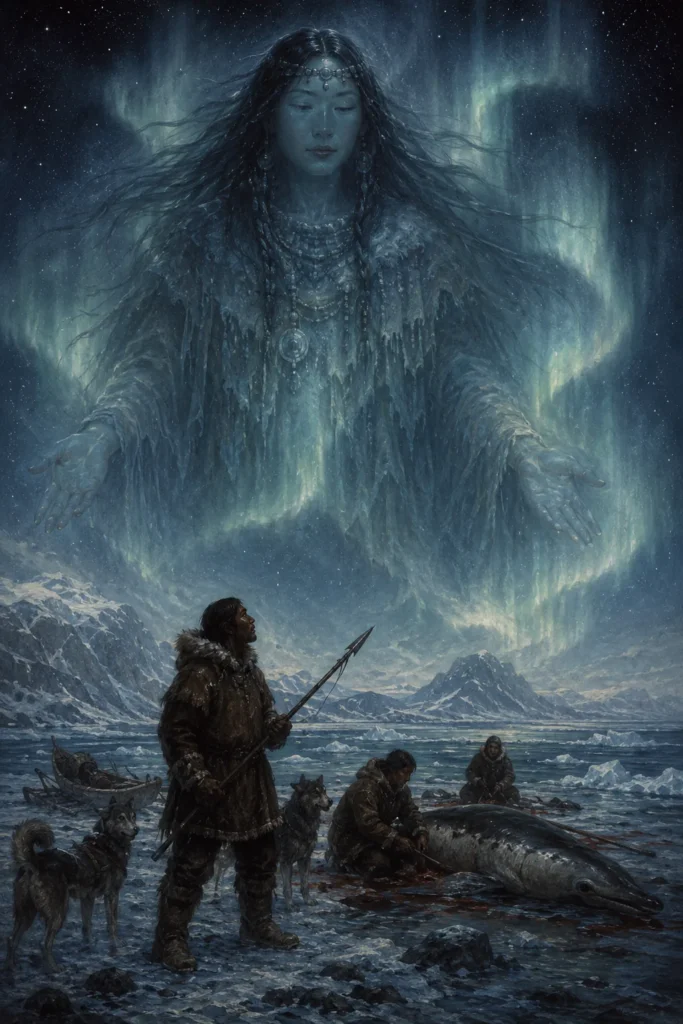
Pinga is hardly described visually. Rasmussen’s records show her as an invisible female power who lives in the sky or in the air and is present in the mountains, in the caribou herds and in births. She has no biography. In contemporary Inuit art she occasionally appears with caribou motifs.
Her main functions are guarding the land animals, protecting women in childbirth and newborns, and escorting the souls, whom she accompanies part of their way before they are handed over to Anguta in Adlivun. She also watches over the moral conduct of people and over the hunt.
Women called on Pinga during childbirth, and midwives addressed prayers to her. The woman in labour withdrew for a few days, avoided certain foods and spoke ritualised words. In the caribou hunt there were taboos on correct slaughtering, on separating foods from land and water, and on the ritual purification of women; she was invoked at burials.
Comparable are the Sami Madderakka and her daughters Sarakka, Juksakka and Uksakka, who cover birth, protection and transition, the Nenets Yu-Kana and the Yupik Nunam-Cua. In Inuit religion Pinga stands as mistress of the land animals beside Sedna as mistress of the sea animals. In her one can see an Arctic variant of the Great Mother.
Overview and brief profile
Alongside Sedna, Pinga is a female figure of the central Arctic who is, however, attested only sparsely in the sources and in a regionally narrow way. While Sedna controls the sea animals, in the Iglulik and Caribou Inuit traditions Pinga is the mistress of land animals, in particular the caribou.
Pinga’s function extends beyond that of mistress of animals. In Rasmussen’s records she is also listed as guardian of women in childbirth and companion of souls.
This multiplicity of responsibilities is, in religious-studies terms, typical of Arctic female deities, whose power extends over fertility, animals and death alike. In the phenomenology of religion this triad constitutes a distinct cluster of functions.
Unlike Sedna, Pinga is considerably less elaborated in the narrative sources. She does not appear in any central myth, but is mentioned in numerous statements by shamans.
Her power is more diffuse and atmospheric, less personal than that of Sedna. In religious-studies terms, this diffuseness makes her a textbook case of a functional theology without narrative personalization.
Pinga, who appears far less elaborated in the narrative sources than Sedna, has been opened up by more recent scholarship through an expanded methodological repertoire that brings together ethnographic precision, linguistic source criticism and a comparative perspective.
Precisely because her transmission remains diffuse, the collaboration of the Inuit knowledge community is important; it is today part of this research and corrects older, partly colonially shaped Western attributions.
Name and linguistic root
The name Pinga, in some sources also Piuli’piuli or Pingajurmaq, probably derives from the stem pinga, which in several Inuit languages means that which is above or the upper one.
This stands in tension with her function as mistress of the land, for the land is not primarily above but beneath the feet of the hunters. In religious-studies terms, this semantic tension is a field of research still to be worked through.
Another etymological reading points to pi- as a general stem for making or bringing forth, which fits her function as guardian of women in childbirth. The etymology is not conclusively settled, and the variants permit several readings. In the phenomenology of religion this ambiguity is productive and underscores the complexity of the Pinga function.
In Iglulik the form Pinga is cited most frequently; among the Caribou Inuit also Hila, which as a dialectal form of Sila (h instead of s) calls for caution.
Such similarities in sound are common in the Inuit languages and call for careful contextual reading. In religious-studies terms, the respective meanings of the terms must be reconstructed from the cultural context, not from the linguistic form alone.
A further perspective is offered by the religious-sociological question of what task Pinga fulfilled within the social order of the traditional Inuit community.
As mistress of land animals, guardian of women in childbirth and companion of souls all at once, she shows that the religious structure was not separate from social practice but closely interwoven with it. This interweaving forms a distinct field of religious-anthropological research, examined systematically above all by Frédéric Laugrand and Jarich Oosten.
Description and functions
Pinga is hardly described visually. In the sources, above all in Rasmussen’s Iglulik records, she appears as an invisible female power present in the mountains, in the caribou herds and in births.
She is not a personalized figure with a biography but a function operating in several spheres at once. In the phenomenology of religion this diffuseness stands on its own.
Her principal functions are: guarding the land animals, in particular the caribou, whose numbers she regulates; protecting women in childbirth and the newborn, whose passage into life she accompanies; and escorting the souls of the dead, whom she accompanies along part of their way.
This triad of animal, birth and death is, in the phenomenology of religion, typical of Arctic mistresses and finds numerous parallels in the circumpolar region.
In relation to Sedna, she does not possess Sedna’s oceanic magnitude but does possess her ethical sensitivity.
Violations of her taboos, such as mistreatment of caribou or forbidden foods during pregnancy, she registers and punishes through illness or hunting misfortune. This taboo-sensitive function is, in the phenomenology of religion, typical.
Within the broader framework of comparative religious studies, Pinga fits as a mistress of animals into the pattern of circumpolar religious topography. That this topography remains structurally stable across thousands of kilometers is, in the phenomenology of religion, among the most remarkable findings of the field and continues to be discussed to this day.
Pinga and the caribou hunt
The Caribou Inuit, whose livelihood was the caribou hunt of the tundra, had a particularly close relationship to Pinga.
Taboos concerned the correct butchering, the separation of land and water foods, the treatment of the hides and the ritual purification of women after the slaughter.
The strictness of these taboos was considerable, and Rasmussen comments that, in religious terms, the Caribou Inuit were an exceptionally disciplined population. In religious-sociological terms, this discipline is a phenomenon in its own right.
In religious-studies terms, the Pinga-caribou connection is a paradigmatic case of ecologically anchored theology. Religion was not an abstract system of belief but a direct regulation of subsistence practice through sacred taboos.
This depth of ecological anchoring is, in the phenomenology of religion, exceptional and makes the Caribou Inuit tradition a central comparative case for the ecological study of religion.
Pinga and childbirth
Pinga’s role as guardian of women in childbirth is a second principal axis. Women in labor called upon her, and the midwives spoke prayers addressed to Pinga.
Birth was, in religious terms, a highly significant moment in which the soul of an ancestor entered the newborn and Pinga secured this passage. In the phenomenology of religion, this conception of rebirth is a phenomenon of its own.
Taboos surrounding birth were strict. The woman in labor had to seclude herself for some days, was not permitted to eat certain foods and had to speak ritualized words.
Pinga sanctioned violations through difficulties in birth or through illness of the newborn. This sanction-laden position makes her one of the ethically densest figures of the Inuit pantheon.
In the phenomenology of religion, the threshold function here combines with rule over the living. Pinga is not only mistress of animals but guardian of every passage from the elsewhere into the here.
In religious-studies terms this dual function is illuminating and makes her one of the theologically densest female figures of the Arctic, whose more precise study remains an open research task.
Pinga and the path of the soul
At the burial of a deceased person, according to Inuit conception, Pinga was called upon, accompanying the soul of the deceased for part of its way before it was handed over to Anguta in Adlivun.
This accompanying function was especially important for women and children, whose souls were considered more delicate and in need of competent accompaniment.
The mourning rituals contained invocations that are partly attested in Rasmussen’s records. A shaman could ask Pinga to guide the soul of a deceased person safely, which counted as a significant shamanic achievement.
This function is not as dramatic as the journey to Sedna, but in the everyday life of religious practice it was significant and relevant in most families at times of death.
The triad of birth, hunting and death united in Pinga makes her a nodal figure of the lifeworld.
In the phenomenology of religion, one may see in this an Arctic variant of the Great Mother, without thereby having to adopt the speculations of a pan-Eurasian mother goddess typical of Marija Gimbutas. Methodological caution in this question is necessary.
Pinga in the comparison of circumpolar religion
In religious-studies terms, Pinga belongs to the group of mistresses of animals that are attested in many forms in the circumpolar region.
Structurally comparable are the Sami Madderakka and her daughters Sarakka, Juksakka and Uksakka, who likewise cover the triad of birth, protection and passage. The Nenets Yu-Kana and the Yupik Nunam-Cua also show comparable functions.
The structural correspondences are not accidental but reflect the doubling of sea and land mistress typical of circumpolar subsistence culture. The religious topography follows the basic economic structure and makes circumpolar religion a privileged field of research for the ecological anthropology of religion. These structural findings are, in religious-studies terms, stable.
Within the Inuit tradition, Pinga stands as mistress of land animals beside Sedna as mistress of sea animals; her transmission is, however, markedly thinner and regionally narrowly bound.
Mission, loss and reappropriation
With the mission, the non-personalized female deities first lost presence, because they could be reinterpreted in Christian terms less readily than the personalized male figures. Pinga fell into oblivion more quickly than Sedna or Tornarssuk and is largely absent in modern Inuit religiosity. This asymmetrical loss of memory is, in religious-sociological terms, illuminating.
The reappropriation of indigenous religion since the 1990s has not yet brought Pinga back into awareness to the extent that Sedna has been. In religious-studies terms, a deeper rediscovery of her functions would be significant for the history of Inuit religion, because it would substantially complete the overall picture of the pantheon.
In modern Inuit schoolbooks Pinga is sometimes mentioned, though usually as a subordinate figure. This corresponds to her rather diffuse manner of appearance in the sources and should not, in religious-studies terms, lead to an underweighting. The theological significance of Pinga is not to be measured in proportion to her narrative visibility.
Research and current state
Research on Pinga is sparse. Rasmussen is the principal source; Kaj Birket-Smith recorded further details in his work on the Caribou Inuit. Daniel Merkur and Frédéric Laugrand treat her in their survey works without devoting a separate monograph to her. In religious-studies terms, this research gap is regrettable and should be addressed.
A more precise religious-studies treatment of Pinga would be desirable, in particular the comparative analysis with the Sami Akka goddesses and with other circumpolar female protective figures.
Approaches to this are found in the work of Birgitte Sonne, who in recent years has made important contributions to opening up the female side of the Inuit pantheon.
In contemporary Inuit art, Pinga appears occasionally, often in connection with caribou motifs. This artistic rediscovery is a significant contribution to making her visible in the history of religion and complements academic research with an aesthetic and culturally practical dimension.
Lexicon cross-references
Pinga stands in relation to Sedna, Sila, Anguta, Tornarssuk, Nanook, Igaluk, Tupilak, Malina and Qailertetang. The cultural hub Inuit tradition frames her. Structurally similar mistresses of animals and guardians of birth are found in the Sami series of entries, in particular with Madderakka.
Pinga in the records of Knud Rasmussen
Pinga is a figure known almost exclusively from the records of Knud Rasmussen, made during the Fifth Thule Expedition among the Caribou Inuit west of Hudson Bay.
In The Netsilik Eskimos and in the materials on the Caribou Inuit, Rasmussen describes Pinga as a female being who dwells in the sky or in the air and watches over the moral conduct of people as well as over the hunt.
According to these records, Pinga is especially connected with the land animals, above all the caribou, on which the Caribou Inuit as an inland group depended.
She sees to it that the animals taken are treated correctly and that the numerous rules and taboos are observed that order the relationship between humans and animals. Whoever violates these rules risks Pinga keeping the animals away and hunger coming over the community.
At the same time, in Rasmussen’s material Pinga appears as a being concerned with the fate of the soul after death. In some statements she takes in the deceased or is involved in their further way. In religious-studies terms it is striking that Pinga thus combines functions which in other Inuit regions are distributed among different beings, for example the sea goddess for securing the game stock. This is likely connected with the particular way of life of the Caribou Inuit, who lived inland from land animals and depended hardly at all on the sea. Pinga is thus a good example of how closely the Inuit beings are bound to the ecological situation of a particular group.
A source-poor figure and the limits of knowledge
As concrete as Rasmussen’s statements may seem, Pinga belongs to those Inuit beings about which secured knowledge is very limited, and an honest account must make this clear.
The transmission hinges at its core on a single expedition and a single researcher. There are hardly any independent confirmations from other sources, because the Caribou Inuit were a small group and only a few ethnographers worked with them.
Rasmussen was comparatively well equipped for this task, since he spoke Greenlandic and could engage with related languages, yet his records too are snapshots of a tradition in upheaval.
At the time of his journey the Caribou Inuit were living under considerable pressure from periods of famine, trade and incipient mission. What Rasmussen recorded is what individual informants conveyed to him in a particular situation, not a complete, self-contained system of belief.
Much therefore remains uncertain: Pinga’s exact relationship to other beings, the question of whether she was understood in the same way everywhere among the Caribou Inuit, and whether Rasmussen perhaps bundled her functions more strongly than corresponded to lived conception. In religious-studies terms, Pinga is thus a typical example of a regionally narrowly bound, weakly attested Arctic being. The appropriate attitude consists in rendering Rasmussen’s few firm statements precisely, marking them as what they are, namely a slim transmission, and not papering over the gaps through comparisons with better-documented Inuit groups.
Literature (selection)
- Knud Rasmussen: Intellectual Culture of the Caribou Eskimos (Copenhagen 1930)
- Kaj Birket-Smith: The Caribou Eskimos (Copenhagen 1929)
- Daniel Merkur: Becoming Half Hidden (Stockholm 1985)
- Frédéric Laugrand and Jarich Oosten: Inuit Shamanism and Christianity (Montreal 2010)
- Birgitte Sonne: Worldviews of the Greenlanders (Fairbanks 2017)
- Franz Boas: The Central Eskimo (Washington 1888)
As soul guide of the Inuit, Pinga accompanies the deceased into the afterlife and at the same time watches over women in childbirth and hunters; her role combines birth, death and the balance between humans and land animals.
Related key terms: Pinga Caribou Inuit mistress of caribou Iglulik guardian of birth soul escort mistress of the land.
iWell Guard and traditions of protection
iWell Guard ties in with the cultural-historical tradition of portable objects of protection, in the tradition of the Inuit and many other cultures worldwide. 41 layers, solid gold, platinum, silver, made in Germany. 30-day right of return.
Personal experiences may vary. Not a medical device. No promise of healing.